

Taiwan's Aboriginal people are the victims of political wrangling between Aboriginal legislators, the head of the Council of Indigenous Peoples said yesterday, citing as proof the recent difficulties establishing an Aboriginal television channel.
"The past two and a half years have been really difficult for the Council of Indigenous Peoples," said Chen Chien-nien (
"Out of the 10 Aboriginal lawmakers in the legislature, nine are from opposition parties. Because non-Aboriginal legislators don't tend to concern themselves with Aboriginal issues, these issues all end up being controlled by the 10 legislators," Chien said at the forum, which was sponsored by the political think tank Taiwan Advocates and the Presbyterian Church of Taiwan.
Chien said that the presence of only one ruling party Aboriginal legislator, Chen Tao-ming (陳道明), leaves the council struggling to pass bills against attacks from the majority of the Aboriginal legislators each legislative sitting. As a result, Aboriginal people have fallen between the cracks, he added.
Chien cited difficulties establishing an Aboriginal television channel as an example.
"The budget for the television channel has been going around the legislature for two years now because of disagreements from opposition party Aboriginal legislators," Chien said.
The television station, a brainchild of the council, was originally slated to begin broadcasting next month, but the project became stalled in the last legislative session. While the establishment of the channel has already been approved, funding for the channel has been withheld because of concerns about low reception rates among Aboriginals in mountain areas and a lack of trained personnel.
During his speech yesterday, Chien said that reception rates and staff deficiencies are not serious enough problems to merit not broadcasting.
The council has already collaborated with the Government Information Office (GIO) to make the satellite television signals available throughout Taiwan and set up satellite dishes in mountainous communities, Chien said.
Further, personnel problems can be easily solved over time, he said.
"A certain legislator said that the channel must have a 100 percent Aboriginal staff before broadcasting can begin. That makes no sense; if there is not enough trained personnel, then we can borrow manpower from other places at first and still begin broadcasting," he said, later identifying the opposition legislator as independent May Chin (
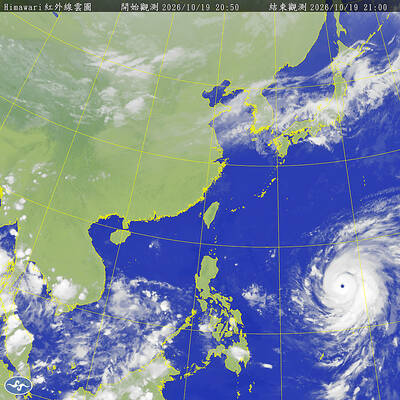
Typhoon Champi is forecast to turn northward earlier than previously expected, sparing Taiwan a direct hit but still bringing heavy rain to the north of the country on Friday and Saturday, the Central Weather Administration (CWA) said yesterday. Typhoon Champi had strengthened and increased in size over the past 12 hours, and as of yesterday afternoon, was packing sustained winds of 198kph near its center, CWA forecaster Cheng Chieh-jen (鄭傑仁) said. However, due to the weakening of a Pacific high-pressure system the storm is now expected to turn northward earlier than initially forecast, likely around Japan’s Ishigaki Island, Cheng said. As Champi brushes
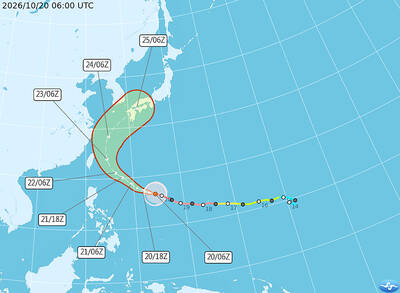
A sea warning for Typhoon Champi might be issued tonight, while the storm’s trajectory would determine whether a land warning is to be issued tomorrow night, the Central Weather Administration (CWA) said yesterday. As of 2pm yesterday, Champi was about 1,536km east-southeast of Taiwan proper’s southernmost point, Oluanpi (鵝鑾鼻), packing maximum sustained winds of 198kph, CWA forecaster Tseng Chao-cheng (曾昭誠) said. The storm was moving west-northwest at 23kph and was expected to strengthen over the next 24 hours before weakening slightly as it approaches cooler waters east of Taiwan, Tseng said. Champi is expected to turn north tomorrow, with the angle of the
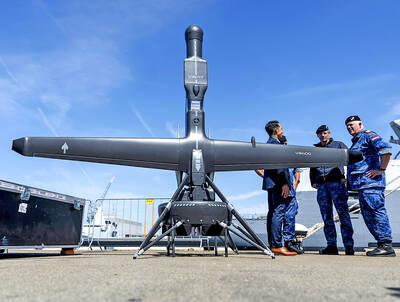
DEFENSE PROCUREMENT: Taiwan could become the largest operator of V-BAT drones outside the US if the contract is finalized, the Ministry of National Defense said The navy and the coast guard reportedly plan to acquire 292 units of MQ-35A V-BAT vertical takeoff and landing (VTOL) surveillance drones. If the contract is awarded and finalized, it would make Taiwan one of the largest buyers of the uncrewed aerial vehicle (UAV) developed by the US-based defense technology company Shield AI. The Coast Guard Administration budgeted NT$1.2 billion (US$37.1 million) to buy 12 drones, which have been delivered, Shield AI said in a report on Oct 13. The navy is planning to spend NT$36 billion under a four-year program code-named Project Yuan Hsiao (遠鴞) to acquire 280 V-BAT drones,
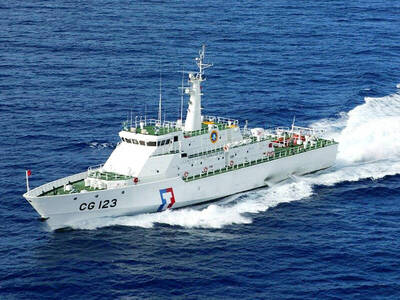
A patrol vessel donated by the Coast Guard Administration (CGA) to the Philippines would not be used in waters near Taiwan or areas where Taiwanese fishing vessels operate, Premier Cho Jung-tai (卓榮泰) said yesterday. The vessel, formerly the CGA's 500-tonne-class Kinmen (金門), was commissioned into the Philippine Coast Guard on Oct. 2. Speaking at the Legislative Yuan, Cho said the Philippines had pledged during the donation process that the vessel would be used only for designated missions and would not operate in waters related to Taiwan. The vessel could even provide assistance to Taiwan if needed, he added. Responding to questions from Chinese


 RSS