


The Ministry of Justice's decision to open prison facilities to the public starting Aug. 1, has brought the issue of the death penalty and how it is carried out to the center of public discussion at a time when the nation's justice officials are working to eliminate the death penalty altogether.
According to the ministry's plan, as of this month, all its prisons, detention houses, reform schools, rehabilitation centers and drug treatment centers will be opened to the public at least once a month. It is part of the ministry's plan to introduce the prison system to the public.
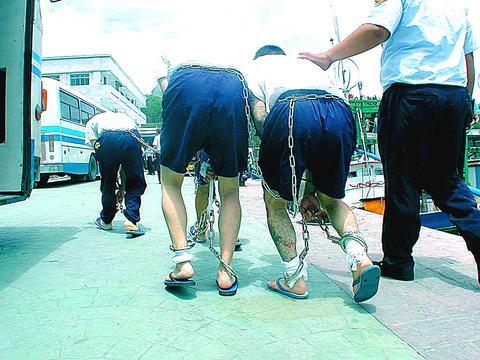
PHOTO: LEE KUNG-BIN, TAIPEI TIMES
On May 2, 2001, Minister of Justice Chen Ding-nan (
Legislative Speaker Wang Jin-pyng (
"We are moving to abolish executions and I agree it is the right thing to do," Wang said. "But at this moment, we should be more sensitive and careful; it does not mean we can give [the death penalty] up immediately."
Taiwan has 22 prisons, 18 detention houses, 18 detention facilities for juveniles, three juvenile reform schools, four vocational training institutes and 17 treatment centers for drug addicts. Altogether, these facilities hold 55,476 inmates or detainees, according to figures updated by the ministry last month.
While the ministry is opening prison doors to the public, execution grounds will remain closed at this time.
"For security reasons, we are not planning to introduce execution grounds to visitors," said Huang Fang-chin (
Huang said that most people think prisons are dark and dirty places where inmates are not treated as human beings.
"This is incorrect. Come visit us and you will realize that what you see in the movies should remain in the movies," Huang said.
Two Weeks to Death
Currently, for a death penalty to be carried out, an execution order from the court where the final instance of the case was heard -- usually the Supreme Court -- to the Ministry of Justice's Department of Prosecution is required. After the department approves the order, it falls to the minister of justice to make the final decision to carry out the execution. Usually, the entire process takes no more than two weeks from when the penalty is issued by a court. Once the minister of justice approves the order, prosecutors must carry out the execution within three days.
According to statistics from the ministry, 157 inmates have been executed since 1996. Most of these were for convictions on charges such as murder, kidnapping, robbing, rape, blackmail and drug dealing. The same statistics show that all 157 of the executed inmates were males, 64 percent had criminal records and 42 percent of them were aged between 30 and 40.
In Taiwan, executions are carried out by prison guards. The guards kill the inmates by shooting, aiming at the inmate's heart. Executions usually take place close to dawn. Guards rouse the prisoner who is to be executed and take him to the "location."
According to Huang, much like the scene in the movie The Green Mile, it usually takes only a few minutes for the inmate to walk the last steps of his life, the "green mile," to the area where the execution will take place, a few meters from the cells.
Before taking these last steps, the inmate ties a few thousand-dollar bills to his shackles. Tradition says that this money, and the shackles of the executed prisoner, will bring good luck to his fellow inmates on death row. The shackles are therefore very popular among the rest of the inmates, who believe that the restraints of their former prison mate will help them win an appeal, offering a chance to escape death.
Once at the execution ground, the inmate is first identified by a prosecutor. Then, the prosecutor will ask whether the inmate has a final wish. Finally, a "last meal" -- usually a bottle of strong alcohol, a bowl of rice and three dishes or so -- will be served.
Anesthetic Provided
After the meal, a forensic scientist will provide the option of an anesthetic. When the inmate passes out completely, guards position the prisoner on the ground, face down, and shoot him directly in the heart. An exception may be made, however, if the inmate is an organ donor, in which case the guards won't shoot for the heart.
After the shots have been fired, the law enforcement officials present wait a few minutes to make sure the inmate is dead. If the person is still alive, at that point the guards must fire a second shot.
Sometimes, inmates may struggle after being shot; some have even regained consciousness and stared at the guards. If that happens, the prosecutors immediately assign another group of guards to continue the execution. This is because execution ground tradition says that the ghost of an executed prisoner will follow the man who shot him if he has looked the man in the eye before dying.
Three or more armed guards usually carry out an execution. The warden will give the guards a couple hundred NT dollars in red envelops as lucky money. Traditionally, whoever receives the money must spend it all before he walks home that day, or he will suffer bad luck.
Huang said the Kaohsiung Second Prison's execution ground was established more than 20 years ago and that over 100 inmates have been executed at the facility. No one has been executed there in the past eight months, however, because officials have become more cautious when it comes to the death penalty, ever since the minister made his remarks three years ago.
The latest statistics show there have been no new death row inmates since this January, a new record.
Notorious Criminals
On July 18, 2000, seven death row inmates, all convicted for murders, including Chen Chin-hsing (
Chen was a notorious criminal who had been involved in the kidnapping, rape and murder of TV entertainer Pai Ping-ping's (
Huang said that another death row inmate, former Pingtung County Council speaker Cheng Tai-ji (
"He did not faint or look scared [as he walked] the `green mile.' Instead, he said he would take responsibility for what he did, and that he was sorry for the country, the victim's family members, as well as for his own family members," Huang said.
Cheng was already a gangster on the "national hoodlum list" before he began his political career in 1990 by winning a seat on the Pingtung County Council.
However, on Dec. 13, 1994, he shot to death Chung Yuan-feng (鐘源峰), the owner of an illegal casino, in front of Chung's mother at the Chung residence because he refused to succumb to blackmail. He shot Chung 19 times.
On July 14, 2000, the Supreme Court upheld the Taiwan High Court's verdict and Cheng's death penalty. Cheng was executed within two weeks.

The Ministry of Foreign Affairs (MOFA) yesterday voiced dissatisfaction with the Comprehensive and Progressive Agreement for Trans- Pacific Partnership (CPTPP), whose latest meeting, concluded earlier the same day, appeared not to address the country’s application. In a statement, MOFA said the CPTPP commission had "once again failed to fairly process Taiwan’s application," attributing the inaction to the bloc’s "succumbing to political pressure," without elaborating. Taiwan submitted its CPTPP application under the name "Separate Customs Territory of Taiwan, Penghu, Kinmen and Matsu" on Sept. 22, 2021 -- less than a week after China

THE GOOD WORD: More than 100 colleges on both sides of the Pacific will work together to bring students to Taiwan so they can learn Mandarin where it is spoken A total of 102 universities from Taiwan and the US are collaborating in a push to promote Taiwan as the first-choice place to learn Mandarin, with seven Mandarin learning centers stood up in the US to train and support teachers, the Foundation for International Cooperation in Higher Education of Taiwan (FICHET) said. At the annual convention of the American Council on the Teaching of Foreign Languages held over the weekend in New Orleans, Louisiana, a Taiwan Pavilion was jointly run by 17 representative teams from the FICHET, the Overseas Community Affairs Council, the Steering Committee for the Test of Proficiency-Huayu, the

A home-style restaurant opened by a Taiwanese woman in Quezon City in Metro Manila has been featured in the first-ever Michelin Guide honoring exceptional restaurants in the Philippines. The restaurant, Fong Wei Wu (豐味屋), was one of 74 eateries to receive a “Michelin Selected” honor in the guide, while one restaurant received two Michelin stars, eight received one star and 25 were awarded a “Bib Gourmand.” The guide, which was limited to restaurants in Metro Manila and Cebu, was published on Oct. 30. In an interview, Feng Wei Wu’s owner and chef, Linda, said that as a restaurateur in her 60s, receiving an

MORE RETALIATION: China would adopt a long-term pressure strategy to prevent other countries or future prime ministers following in Sanae Takaichi’s steps, an academic said Taiwan should maintain communications with Japan, as Japanese Prime Minister Sanae Takaichi is to lead a revision of security documents, Taiwanese academics said yesterday. Tensions have risen between Japan and China over remarks by Takaichi earlier this month that the use of force against Taiwan would constitute a “survival-threatening situation” for Japan. Prospect Foundation president Lai I-chung (賴怡忠) yesterday said Takaichi’s stance regarding Taiwan is the same as past Japanese prime ministers, but her position is clearer than that of her predecessors Fumio Kishida and Shigeru Ishiba. Although Japan views a “Taiwan contingency” as a “survival-threatening situation,” which would allow its military to


 RSS
RSS