


High school debating star Astrid Kusumawardhani thinks she can out-debate any of Indonesia's five presidential candidates.
"They think that one-liner promises can impress the general public. Of course, I can do better," said the captain of the school debating team that beat squads from Europe to rank 13th overall in this year's world championship.
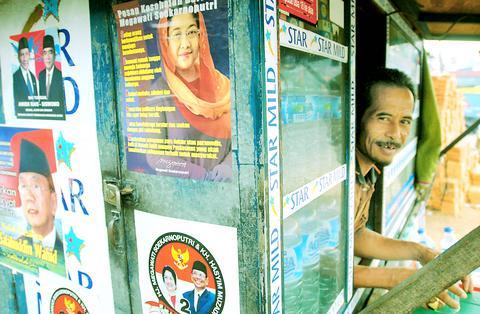
PHOTO: AP
"They're scared to be straightforward and really take a stance on any issue," said Kusumawardhani, who is from Indonesia's main island of Java and Muslim, as are four of the five presidential contenders.
Traditionalists in Indonesia say debate goes against the culture, which emphasizes avoiding confrontation.
That hasn't stopped television stations from striving to pit the candidates against each other but so far none has succeeded in getting more than two of them at the same time.
And none has got the candidates to directly debate each other. They have only accepted offers where they face panels.
"All of them refuse to be in a cross-fire debate. They say they don't want to offend each other," said Tomi Satryatomo, who produces a debate program at Trans TV.
The station did manage to get four vice-presidential candidates on one stage, in the only debate so far of that size.
Satryatomo said President Megawati Sukarnoputri, seeking another term, was too demanding and hard to get for debates and the station eventually stopped asking her.
But no presidential candidate can run away from a general election commission (KPU) 90-minute debate on June 30, a week before voters choose their leader for the first time in history.
However, that mandatory contest also will only force candidates to answer a panel of experts. They will be barred from querying a rival, fearing reaction from supporters who cannot handle the heat such direct challenges might arouse.
Brief swipes at a rival's answer to the panel are allowed if the moderator permits. Heckling is out of the question.
"KPU has failed to grab this golden opportunity and chose to to be too cautious," said Indra Jaya Piliang, a political analyst from the Centre for Strategic and International Studies.
Among the candidates, only former security minister Susilo Bambang Yudhoyono and supreme legislature chief Amien Rais -- ranked one and two in a survey this month -- had faced off in debates on major issues, all sponsored by private groups.
Former military chief Wiranto, nominee of the Golkar party that topped the April parliamentary elections, had faced off with Rais before but that was on the topic of football.
Media-shy Megawati has only recently -- with her job on the line -- started to accept significant numbers of interviews and let reporters fire queries at her during news conferences. But she has not yet taken up a debate offer.
"Megawati will attend the KPU-controlled debate. Previously, she was too busy going down and meeting the people. She is not afraid of public debates," said campaign manager Pramono Anung.
Many voters still seek a candidate who can articulate a message in depth and defend it with eloquence and logic.
"The debates so far are superficial, have no dynamic response and lack clear stances on tangible issues," said Ria Nuri Dharmawan, who heads the Association for Critical Thinking, a group that introduces debate to high schools across the country.
"But at least they have recognized that debate should be a vehicle in a democratic and open society," she said. Analysts such events may have little impact on the race in Indonesia.
Indonesian voters will directly choose their leader on July 5. If no candidate wins more than half the vote, the top two contenders face a run-off in September.

UPGRADE: The Kang Ding-class frigate is replacing its Chaparall missiles with Tien Chien II and Hua Yang VLS, which would provide it with long-range, 360° air defense Taiwan plans to produce 1,200 to 1,376 Hai Chien II missiles (海劍二, Sea Sword II) — also known as TC-2N — to serve as the standard air defense system of the navy’s surface combatant fleet, a source said yesterday. Last week, the Hai Chien II, the naval version of the Tien Kung II missile (天劍二, Sky Sword II), completed a live-fire test in waters off the National Chungshan Institute of Science and Technology’s Jiupeng facility (九鵬) in Pingtung County’s Manjhou Township (滿州). The MIM72 Chaparral and other dated air defense missiles that currently arm Taiwanese ships have inadequate range to combat Chinese

REASONS FOR TRAVEL: An assistant professor said that proposed amendments to penalize drivers if they used drugs overseas would not deter people from traveling People who operate a motor vehicle under the influence of marijuana would have their driver’s license revoked, even if they used the substance while overseas, the Ministry of Transportation and Communications said yesterday, citing proposed amendments to the Road Traffic Management and Penalty Act (道路交通管理處罰條例). The amendments would also authorize the government to revoke the licenses of people determined to have used Category 1 or Category 2 narcotics, even if they were not operating a vehicle while under the influence of drugs, as well as ban them from taking the license test for three years, the ministry said. People aged 18 or
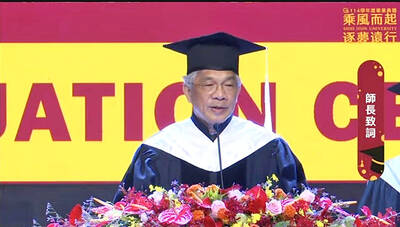
Shih Hsin University President Chen Ching-he (陳清河) yesterday issued a public apology for comments made in his commencement speech last week, stating that he has asked the school to suspend his duties and halt his wages for two months as a show of contrition. At the commencement ceremony on May 30, Chen said, “If you don’t manage your time well, or your own emotions, or your health, then I am telling every one of you — put a quick end to ‘you,’ because the world has no need for ‘you.’” The comments have sparked significant controversy online, and Chen through an open
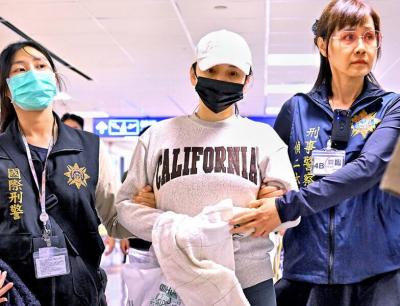
Johanne Liou (劉喬安), a Taiwanese woman who shot to unwanted fame during the Sunflower movement protests in 2014, returned to Taiwan last night after being deported from the US. She is to stand trial in Taiwan for charges involving embezzlement, fraud and drug crimes. The Criminal Investigation Bureau (CIB) said it took her into custody at Taiwan Taoyuan International Airport and would first question her before transferring her to the New Taipei District Prosecutors’ Office. She was arrested upon disembarking a flight from San Francisco that landed shortly before 7pm. Liou absconded to the US in 2019 after jumping bail


 RSS
RSS