


Women's groups yesterday urged the Democratic Progressive Party (DPP) to stay true to its promise of appointing women to one-quarter of high-ranking posts in the Cabinet.
"When President Chen Shui-bian (陳水扁) entered office in 2000, he made the undertaking that one-quarter of high-ranking Cabinet officials would be women, and he delivered on his promise. But with the new Cabinet, it seems that only seven women have been appointed, and those who are not being retained are being succeeded by men," Awakening Foundation president Huang Chang-ling (黃長玲) said.
Huang said there was an international trend toward the sexes having equal weight in a government. This was a measure of democratic progress, she said.
According to the foundation's figures, female officials occupied only 19.4 percent of Cabinet-level positions. Only one female minister without portfolio has been appointed out of the seven posts available.
"Turnover among government-appointed officials is nothing unusual. However, we do hope that female officials who are not retained will be recognized for their accomplishments in office," said Chen I-lin (
Chiang Yue-chin (蔣月琴), the secretary-general of the National Union of Taiwan Women Association, said that female Cabinet officials such as National Youth Commission Chairwoman Lin Fang-mei (林芳玫), Mainland Affairs Council Chairwoman Tsai Ing-wen (蔡英文), Council for Cultural Affairs Chairwoman Tchen Yu-chiou (陳郁秀) and Vice Minister of Education Fan Sun-lu (范巽綠) had performed outstandingly, but that their political futures had become unclear in the wake of the reshuffle.
"Although they did a good job in office, they were not treated with a lot of respect in the way they were replaced, nor were they offered substantial positions elsewhere," Chiang said.
Chang Chin-fen (
"Such training demands that female politicians have the opportunity to serve on the Cabinet. However, the reshuffle seems to be rewarding those who campaigned hard for [Cabinet appointments] during the presidential election," she said.
"If the DPP government continues to use a `lack of qualified female officials' as an excuse, then it should face the music for not having provided sufficient job training," Chang said.
Huang said that while it was important to appoint qualified officials to any government post, an increase in the quantity of female officials in a government also had an important role to play in advancing women's interests.
"Of course quality is important. But having more female government officials, especially high-ranking ones such as ministry heads, will allow people to become more accustomed to the idea of having strong female figures in government," she said.

NATIONAL SECURITY: Authorities are working to confirm the identities of the military personnel involved and investigating possible illegal conduct and regulatory violations Authorities are probing possible national security implications after Kinmen police and immigration officers on Sunday found a Chinese woman allegedly posing as a tourist while engaging in prostitution involving more than 10 military personnel. The woman, surnamed Chen (陳), has since been deported, authorities said, adding that investigators are still working to confirm the identities of those implicated, as the records only listed code names and aliases. The case stemmed from a report received by the Kinmen District Prosecutors’ Office on Friday last week from the Jinhu Precinct of the Kinmen County Police Bureau. On Sunday, police, along with the National Immigration

GLOBALGIVING: ‘ Caving to external pressure is not acceptable for an organization that has cultivated justice reform and human rights for 30 years,’ one NGO said A slew of non-government organizations (NGOs) have withdrawn from the GlobalGiving fundraising platform after it announced it would use “Chinese Taipei” instead of “Taiwan” from next month. The Taiwan Good Rice Association wrote on Facebook on Friday that it was informed on April 28 via a teleconference call of the change, which was made because the platform wanted to operate in China. Taiwan Good Rice is to terminate all cooperative relationships with GlobalGiving in response to the platform’s “unilateral and non-negotiable” decision to remove references to Taiwan, the NGO said. “Taiwan is in the official name of Taiwan Good Rice Association and the

HEAVY WEATHER: Typhoon Jangmi is due to crash straight into the Ryukyus as airlines look to shift flights to larger aircraft or cancel flights to Okinawa entirely Taiwan’s international air carriers announced flight adjustments over the weekend as Typhoon Jangmi is forecast to hit the Ryukyu Islands today and tomorrow. The Central Weather Administration (CWA) upgraded Jangmi from a tropical storm to a typhoon at 8am yesterday, with the eye located 580km south of Naha city. It was moving north at 19kph. Today, China Airlines’ CI-120, CI-121, CI-122 and CI-123 flights between Taoyuan and Naha, Okinawa, have been canceled as well as CI-132 and CI-133 between Kaohsiung and Naha. EVA Air’s BR-112, BR-113, BR-186 and BR-185 flights between Taoyuan and Naha are also canceled. Low-cost carrier Tigerair Taiwan canceled IT-230,
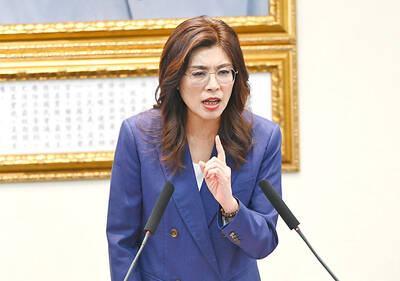
Chinese Nationalist Party (KMT) Chairwoman Cheng Li-wun (鄭麗文) yesterday briefed her party’s Central Standing Committee regarding her scheduled visit to the US between Monday next week and June 16, saying that her purpose would be to persuade the US that the Republic of China (ROC) Constitution was a “one China” constitution that would foster stable and peaceful cross-strait relations. The ROC Constitution is the most important defense for all Taiwanese citizens, as it upholds our democracy and has contributed to our robust economy, which aligns with international and US interests, she said. “We would not be troublemakers and drag the US under,”


 RSS
RSS