


President Chen Shui-bian (
Chen said the task force's priority for the moment was to draw up guidelines that would further peaceful interaction between Taiwan and China.
"For a number of reasons, the people of Taiwan and the international community have expressed concern over future instability in cross-strait relations," Chen told the meeting held at the Presidential Office.
"I therefore decided before the election to endeavor to build a peace and stability framework," he said.
"Now that the election has run its course, and with the people putting their trust in myself and Vice President [Annette] Lu (呂秀蓮), I must act on my promise," Chen said.
Chen stressed that the task force was just the first step and that, if the task force operated smoothly, a cross-strait peace development committee would be formed.
"We need to create criteria for the development of a peaceful and stable cross-strait relationship, creating a consensus of the government, the opposition alliance and all the people of Taiwan, I hope that this will be the first goal that the task force can accomplish," he said.
Chen announced in January that he would form a nine-member task force to set up the framework if he won the presidential election.
Chen also said that the task force would send a representative to Beijing to facilitate contact with the Chinese government.
High-powered members of the task force include Straits Exchange Foundation Chairman Koo Chen-fu (
Task force members made suggestions on improving interaction with Beijing but remained tight-lipped yesterday.
"We gave our points of view to the president," Wu said, "however, it is inappropriate to go into the details of our meeting for the time being."
Chen Po-chih also refused to comment on the content of their discussion.
Other task force members are government officials with responsibilities in cross-strait affairs, such as Presidential Office Secretary General Chiou I-jen (邱義仁), National Security Council Secretary General Kang Ning-hsiang (康寧祥) and Mainland Affairs Council Chairwoman Tsai Ing-wen (蔡英文).
Vice President Annette Lu also sits on the task force.
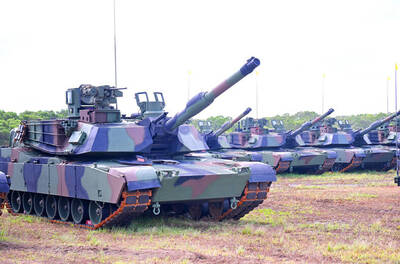
The manufacture of the remaining 28 M1A2T Abrams tanks Taiwan purchased from the US has recently been completed, and they are expected to be delivered within the next one to two months, a source said yesterday. The Ministry of National Defense is arranging cargo ships to transport the tanks to Taiwan as soon as possible, said the source, who is familiar with the matter. The estimated arrival time ranges from late this month to early next month, the source said. The 28 Abrams tanks make up the third and final batch of a total of 108 tanks, valued at about NT$40.5 billion
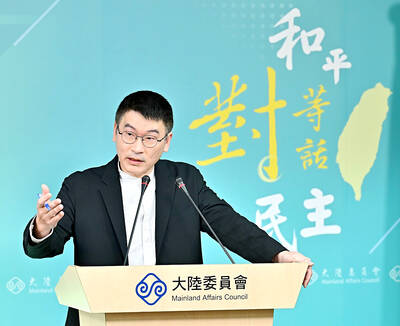
Two Taiwanese prosecutors were questioned by Chinese security personnel at their hotel during a trip to China’s Henan Province this month, the Mainland Affairs Council (MAC) said yesterday. The officers had personal information on the prosecutors, including “when they were assigned to their posts, their work locations and job titles,” MAC Deputy Minister and spokesman Liang Wen-chieh (梁文傑) said. On top of asking about their agencies and positions, the officers also questioned the prosecutors about the Cross-Strait Joint Crime-Fighting and Judicial Mutual Assistance Agreement, a pact that serves as the framework for Taiwan-China cooperation on combating crime and providing judicial assistance, Liang
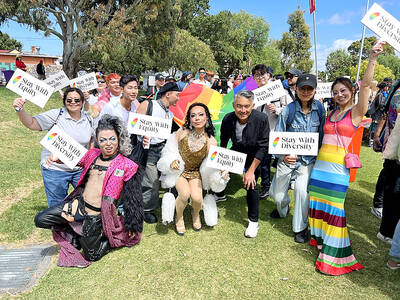
A group from the Taiwanese Designers in Australia association yesterday represented Taiwan at the Midsumma Pride March in Melbourne. The march, held in the St. Kilda suburb, is the city’s largest LGBTQIA+ parade and the flagship event of the annual Midsumma Festival. It attracted more than 45,000 spectators who supported the 400 groups and 10,000 marchers that participated this year, the association said. Taiwanese Designers said they organized a team to march for Taiwan this year, joining politicians, government agencies, professionals and community organizations in showing support for LGBTQIA+ people and diverse communities. As the first country in Asia to legalize same-sex
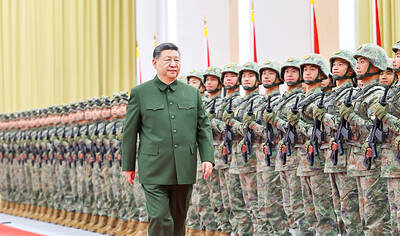
MOTIVES QUESTIONED The PLA considers Xi’s policies toward Taiwan to be driven by personal considerations rather than military assessment, the Epoch Times reports Chinese President Xi Jinping’s (習近平) latest purge of the Chinese People’s Liberation Army (PLA) leadership might have been prompted by the military’s opposition to plans of invading Taiwan, the Epoch Times said. The Chinese military opposes waging war against Taiwan by a large consensus, putting it at odds with Xi’s vision, the Falun Gong-affiliated daily said in a report on Thursday, citing anonymous sources with insight into the PLA’s inner workings. The opposition is not the opinion of a few generals, but a widely shared view among the PLA cadre, the Epoch Times cited them as saying. “Chinese forces know full well that


 RSS
RSS