


About 20 percent of the residents of Puli township, Nantou County -- one of the areas near the epicenter of a devastating earthquake that claimed 2,400 lives in 1999 -- suffer from problems such as insomnia and poor sleep quality, scientists affiliated with the National Science Council (NSC) said yesterday.
A five-year government-sponsored psychological research project on trauma survivors in central Taiwan -- the part of the country most seriously affected by the temblor, which hit 7.3 on the Richter scale -- has yielded preliminary results that scientists are using to analyze the disaster's effects on survivors.
About 53.7 percent of the buildings in the township collapsed partially or fully.
According to Hsu Wen-yau (
Hsu said that about 15.9 percent of the survivors feel that such a disaster could happen again in the near future.
Hsu's study involved interviews with 354 residents of Puli.
When the research project was launched in August, 2001, about 41 percent of interviewees were jobless. About 10 percent of interviewees suffered from mental problems, such as becoming angry or frightened easily. Some felt a sense of helplessness and could not stop thinking about the earthquake.
"The most important factor in how well survivors cope with a disaster like this seems to be their mental makeup, more than factors like their family's financial situation," Hsu said yesterday.
Hsu said that survivors would suffer from fewer mental problems if they were able to regain positive feelings not only about life, but also about themselves.
After the 921 earthquake, psychological researchers contacted victims immediately in a bid to help them cope with trauma resulting from the quake.
In the past four years, Liang Pei-yung (
Liang said that among children placed with foster families, the mental condition of those who identified with their foster families was significantly better than that of those who felt excluded from their foster families.
Wu Yin-chang (
Wu said that the meaningfulness of one's past experience was important in helping trauma victims release themselves from their mental prisons.
"Some victims generalize and find the meaning of life in their experiences. But some need more external assistance, such as religion, in order to find meaning in life," Wu said.
NSC officials said that the research project would end in July, 2006. However, similar studies about earthquake-related issues will receive strong support from the government.

LOUD AND PROUD Taiwan might have taken a drubbing against Australia and Japan, but you might not know it from the enthusiasm and numbers of the fans Taiwan might not be expected to win the World Baseball Classic (WBC) but their fans are making their presence felt in Tokyo, with tens of thousands decked out in the team’s blue, blowing horns and singing songs. Taiwanese fans have packed out the Tokyo Dome for all three of their games so far and even threatened to drown out home team supporters when their team played Japan on Friday. They blew trumpets, chanted for their favorite players and had their own cheerleading squad who dance on a stage during the game. The team struggled to match that exuberance on the field, with
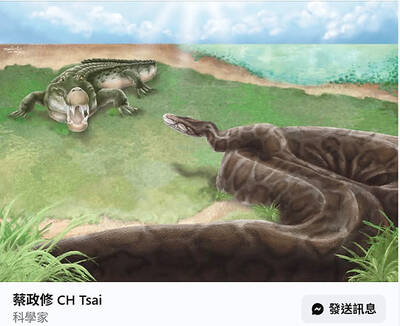
Taiwanese paleontologists have discovered fossil evidence that pythons up to 4m long inhabited Taiwan during the Pleistocene epoch, reporting their findings in the international scientific journal Historical Biology. National Taiwan University (NTU) Institute of Ecology and Evolutionary Biology associate professor Tsai Cheng-hsiu (蔡政修) led the team that discovered the largest snake fossil ever found in Taiwan. The single trunk vertebra was discovered in Tainan at the Chiting Formation, dated to between 400,000 and 800,000 years ago in the Middle Pleistocene, the paper said. The area also produced Taiwan’s first avian fossil, as well as crocodile, mammoth, saber-toothed cat and rhinoceros fossils, it said. Discoveries

Taiwanese paleontologists have discovered fossil evidence that pythons up to 4m long inhabited Taiwan during the Pleistocene epoch, reporting their findings in the international scientific journal Historical Biology. National Taiwan University (NTU) Institute of Ecology and Evolutionary Biology associate professor Tsai Cheng-hsiu (蔡政修) led the team that discovered the largest snake fossil ever found in Taiwan. A single trunk vertebra was discovered in Tainan at the Chiting Formation, dated to between 800,000 to 400,000 years ago in the Middle Pleistocene, the paper said. The area also produced Taiwan’s first avian fossil, as well as crocodile, mammoth, sabre-toothed cat and rhinoceros fossils, it said. Discoveries

Whether Japan would help defend Taiwan in case of a cross-strait conflict would depend on the US and the extent to which Japan would be allowed to act under the US-Japan Security Treaty, former Japanese minister of defense Satoshi Morimoto said. As China has not given up on the idea of invading Taiwan by force, to what extent Japan could support US military action would hinge on Washington’s intention and its negotiation with Tokyo, Morimoto said in an interview with the Liberty Times (sister paper of the Taipei Times) yesterday. There has to be sufficient mutual recognition of how Japan could provide


 RSS
RSS