


A long-range early-warning radar system that the air force is to buy from the US is scheduled to become operational in five years, defense sources said yesterday. The system will be capable of detecting both the ballistic missiles and cruise missiles that China might use in an attack on Taiwan.
The early-warning radar is designed to provide sufficient time for the military to prepare for missile attacks from China, whether of the ballistic or cruise missile type. It would serve as the eyes for the Patriot PAC-3 anti-missile system that the army is to buy from the US.
In a recent closed-door briefing for legislators on the Legislative Yuan's National Defense Committee, the air force expressed optimism about the benefits of the much-anticipated early-warning radar. But one of the legislators who attended the briefing said that if he were a military leader, he would not be so optimistic.
The legislator, who declined to be identified because an agreement with the military prevents him from disclosing the contents of the briefing, said the early-warning radar would be effective only for a short time since it could not detect all of the ballistic and cruise missiles in China's inventory.
"But even considering the limited capabilities of the early-warning radar that the US is to sell us, the system is still necessary for us to defend against missile threats from China," the legislator said.
The air force has not made public what kind of early-warning radar it plans to buy from the US, but two types have been reported to be under consideration. One is the PAVEPAW system, made by Raytheon, and the other is a modified version of Lockheed Martin's SPY-1 radar, which is currently under development. SPY-1 is a radar system for AEGIS-class ships.
The PAVEPAW has a range of 3,000km while the modified version of the SPY-1 has a much shorter range.
A defense official said that a longer-range radar system like the PAVEPAW is much more desirable than a shorter-range, one but that shorter-range systems achieve greater accuracy.
The air force initially planned to buy two sets of long-range early-warning radar but now plans to buy only one because of budget constraints.
The cost of buying two sets of radar has been estimated at about NT$30 billion (US$909 million).
Two deployment sites were chosen over three years ago for the two early-warning radars. One site is in northern Hsinchu County and the other in southern Pingtung County. As the planned purchase has been reduced from two sets to one, the Pingtung site has been abandoned in favor of the one in Hsinchu.
Chinese Nationalist Party (KMT) Legislator Kao Chung-yuan (
"We must try to establish satellite links for the anti-missile defense system that is to be comprised of long-range early-warning radar and missile defense systems such as the PAC-III. We do not see the possibility of acquiring such vital satellite links any time soon," Kao said.
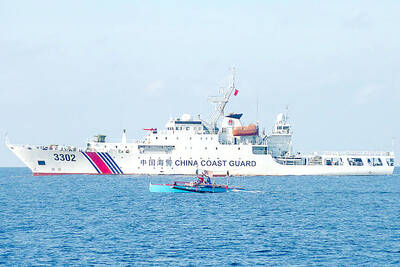
EXPANSIONIST: China deploys an average of 40 to 50 warships and coast guard vessels daily in the South China Sea, despite pledges not to militarize the region, an official said China is attempting to expand its influence across the First Island Chain and increase pressure on Japan by sending coast guard vessels into waters off of Taiwan under the pretext of maritime negotiations with Japan and the Philippines, a national security official said yesterday. China’s recent actions in the waters east of Taiwan and Japan and the Philippines’ exclusive economic zones (EEZ) are attempts to establish dominance in First Island Chain waters, said the official who declined to be named, adding that this is “expansion disguised as law enforcement.” Framing China’s actions solely as a cross-strait issue is a serious misjudgment that
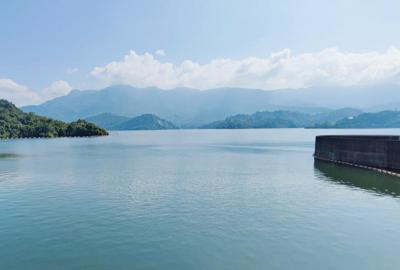
Several major reservoirs are estimated to have received 590 million tonnes of water inflow from June 4 to this morning, with storage levels at Wushantou Reservoir exceeding 50 percent and Zengwen Reservoir approaching 30 percent as of 9am today, data from the Water Resources Agency showed. Of the estimated 590 million tonnes, 450 million have already been stored in reservoirs, the data showed. As of 9am today, Baoshan Reservoir storage levels reached 100 percent, while Baoshan Second Reservoir, Yongheshan Reservoir and Techi Reservoir all exceeded 90 percent, data on the Water Resources Agency’s Web site showed. In addition, the Shimen Reservoir is at

BAIT AND SWITCH: Allowing KMT-run counties to sell to China while the threat of abrupt cancelations hangs overhead is another form of coercion, officials said Beijing is using agricultural purchase offers announced during the Straits Forum to deepen Taiwan’s dependence on the Chinese market, a Taiwanese official said yesterday as they criticized the Taitung County commissioner’s participation in the initiative. During the Straits Forum held in Xiamen on Saturday, Chinese officials announced a sales and purchase agreement for agricultural products from some counties led by the Chinese Nationalist Party (KMT). Taitung County Commissioner Yao Ching-ling (饒慶鈴), who was barred from attending the event in person by the Mainland Affairs Council, participated via video. Under the agreement, China would purchase atemoyas, pomeloes, tea and grouper harvested in Taitung,
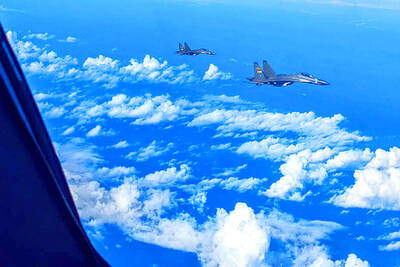
SHIFTING FIRE: While the tempo of purely military exercises around Taiwan has gone down somewhat, Beijing is working to isolate Lai diplomatically from support abroad Chinese President Xi Jinping (習近平) is shifting tactics in his campaign to pressure Taiwan, ramping up diplomatic isolation of the nation while dialing down provocative displays of military aggression. Taiwan recorded a daily average of five Chinese military aircraft crossing the Taiwan Strait’s buffer line with China through May this year — half the number logged in the same period last year. In March, Beijing did not send a single fighter jet near Taiwan for seven days, the longest absence on record outside of typhoon season. In comparison, China sent 153 planes near Taiwan during one day at its peak in


 RSS
RSS