


Divisions have started to appear within Taiwan's opposition as the parties contesting President Chen Shui-bian's (
While opposition hardliners have insisted that anti-Chen protests in the capital should continue, moderates fear that further demonstrations will alienate their middle-class supporters who are calling for stability, observers say.
And they believe that the under-fire Chen, leader of the pro-independence Democratic Progressive Party (DPP), could cash in on the apparent split.
"The noises from the opposition have provided the DPP a chance to reduce the pressure by switching the limelight from the disputed election to the emerging conflict within the opposition," said Wu Tung-yeh (吳東野), professor of National Chengchi University's Institute of International Relations.
Since the March 20 ballot, tens of thousands of opposition supporters have protested Chen's victory. He beat his opponent, Chinese Nationalist Party (KMT) Chairman Lien Chan (連戰), by less than 30,000 votes, or 0.22 percent of the vote.
Lien and his allies have demanded an independent inquiry into the election-eve shooting of Chen and Vice President Annette Lu (
The opposition has also demanded an amendment to existing election laws and a recount of the ballots. Legal wrangling over the recount is under way.
But while some KMT politicians have been more outspoken in their criticism than others, the most prominent attacks have come from the People First Party (PFP), which joined the KMT in order to challenge Chen in the polls.
"The PFP tends to be radical," said Emile Sheng (

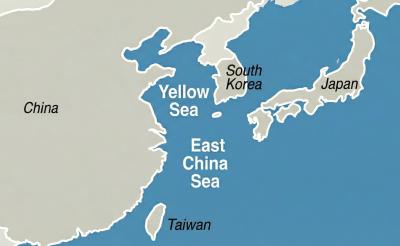
China has reserved offshore airspace in the Yellow Sea and East China Sea from March 27 to May 6, issuing alerts usually used to warn of military exercises, although no such exercises have been announced, the Wall Street Journal (WSJ) reported yesterday. Reserving such a large area for 40 days without explanation is an “unusual step,” as military exercises normally only last a few days, the paper said. These alerts, known as Notice to Air Missions (Notams), “are intended to inform pilots and aviation authorities of temporary airspace hazards or restrictions,” the article said. The airspace reserved in the alert is

NAMING SPAT: The foreign ministry called on Denmark to propose an acceptable solution to the erroneous nationality used for Taiwanese on residence permits Taiwan has revoked some privileges for Danish diplomatic staff over a Danish permit that lists “Taiwan” as “China,” Eric Huang (黃鈞耀), head of the Ministry of Foreign Affairs’ Department of European Affairs, told a news conference in Taipei yesterday. Reporters asked Huang whether the Danish government had responded to the ministry’s request that it correct the nationality on Danish residence permits of Taiwanese, which has been listed as “China” since 2024. Taiwan’s representative office in Denmark continues to communicate with the Danish government, and the ministry has revoked some privileges previously granted to Danish representatives in Taiwan and would continue to review
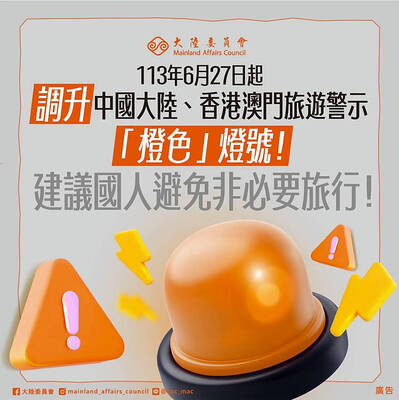
More than 6,000 Taiwanese students have participated in exchange programs in China over the past two years, despite the Mainland Affairs Council’s (MAC) “orange light” travel advisory, government records showed. The MAC’s publicly available registry showed that Taiwanese college and university students who went on exchange programs across the Strait numbered 3,592 and 2,966 people respectively. The National Immigration Agency data revealed that 2,296 and 2,551 Chinese students visited Taiwan for study in the same two years. A review of the Web sites of publicly-run universities and colleges showed that Taiwanese higher education institutions continued to recruit students for Chinese educational programs without

China has reserved offshore airspace over the Yellow Sea and East China Sea from March 27 to May 6, issuing alerts that are usually used to warn of military exercises, although no such exercises have been announced, the Wall Street Journal (WSJ) reported on Sunday. Reserving such a large area for 40 days without explanation is an “unusual step,” as military exercises normally only last a few days, the paper said. The alerts, known as notice to air missions (NOTAMs), “are intended to inform pilots and aviation authorities of temporary airspace hazards or restrictions,” the article said. The airspace reserved in the alert


 RSS
RSS