


Malaysian Prime Minister Abdullah Ahmad Badawi yesterday unveiled an enlarged cabinet with 14 new faces in a major overhaul after his landslide election victory.
He said three ministries -- home, education, culture, arts and tourism -- would be split up, five ministries renamed to reflect new focus and two new ones formed.
Abdullah kept the key finance and internal security portfolios.
There are 34 ministers in the new line-up, up from 29, and Abdullah said 14 of the ministers were new faces. There was also an increase of women representatives and younger people.
"This is a major restructuring of the government," he told a news conference broadcast live on national television.
"All these changes are made to ensure effective and efficient government service ... to provide more specific focus and to streamline the administration. The economy will benefit from the changes."
The opposition Democratic Action Party (DAP) described the new cabinet as "bloated and flabby."
"His first cabinet is as flawed as the 2004 elections which gave him a landslide victory. He has failed his first acid test," DAP chairman Lim Kit Siang told reporters.
The multi-racial National Front coalition won 90 percent of parliamentary seats on Sunday but opposition parties had said there were irregularities in the electoral roll that kept thousands of voters from the ballot box.
Lim said it was disappointing that Abdullah kept the key finance and internal security posts which he inherited from former premier Mahathir Mohamad.
"Why is he holding the two ministries? Are there no qualified or trustworthy person to lead the two ministries," he said.
Abdullah defended the bigger cabinet, saying it would allow ministers to focus on specific duties and cut bureaucracy.
"These changes are made to enable ministers to focus [on their jobs]," he told reporters.
Abdullah said the new line-up would enhance the nation's competitiveness and boost Malaysia's aim to become a developed country by 2020.
"The changes in the new administration are made to fulfil our promises... a government that supports the people and that will work to ensure a better, peaceful and prosperous future," he added.
Abdullah named Azmi Khalid as new home affairs minister.
Deputy Prime Minister Najib Razak retained his defense portfolio while Hishamuddin Hussein was was promoted to education minister. Newcomer and Abdullah loyalist Azalina Othman is the youth and sports minister.
Veteran Trade Minister Rafidah Aziz retained her post, as did Foreign Minister Syed Hamid Albar.
Abdullah created two new ministries for natural resources and environment, and federal territory.
The national unity, and women and family development ministries were merged to become women, families and social development.
Five ministries were renamed as plantation enterprises and commodities; science and technology; power, water and telecommunications; rural and regional development; and agriculture and agro-based industries.
Abdullah also abolished the 10-year rotation system for the chief minister of Sabah state on Borneo island. The post has been rotated every two years among leaders of the three major communities since the ruling coalition won power in 1994.
The ministers are expected to be sworn in Tuesday, a day before the weekly cabinet meeting.

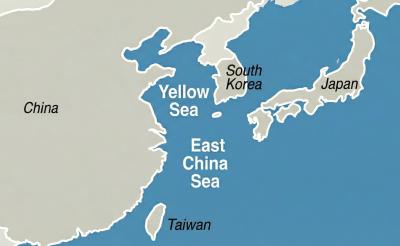
China has reserved offshore airspace in the Yellow Sea and East China Sea from March 27 to May 6, issuing alerts usually used to warn of military exercises, although no such exercises have been announced, the Wall Street Journal (WSJ) reported yesterday. Reserving such a large area for 40 days without explanation is an “unusual step,” as military exercises normally only last a few days, the paper said. These alerts, known as Notice to Air Missions (Notams), “are intended to inform pilots and aviation authorities of temporary airspace hazards or restrictions,” the article said. The airspace reserved in the alert is
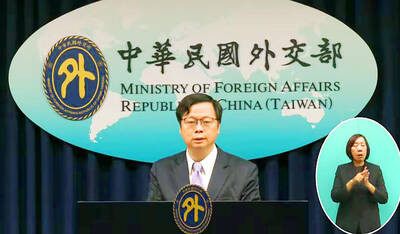
NAMING SPAT: The foreign ministry called on Denmark to propose an acceptable solution to the erroneous nationality used for Taiwanese on residence permits Taiwan has revoked some privileges for Danish diplomatic staff over a Danish permit that lists “Taiwan” as “China,” Eric Huang (黃鈞耀), head of the Ministry of Foreign Affairs’ Department of European Affairs, told a news conference in Taipei yesterday. Reporters asked Huang whether the Danish government had responded to the ministry’s request that it correct the nationality on Danish residence permits of Taiwanese, which has been listed as “China” since 2024. Taiwan’s representative office in Denmark continues to communicate with the Danish government, and the ministry has revoked some privileges previously granted to Danish representatives in Taiwan and would continue to review

More than 6,000 Taiwanese students have participated in exchange programs in China over the past two years, despite the Mainland Affairs Council’s (MAC) “orange light” travel advisory, government records showed. The MAC’s publicly available registry showed that Taiwanese college and university students who went on exchange programs across the Strait numbered 3,592 and 2,966 people respectively. The National Immigration Agency data revealed that 2,296 and 2,551 Chinese students visited Taiwan for study in the same two years. A review of the Web sites of publicly-run universities and colleges showed that Taiwanese higher education institutions continued to recruit students for Chinese educational programs without
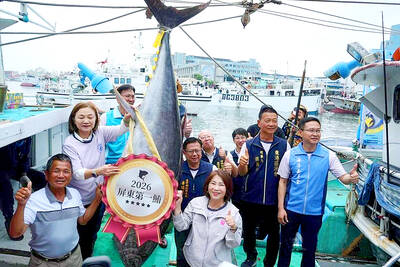
The first bluefin tuna of the season, brought to shore in Pingtung County and weighing 190kg, was yesterday auctioned for NT$10,600 (US$333.5) per kilogram, setting a record high for the local market. The auction was held at the fish market in Donggang Fishing Harbor, where the Siaoliouciou Island-registered fishing vessel Fu Yu Ching No. 2 delivered the “Pingtung First Tuna” it had caught for bidding. Bidding was intense, and the tuna was ultimately jointly purchased by a local restaurant and a local company for NT$10,600 per kilogram — NT$300 ,more than last year — for a total of NT$2.014 million. The 67-year-old skipper


 RSS
RSS