


President Chen Shui-bian (陳水扁) presided yesterday morning over a ribbon-cutting ceremony that marked the opening of Taichung's Chingchuankang International Airport. Three international charter flights departed from the airport.
Chen praised the completion of the airport's first-phase development, which only took six months.
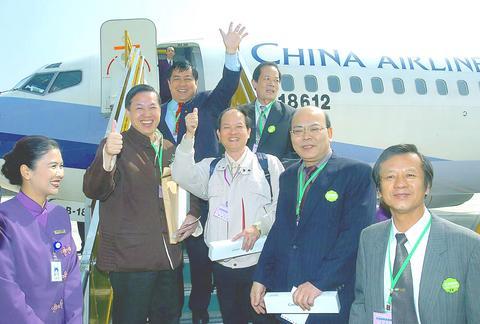
PHOTO: SUNG CHIH-HSIUNG, TAIPEI TIMES
"An international airport in central Taiwan has long been looked forward to by local residents. As the commander-in-chief of the armed forces, I was able to take an active role in negotiations with the Ministry of Defense and persuade them to accommodate civilian use of the Chingchuankang military airbase. This is a dream come true for Taichung residents," Chen said.
The airport's opening has brought about a round of political bickering over whether it is being opened prematurely.
"Construction on the Taichung International Airport can not be completed in just one phase," Chen said.
"In the past 10 years, many legislators, local representatives and social groups, no matter their political background, fought for this airport," Chen said.
"This is not the selfish work of just one person or one political party. This is something that everyone has been anticipating," he said.
"The completion of the airport is a long-term goal," said Civil Aeronautics Administration (CAA) Director General Billy Chang (張國政).
"In the future, the airport will expand to the west," Chang said, saying that details for the airport's construction from last year through 2006 had been laid out in budgeting. Chang said that the speed of future construction would depend on regional demand.
Chen called attention to the absence of two Chinese Nationalist Party (KMT) members, Taichung Mayor Jason Hu (
"Because of the close proximity of the presidential elections, neither [Hu] nor [Huang] is present at this important event," Chen said.
Both men had previously welcomed the idea of an international airport in central Taiwan.
Hu later said that he had not received an invitation until yesterday morning, which was too late for him to make arrangements to attend.
"The local government had recommended that the transfer to Chingchuankang Airport be completed in one year, followed by cross-strait direct flights in three years, and then the establishment of Chingchuankang Airport as an international facility was to come in five years' time. No one said that an international airport had to be established in half a year," Hu said, criticizing the timing of the airport's opening.
However, Chang said that while he was only fulfilling his duties as a civil servant in helping launch the airport yesterday, the CAA would insist that safety and service could not be compromised under any circumstances.
Meanwhile, KMT Legislator Chi Kuo-tung (
Shuinan Airport in Taichung will relocate to Chingchuankang airport today, where domestic service will resume. Shuttle buses have been arranged for travelers who go to Shuinan Airport by mistake.
The three international chartered flights that departed yesterday were operated by China Airlines and Far Eastern Air Transport and were bound for Tokyo, Phuket and Palau. All three will return to CKS International Airport.
Chartered by the Taichung Chamber of Commerce, the three flights were filled to capacity. Passengers were given commemorative stamps as well as toy models of China Airlines aircraft to mark the airport's opening.

The military has spotted two Chinese warships operating in waters near Penghu County in the Taiwan Strait and sent its own naval and air forces to monitor the vessels, the Ministry of National Defense (MND) said. Beijing sends warships and warplanes into the waters and skies around Taiwan on an almost daily basis, drawing condemnation from Taipei. While the ministry offers daily updates on the locations of Chinese military aircraft, it only rarely gives details of where Chinese warships are operating, generally only when it detects aircraft carriers, as happened last week. A Chinese destroyer and a frigate entered waters to the southwest
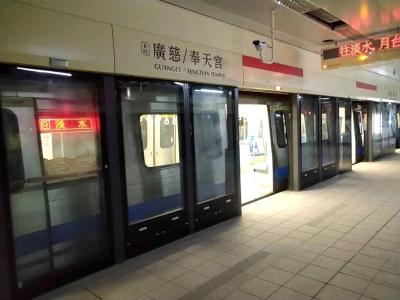
The eastern extension of the Taipei MRT Red Line could begin operations as early as late June, the Taipei Department of Rapid Transit Systems said yesterday. Taipei Rapid Transit Corp said it is considering offering one month of free rides on the new section to mark its opening. Construction progress on the 1.4km extension, which is to run from the current terminal Xiangshan Station to a new eastern terminal, Guangci/Fengtian Temple Station, was 90.6 percent complete by the end of last month, the department said in a report to the Taipei City Council's Transportation Committee. While construction began in October 2016 with an
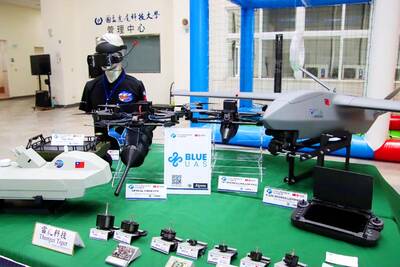
NON-RED SUPPLY: Boosting the nation’s drone industry is becoming increasingly urgent as China’s UAV dominance could become an issue in a crisis, an analyst said Taiwan’s drone exports to Europe grew 41.7-fold from 2024 to last year, with demand from Ukraine’s fight against Russian aggression the most likely driver of growth, a study showed. The Institute for Democracy, Society and Emerging Technology (DSET) in a statement on Wednesday said it found that many of Taiwan’s uncrewed aerial vehicle (UAV) sales were from Poland and the Czech Republic. These countries likely transferred the drones to Ukraine to aid it in its fight against the Russian invasion that started in 2022, it said. Despite the gains, Taiwan is not the dominant drone exporter to these markets, ranking second and fourth
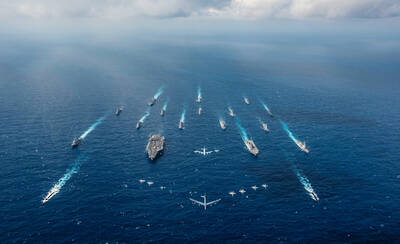
Japanese Prime Minister Sanae Takaichi’s comment last year on Tokyo’s potential reaction to a Taiwan-China conflict has forced Beijing to rewrite its invasion plans, a retired Japanese general said. Takaichi told the Diet on Nov. 7 last year that a Chinese naval blockade or military attack on Taiwan could constitute a “survival-threatening situation” for Japan, potentially allowing Tokyo to exercise its right to collective self-defense. Former Japan Ground Self-Defense Force general Kiyofumi Ogawa said in a recent speech that the remark has been interpreted as meaning Japan could intervene in the early stages of a Taiwan Strait conflict, undermining China’s previous assumptions


 RSS
RSS