


With the completion of the first televised presidential debate on Saturday, both the Democratic Progressive Party (DPP) and Chinese Nationalist Party (KMT) said there is much room for their respective candidates to improve in the next debate, scheduled for next Saturday afternoon.
Chen Chun-lin (
Chen Chun-lin said that since the DPP has been the subject of verbal attacks by the rival camp of the KMT-People First Party (PFP) alliance, Chen Shui-bian's attacks on KMT Chairman Lien Chan (連戰) during the debate showed a prompt and appropriate counter-offensive.
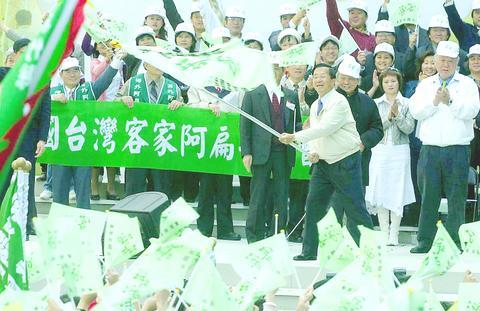
PHOTO: CHIANG YING-YING, TAIPEI TIMES
"However, because Chen always wears a smile while saying those acidic words to Lien, it also demonstrated Chen's good demeanor and his sincerity for reforms," Chen Chun-lin said.
As for the strategy for the second debate, Chen Chun-lin said the president will need to maintain his performance level while focussing more on detailing the country's future, which was largely ignored by both candidates on Saturday.
Policies needing debate include the five-year, NT$500 billion public construction project, the election-day referendum, a nine-member task force to promote Chen Shui-bian's peace and stability framework for cross-strait interaction, economic and financial reforms, the reduction in the number of legislative seats and political donations.

PHOTO: CHIANG YING-YING, TAIPEI TIMES
Meanwhile, the DPP said yesterday that Chen Shui-bian hopes the panelists in the second debate can be replaced by media representatives instead of the academics and pundits who asked questions in the first debate.
Lien's performance was seen as weak in last Saturday's debate.
KMT Legislator Yu Tzu-shiang (游梓翔), who also serves as a campaign aide for the pan-blue camp, said that it had not been the KMT-PFP alliance's intention to highlight Lien's offensive capabilities.
"What we aimed for in the debate was for Lien to exude his leadership gravitas -- stable and calm -- and his usual image as an individual of steadiness with substantive insights," Yu said.
Yu acknowledged, however, that Lien might work to improve his attacks for the final televised debate.
Another issue members of the blue camp felt needed to be reviewed was the selection of questions Lien would put to Chen.
Some felt that Lien's questions during Saturday's debate were not sharp enough to pin down Chen, and instead gave Chen room to strike back and paint Lien with a pro-China brush.
When Lien asked Chen for proof of his accusation that he was being manipulated by China, Chen came back and cited the fact that Chang Yang (
Chen threw the question back at Lien, questioning how Chang was able to run the office without the support of the Chinese government.
Stating that steadiness and calmness are needed to take on the nation's top job, alliance spokesman Alex Tsai (蔡正元) expressed confidence that the KMT chief would do a better job in the next debate.
"Lien is known for being scrupulous," Tsai said. "In preparation for being the national leader in the foreseeable future, Lien will this week attempt to present a blueprint of his national policies and ideals to the people of Taiwan in the second televised debate."

REASONS FOR TRAVEL: An assistant professor said that proposed amendments to penalize drivers if they used drugs overseas would not deter people from traveling People who operate a motor vehicle under the influence of marijuana would have their driver’s license revoked, even if they used the substance while overseas, the Ministry of Transportation and Communications said yesterday, citing proposed amendments to the Road Traffic Management and Penalty Act (道路交通管理處罰條例). The amendments would also authorize the government to revoke the licenses of people determined to have used Category 1 or Category 2 narcotics, even if they were not operating a vehicle while under the influence of drugs, as well as ban them from taking the license test for three years, the ministry said. People aged 18 or

GLOBALGIVING: ‘ Caving to external pressure is not acceptable for an organization that has cultivated justice reform and human rights for 30 years,’ one NGO said A slew of non-government organizations (NGOs) have withdrawn from the GlobalGiving fundraising platform after it announced it would use “Chinese Taipei” instead of “Taiwan” from next month. The Taiwan Good Rice Association wrote on Facebook on Friday that it was informed on April 28 via a teleconference call of the change, which was made because the platform wanted to operate in China. Taiwan Good Rice is to terminate all cooperative relationships with GlobalGiving in response to the platform’s “unilateral and non-negotiable” decision to remove references to Taiwan, the NGO said. “Taiwan is in the official name of Taiwan Good Rice Association and the

HEAVY WEATHER: Typhoon Jangmi is due to crash straight into the Ryukyus as airlines look to shift flights to larger aircraft or cancel flights to Okinawa entirely Taiwan’s international air carriers announced flight adjustments over the weekend as Typhoon Jangmi is forecast to hit the Ryukyu Islands today and tomorrow. The Central Weather Administration (CWA) upgraded Jangmi from a tropical storm to a typhoon at 8am yesterday, with the eye located 580km south of Naha city. It was moving north at 19kph. Today, China Airlines’ CI-120, CI-121, CI-122 and CI-123 flights between Taoyuan and Naha, Okinawa, have been canceled as well as CI-132 and CI-133 between Kaohsiung and Naha. EVA Air’s BR-112, BR-113, BR-186 and BR-185 flights between Taoyuan and Naha are also canceled. Low-cost carrier Tigerair Taiwan canceled IT-230,

UPGRADE: The Kang Ding-class frigate is replacing its Chaparall missiles with Tien Chien II and Hua Yang VLS, which would provide it with long-range, 360° air defense Taiwan plans to produce 1,200 to 1,376 Hai Chien II missiles (海劍二, Sea Sword II) — also known as TC-2N — to serve as the standard air defense system of the navy’s surface combatant fleet, a source said yesterday. Last week, the Hai Chien II, the naval version of the Tien Kung II missile (天劍二, Sky Sword II), completed a live-fire test in waters off the National Chungshan Institute of Science and Technology’s Jiupeng facility (九鵬) in Pingtung County’s Manjhou Township (滿州). The MIM72 Chaparral and other dated air defense missiles that currently arm Taiwanese ships have inadequate range to combat Chinese


 RSS
RSS