


The plot of US television series The West Wing is based on internal White House power games, giving the public an inside look at how a certain image of the president might be created through hard work and the efforts of a group of talented young people.
Thousands of kilometers away, inside President Chen Shui-bian's (
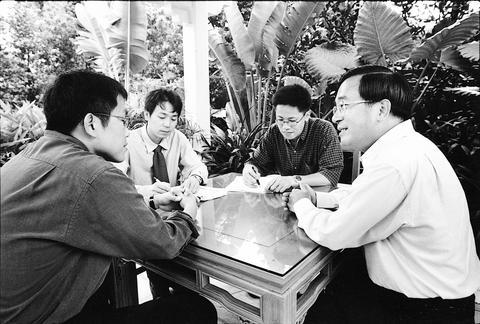
PHOTO COURTESY OF CITE PUBLISHING LTD
In The West Wing, there are moments when congressmen laugh at the greenness of some of the president's aides and then swagger off. Similarly, the opposition parties in Taiwan like to use the phrase "a country run by the scouts" when referring to the number of relatively young people in the Chen administration.
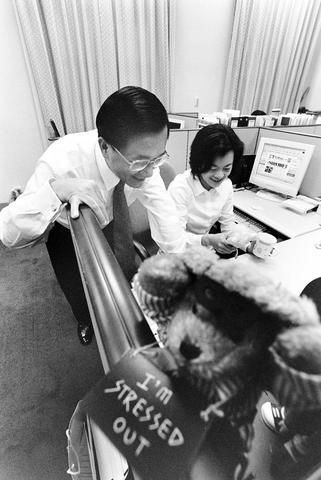
PHOTO COURTESY OF CITE PUBLISHING LTD
So what kind of role has this group of "scouts" played since the power transfer in 2000? How great are their powers? The media has tended to make assumptions and reports about the Presidential Office staff seemingly based on unrestricted imagination, but as the DPP administration's operation matures and gets more focused, the "scouts" are showing that their activities are transparent and can stand up to public scrutiny.
FELLOWSHIP OF PRESIDENT CHEN
Chen's Presidential Office has 12 members divided into two teams.
One team, led by Lin Ching-chang (
The other team is led by Ma Yung-cheng (
Born in 1965 in a mainlander community in Taichung, Ma is Chen's closest aide. He joined the cause in the late 1980s when Chen was still a legislator. Later, when Chen became Taipei mayor, Ma became Chen's shadow, taking care of negotiations with other powerful politicians and even undertaking some secret missions.
Ma, who was just a little over 30 back then, was under great pressure, dealing with politicians 10 or even 20 years his senior.
"I had to work hard to act like an old fox and demonstrate my ability so that I would not be overpowered at the beginning of the negotiations. When I was actually shivering and feeling cold, I had to sneer and pretend I didn't care," Ma recalls.
His experiences have given him a mind far more mature than people of the same age, and an excellent understanding of the essence of power.
"It's all about techniques of exchange and distribution. I have internalized these processes; they have become an intuitive reaction. As soon as I meet someone, I can see through his intentions and resources right away," Ma said.
Ma is known for his beard, and he does not deny that he uses it to make himself look more authoritative.
Following a more reckless youth, Ma is now a core member of the nation's power center. His team is in control of the president's itineraries, task progress reports and organizational functions. After first lady Wu Shu-chen (
The other team leader, Lin, was born in 1967 and is a graduate of National Taiwan University's Department of Foreign Languages and Literature. He has won several literary prizes for creative writing.
He was introduced to the president when Chen was still Taipei mayor by the then city government spokesman Lo Wen-chia (羅文嘉). Later, when Lo resigned over a tragedy that occurred during a city government event, Lin took over his position and began writing Chen's speeches and press releases.
Lin hails from rural Hualien, and is a romantic, handsome man with literary talent and a connoisseur of good wine and opera.
A famous anecdote clearly demonstrates his traits: Lin spent one night during the 2000 presidential election drinking with journalists until morning, completely forgetting about a speech he should have prepared for that day. Other members in Chen's camp finished writing the speech for him, but he managed to recover from the drinking session and write another speech at the last minute. When Chen took to the stage that night, it was Lin's version of the speech that was delivered.
Ma and Lin are Chen's right and left hands. In fact, the intelligence and traits of these two people have influenced the DPP administration tremendously, but invisibly. These two people are not only Chen's eyes and limbs, but they have become his brain.
MAKERS OF A-BIAN CULTURE
Chen Sung-shan (
Chen said that they tended to disregard the regulations, and that this style has made the DPP administration look disordered over the past three years.
"Everyone was competing to be the most ingenious and creative, but sometimes their methods conflicted with the bureaucratic procedures. Consequently there was a period of adjustment. Perhaps this kind of style is to break the stiffness that resulted from a dictatorial administration that lasted for 50 years. But the new administration is not powerful or resourceful enough, and adopting a conflicting way surely carries a bigger price," Chen said.
But Chuang Chia-yin (
Chuang, who played an important role in the DPP's campaign in the 2000 presidential election, is now a doctoral student in the Department of Sociology at Lancaster University.
"Because these aides are young, power has become a kind of cultural consumption, replete in daily life. It has also gained momentum, bestowing young intellectuals with a passion for the future and participation in politics," Chuang said.
She said that Chen's high esteem of his youthful aides has enabled him to guide the currents of thought of young people and the middle class since 1994, when he ran for Taipei mayor. He was able to offer a different approach in his campaign, giving people another option.
"After winning the election in 2000, Chen had to compromise with the huge bureaucratic system to run the country. The unique `A-bian culture' then disappeared at one point and went into hibernation. When A-bian described Taiwan and China as `one country on each side' of the Taiwan Strait in 2002, his aides seemed to be reborn, the civil strength was also reborn, and the `A-bian culture' was revived," Chuang said.
The members of the Presidential Office, meanwhile, have said that with the new administration, after their regular tasks, most of their time has been devoted to crisis management and damage control.
"When the administration first went into operation, the halting of construction on the Fourth Nuclear Power Plant, the opposition parties' attempt at recalling Chen and uncertainty about the appointment of a premier all rattled domestic politics," said Liu Shih-chung (
"The aides were all busy with damage control. To some degree we were trying to pull back President Chen, who was thrusting forward alone. We were monitoring public opinion closely and offering advice accordingly so that the president could adjust his visions according to our observations.
"Later, when we were more familiar with the operation, we became more focused on the establishment of standard procedures in every field, and the molding of the president's leadership," Liu said.
SUPERSTAR AND HIS SCRIPTWRITERS
Liu was born in 1965, and, like Ma, is also a second-generation mainlander from Taichung. Liu earned a master's degree in politics from Columbia University and joined the DPP in 1998, when then DPP chairman Hsu Hsin-liang (
After Chen won the election in 2000, he became a focus for the international media, and Liu joined Chen's team of aides. He described the relations among the aides in the office as "brothers in arms."
"The president is like a friend and a big brother to us. The job description of the office members should be negotiating, not policymaking, and executing orders, not giving them," Liu said.
His aides have described Chen as a dutiful leading actor who is most sensitive to the reaction of the audience. They say he is a master of delivering speeches, and even if his aides present him with material that is not very mature, Chen can still deliver his message to perfection.
"A-bian is like a mega-sponge that can absorb everything at a surprisingly fast rate," said Lin Te-hsun (
Lin said that the DPP administration has been adjusting and improving continuously, and although there have been problems, the administration can always respond to the public immediately.
"The Chinese Nationalist Party (KMT) administration could not do what we are doing," Lin said, adding that the main reason for this was Chen's high esteem of the media.
"The president reads the newspapers every morning. He not only reads the briefings from his aides, but also many domestic and international heavyweight news-papers from the first page to the last," one of the aides said.
Chen makes time every day to respond to issues reflected in the media. These responses include moderating a speech or accepting media interviews. Sometimes, to catch the media's attention, Chen would deliver a speech that deviates from the prepared copy, in which case the media tends to report heavily on his improvisation.
A BIG HAPPY FAMILY
Outsiders assume that the Presidential Office team are long-time A-bian followers and have earned his trust. But Chen has actually picked members from the DPP's many factions to expand the reach of his power.
Ma's team includes Lin Te-hsun, who has followed Chen since he was a lawmaker.
Then there is Kuo Wen-pin (
Others in charge of administrative affairs include Chen Hsin-yi (
Lin Ching-chang's team, besides Liu Shih-chung, includes 41-year-old Liu Tao (
There is also 39-year-old Liang Hsueh-tu (
Thirty-three-year-old Cheng Tsun-yi (
Kuo Lin-wu (
Although there are only 12 members of the Presidential Office, over the past three years, many have come and gone. Most left because they went abroad for advanced studies.
There seems to be no power struggle within this office, and one key reason is that this group of people are not interested in having a political career of their own.
"Ma Yung-cheng, Lin Ching-chang and Lin Te-hsun have almost become a part of the political noun `Chen Shui-bian,'" senior political columnist Hu Wen-hui (胡文輝) said.
"Meanwhile, DPP headquarters-based Liu Shih-chung, legislature-based Kuo Wen-ping and Liang Hsueh-tu, and regional government-based Liu Tao were all born in the 1960s. They fought their way out among thousands of young DPP talents. They have witnessed the power games, but they are not planning to take over in the power games. I think this is why there is no power struggle in the Presidential Office," Hu said.
"Chen's talent lies with the strategy of procuring talent from the two other most seasoned DPP veterans, Su Tseng-chang and Frank Hsieh. But this is also because Su and Hsieh both understand how to invest in politics, and send their people into the power center to control the process of policy-making," Hu said.
EYEING THE FUTURE
"The best thing we have got over the past three years is not the ability to influence President Chen's policy-making, nor greater power than Cabinet members, but the experience in crisis management, damage control and the establishment of standard operating procedures in different fields," Liu said.
"The work the Presidential Office members really do is about the negotiations between the Presidential Office and the executive departments after a policy is decided. President Chen's councilors come from different circles, and the policy-making process involves experts from different fields. Our mission is to execute the policy or explain the policy to government departments after a policy is formulated," Liu said.
After witnessing the power games for more than three years, the aides have developed some ideas about how to improve the Presidential Office, such as moving people between the office and important government departments such as the Executive Yuan, National Security Council or even the local governments.
"It is because we have been involved in the highest level of policy-making that we are most clear about the process of policy-making. When we are relocated to other departments, we can be very helpful in working out how to execute a policy and set up standard operating procedures in the shortest time," Liu said.
"Over the past three years, the president has been trying to set up a cross-departmental mechanism for policy-making, including holiday meetings, the nine-person task force formed by the Presidential Office, the Executive Yuan and the party, and the synchronization of party and national politics," he said.
"However, they all had only a short-term effect. If we can add the transfer of the aides, it would the best way to minimize the delay in the bureaucratic system and the mistakes from misreading the information," he said.

REASONS FOR TRAVEL: An assistant professor said that proposed amendments to penalize drivers if they used drugs overseas would not deter people from traveling People who operate a motor vehicle under the influence of marijuana would have their driver’s license revoked, even if they used the substance while overseas, the Ministry of Transportation and Communications said yesterday, citing proposed amendments to the Road Traffic Management and Penalty Act (道路交通管理處罰條例). The amendments would also authorize the government to revoke the licenses of people determined to have used Category 1 or Category 2 narcotics, even if they were not operating a vehicle while under the influence of drugs, as well as ban them from taking the license test for three years, the ministry said. People aged 18 or

GLOBALGIVING: ‘ Caving to external pressure is not acceptable for an organization that has cultivated justice reform and human rights for 30 years,’ one NGO said A slew of non-government organizations (NGOs) have withdrawn from the GlobalGiving fundraising platform after it announced it would use “Chinese Taipei” instead of “Taiwan” from next month. The Taiwan Good Rice Association wrote on Facebook on Friday that it was informed on April 28 via a teleconference call of the change, which was made because the platform wanted to operate in China. Taiwan Good Rice is to terminate all cooperative relationships with GlobalGiving in response to the platform’s “unilateral and non-negotiable” decision to remove references to Taiwan, the NGO said. “Taiwan is in the official name of Taiwan Good Rice Association and the

HEAVY WEATHER: Typhoon Jangmi is due to crash straight into the Ryukyus as airlines look to shift flights to larger aircraft or cancel flights to Okinawa entirely Taiwan’s international air carriers announced flight adjustments over the weekend as Typhoon Jangmi is forecast to hit the Ryukyu Islands today and tomorrow. The Central Weather Administration (CWA) upgraded Jangmi from a tropical storm to a typhoon at 8am yesterday, with the eye located 580km south of Naha city. It was moving north at 19kph. Today, China Airlines’ CI-120, CI-121, CI-122 and CI-123 flights between Taoyuan and Naha, Okinawa, have been canceled as well as CI-132 and CI-133 between Kaohsiung and Naha. EVA Air’s BR-112, BR-113, BR-186 and BR-185 flights between Taoyuan and Naha are also canceled. Low-cost carrier Tigerair Taiwan canceled IT-230,
MULTIPRONGED APPROACH: China has sought to pressure Palau across a number of fronts, but the island nation has staunchly resisted overtures to ditch Taiwan Palau has been firm in backing Taiwan despite Chinese pressure that uses tourism economics, cyberattacks and criminal infiltration as tools to threaten the Pacific ally into renouncing its recognition of Taiwan as a sovereign state. The Presidential Office yesterday announced that Vice President Hsiao Bi-khim (蕭美琴) would visit Palau from Saturday to Wednesday next week at the invitation of Palauan President Surangel Whipps Jr. Whipps in April said in an interview that China had outspokenly asked Palau to “denounce Taiwan.” “And we have said: ‘We have no enemies, but nobody tells us who our friends are,’” he said. Whipps has told reporters multiple times


 RSS
RSS