


Officials from the quasi-official Straits Exchange Foundation (SEF) yesterday declined to comment on reports regarding the arrests of seven Taiwanese citizens by Chinese authorities last month on charges of espionage.
SEF officials confirmed yesterday, however, that the foundation had received a letter regarding the arrests from its Beijing counterpart, the Association for Relations Across the Taiwan Strait (ARATS), and that the SEF is working to verify whether the arrests are authentic.
The SEF will give a public explanation on the matter after it finishes its verification work, the officials said.
The SEF and the ARATS were authorized by their governments more than a decade ago to handle exchanges across the Taiwan Strait in the absence of formal ties between the two sides.
ARATS letter said that seven "Taiwan residents" were arrested between Dec. 4 and Dec. 15 in China on suspicions of spying.
According to a report yesterday by the Beijing-based China News Service, Fu Hung-chang (傅宏章), Lee Chieh-shan (林介山), Soong Hsiao-lien (宋孝濂), Wang Chang-yung (王長勇), Chang Keng-huan (張耿桓) and Chang yu-jen (張豫人) were apprehended on Dec. 15 in Guangdong, Fujian, Anhui and Hainan provinces on suspicion of gathering intelligence for Taiwan's military authorities.
A seventh Taiwanese citizen, Tung Tai-ping (
ARATS claimed that all seven men were "cells" dispatched by Taiwan's Military Intelligence Bureau. All of them are in good health, the report said.
In related news, the Cabinet's spokesman warned the pan-blue camp to avoid trying to manipulate reports from China for its own political gain.
Beijing's official Xinhua News Agency reported on Dec. 24 that Chinese security authorities had arrested 24 Taiwanese and 19 Chinese on charges of spying for Taiwan.
Cabinet Spokesman Lin Chia-lung (
"It's unfair to believe China's accusation that the arrested China-based Taiwanese business-people are engaged in espionage activities before the truth is learnt," Lin told a press conference held after the weekly closed-door Cabinet meeting yesterday afternoon.
"We hope to see more support, less finger-pointing and less political feuding."
As the Chinese government often violates human rights and arrests its own people without justification, it is not surprising to see it persecute Taiwanese people and foreigners, Lin said.
Yen Wan-ching (顏萬進), deputy secretary-general of the SEF, pointed out that it was unusual for Beijing to make public arrests and investigations of espionage activities.
"They used to keep it as a secret but this time they took the initiative to confirm a report by a Hong Kong daily and then send a letter to us," Yen said.
"It'd be very interesting to know the ulterior motive of its change," Yen said.
Yen also called on the Chinese government to treat the seven arrested Taiwanese businesspeople humanely.
"We're very concerned about their health. We'll try to arrange meetings with their families and hire local lawyers if necessary."

The military has spotted two Chinese warships operating in waters near Penghu County in the Taiwan Strait and sent its own naval and air forces to monitor the vessels, the Ministry of National Defense (MND) said. Beijing sends warships and warplanes into the waters and skies around Taiwan on an almost daily basis, drawing condemnation from Taipei. While the ministry offers daily updates on the locations of Chinese military aircraft, it only rarely gives details of where Chinese warships are operating, generally only when it detects aircraft carriers, as happened last week. A Chinese destroyer and a frigate entered waters to the southwest
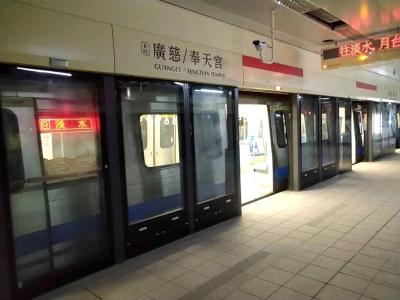
The eastern extension of the Taipei MRT Red Line could begin operations as early as late June, the Taipei Department of Rapid Transit Systems said yesterday. Taipei Rapid Transit Corp said it is considering offering one month of free rides on the new section to mark its opening. Construction progress on the 1.4km extension, which is to run from the current terminal Xiangshan Station to a new eastern terminal, Guangci/Fengtian Temple Station, was 90.6 percent complete by the end of last month, the department said in a report to the Taipei City Council's Transportation Committee. While construction began in October 2016 with an
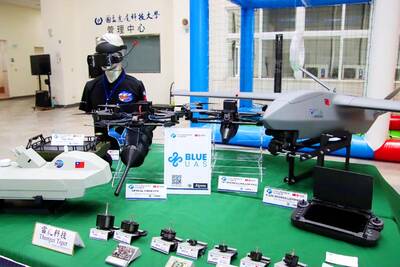
NON-RED SUPPLY: Boosting the nation’s drone industry is becoming increasingly urgent as China’s UAV dominance could become an issue in a crisis, an analyst said Taiwan’s drone exports to Europe grew 41.7-fold from 2024 to last year, with demand from Ukraine’s fight against Russian aggression the most likely driver of growth, a study showed. The Institute for Democracy, Society and Emerging Technology (DSET) in a statement on Wednesday said it found that many of Taiwan’s uncrewed aerial vehicle (UAV) sales were from Poland and the Czech Republic. These countries likely transferred the drones to Ukraine to aid it in its fight against the Russian invasion that started in 2022, it said. Despite the gains, Taiwan is not the dominant drone exporter to these markets, ranking second and fourth

Japanese Prime Minister Sanae Takaichi’s comment last year on Tokyo’s potential reaction to a Taiwan-China conflict has forced Beijing to rewrite its invasion plans, a retired Japanese general said. Takaichi told the Diet on Nov. 7 last year that a Chinese naval blockade or military attack on Taiwan could constitute a “survival-threatening situation” for Japan, potentially allowing Tokyo to exercise its right to collective self-defense. Former Japan Ground Self-Defense Force general Kiyofumi Ogawa said in a recent speech that the remark has been interpreted as meaning Japan could intervene in the early stages of a Taiwan Strait conflict, undermining China’s previous assumptions


 RSS
RSS