


Why was President Chen Shui-bian (
It is because he has conquered a myriad of difficulties in the name of establishing a new Constitution, determined to draw out a blueprint for a new nation. Come 2008, Chen, the "Son of Taiwan," will become the founding father of a new nation with the implementation of a new Constitution that receives its mandate via a referendum.
The results of the 2000 Presidential election reversed the roles of the nation's political parties, putting the long-time opposition party into office. Chen was not only the president, but was also a creator and writer of Taiwanese history.
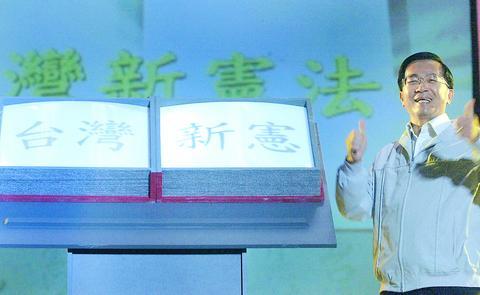
FILE PHOTO: SEAN CHAO, TAIPEI TIMES
In Chen's book, The Premier Voyage of the Century (
Chen pointed out that during the first democratic wave, the debate revolved around those for and against revolution, pro-Taiwan localization and mainstream political thought. However, in the second democratic wave, the societal struggle was between those for and against democracy.
Concrete value
The party switch in the presidential office demonstrated the concrete value of democracy. Political switchover is a normal occurrence in democratic societies, but during the 2000 presidential elections, in which Chen recorded a landslide victory and which was a developmental leap for Taiwan's democracy, it met with protest and attacks from the pan-blue camp.
The result was a loss of political and economic stability that led to societal chaos. What had been an occasion worthy of celebration was manipulated into a tragedy.
The number of seats the Democratic Progressive Party (DPP) won during the 2001 Legislative elections significantly increased to 87 seats from the previous 70. In addition, the Taiwan Solidarity Union's (TSU) 13 seats brought the total pan-green legislators to 100. However, the People First Party (PFP), together with the Chinese Nationalist Party (KMT), controlled over half of the legislative seats.
Having the ruling party in the legislative minority and the opposition party in the legislative majority resulted in resistance to all initiatives put forth by the Chen administration.
Why is it that the KMT can be counted on to oppose Chen's policies? Most people say its because the pan-blue camp was especially unwilling to admit defeat, given that James Soong (
If the two had not split the vote, Chen would not have taken the presidential office with just 40 percent of the vote. The prize went to the third contender, leaving not only Lien and Soong unable to tolerate the outcome, but also their supporters.
In the 2001 Legislative elections, the pan-green camp's DPP and TSU won roughly 100 seats with about 45 percent of voters opting pan-green. High-ranking officials in the pan-blue camp asserted that Lee Teng Hui's departure from the KMT only removed about 5 percent of the vote.
Also, in the 2002 Taipei Mayoral elections, KMT political superstar Ma Ying-jeou (
This brought together Lien and Soong as running mates for the upcoming elections on Valentine's Day, marking a pivotal turning point.
As president, Chen faced numerous challenges: unprecedented dangers in the economic and political sectors; strong political resistance from opponents; supporters who had yet to be mobilized to action; the political, economic, agricultural problems that came with entry into the World Trade Organization (WTO); and irrational attacks from the opposition party.
In light of these circumstances, Chen's scars do not come as a surprise to anyone.
Su Tseng-chang (
Support
In addition, with support from both Chen and Lee Teng-hui, Frank Hsieh (
While Hsieh and Su's determination and success bode well for Chen's bid for a second term as President, news reports from pro-unification media touting high support ratings for the Lien-Soong pairing have caused green-camp senior officials to break out in a cold sweat, even causing some to lose confidence in Chen.
The referendum and constitution
The Constitution and referendum are key issues to Chen's election strategy. Election polls indicated an upward trend in Chen's support ratings after Chen announced his intentions for a new Constitution on Sep. 28 and after his October stopover in the US, during which Chen had met with several senior US officials. At the same time, Lien and Soong saw a decline in their support ratings.
All the polls agreed that support for Chen had increased even amongst Taiwan's middle range voters who did not side with either political camp.
What few people know is that before Chen officially put the topics of a referendum and a new Constitution on the table, he had asked senior DPP members and his administration officials for their opinion on the two issues.
Despite the fact that the referendum and new Constitution had long been DPP ideals and that several party members had sacrificed a great deal in pursuit of them, many responded that the two controversial issues were not necessarily beneficial to Chen's election campaign.
At the time, Chen took the opinion of his advisors to heart, but said no more on the issue.
When Chen formally announced his intention to bring about a referendum and new Constitution, there was resistance within the DPP. Chen later revealed to a friend that the DPP's spirit of idealism had room for improvement. He said that if he had first informed the DPP that he would be officially announcing the referendum and new constitution issues, then the fetus would have died in the womb.
It is understood that some members from the pan-green camp are using the term "pragmatism" to stop further reform and rooting out democracy, so they can preserve their own interests. Chen feels pained by the situation, but he can only try to set a good example and hope more party members will follow him on the way of reform.
"Suffering is nutrition" -- this has been Chen's consistent philosophy in life. Chen has walked a long and winding road in life and reached the nation's top office, and what is the difference between one term and two terms of presidency from the perspective of honoring his forefathers?
For Chen, the purpose of seeking a second term is to carry through his ideals, create Taiwan's core values and be able to endure scrutiny by generations to follow. Those in the know said that maybe everything was meant to be.
Back in the presidential election in 2002, Chen's campaign team opposed the idea of Soong-bashing at one point. They thought that from a strategic point of view, bashing Soong would be helping Lien in a way and Lien might consequently win the election.
Chen, however, listened to some other friends and decided to lash out at Soong despite disagreement from his campaign team.
But not long after, everyone attacked Soong with Chen and in the end Chen surprised many political analysts and unexpectedly won the election.
For the presidential election this year, Chen is pushing the referendum and new Constitution issues out of his strong sense of mission, disregarding strong opposition. From the electoral point of view, Chen is facing an unprecedented, difficult battle. It is very difficult to predict who will win the election, and the battle is full of unknown and unpredictable variables.
Right now Chen is the only one in the DPP who is putting more emphasis on the referendum, the new Constitution and normalizing Taiwan as a country than on the election, while many DPP members still have not caught up with these issues.
This results in the DPP's thin discourses on these issues and not many are enthusiastic in persuading their electorates to support the ideologies that concern Taiwan's future development. The public energies are not directed toward these issues and Chen still cannot get a clear lead in his supporting rate, compared with the Lien-Soong ticket.
The new issues of a referendum and a new Constitution have been stigmatized after manipulation by the pan-blue camp. In fact, the referendum and new Constitution are the essence of Chen's "second-wave democratic reform" -- the referendum is the means, and the new Constitution is the goal.
Anti-reform
But because the pan-blue camp's anti-reform influence dominates the legislature, and they would oppose everything propounded by Chen, there is indeed political difficulties for Chen in further promoting democratic reform.
Therefore, Chen needs to direct the public's will to break the existing political impasse and he has to take the road to referendum. A new Constitution is the inevitable way for Taiwan to transform from a virtual country based on China to a real country based on Taiwan.
The blueprint set out in the new Constitution can also solve the sensitive issues generated by independence. Right now the popular saying is that "Taiwan is already a sovereign and independent country, called Republic of China," but from an international point of view, Taiwan is still not a normal, complete or great country.
But there would be no need to declare independence and create political opposition with the birth of a new Constitution. With the operation of the new Constitution, many sensitive issues can be solved by democratic mechanisms.
The pan-blue camp's version of a referendum is indeed a "bird-cage version of a referendum law," but it gives Chen a way out and Chen did not miss the opportunity to pursue a defensive referendum.
International concern
But besides the pan-blue camp's strong opposition, the idea of a defensive referendum has also attracted international concern from China, the US and Japan. Pressure has been increased and Chen's campaign has also been negatively influenced by China's spy allegations and the tumult in the Taiwan-US relations.
Political analysts pointed out that when former president Lee proposed his two-country discourse, it also raised controversies internationally. But after Taiwan weathered the storm, Taiwan's sovereignty also made a major breakthrough.
Now Chen also is pressured by his ideals and whether he can get public consensus remains the key to his election campaign and Taiwan's normalization.
Translated by Joy Su and Debby Wu
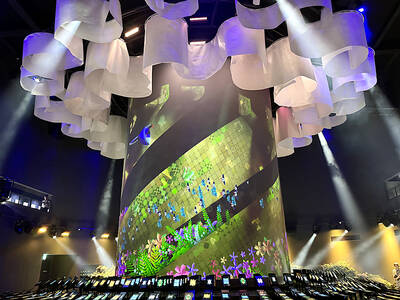
PRAISE: Japanese visitor Takashi Kubota said the Taiwanese temple architecture images showcased in the AI Art Gallery were the most impressive displays he saw Taiwan does not have an official pavilion at the World Expo in Osaka, Japan, because of its diplomatic predicament, but the government-backed Tech World pavilion is drawing interest with its unique recreations of works by Taiwanese artists. The pavilion features an artificial intelligence (AI)-based art gallery showcasing works of famous Taiwanese artists from the Japanese colonial period using innovative technologies. Among its main simulated displays are Eastern gouache paintings by Chen Chin (陳進), Lin Yu-shan (林玉山) and Kuo Hsueh-hu (郭雪湖), who were the three young Taiwanese painters selected for the East Asian Painting exhibition in 1927. Gouache is a water-based
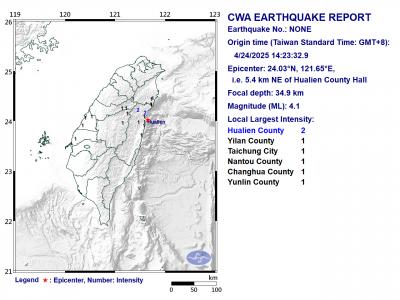
A magnitude 4.1 earthquake struck eastern Taiwan's Hualien County at 2:23pm today, according to the Central Weather Administration (CWA). The epicenter of the temblor was 5.4 kilometers northeast of Hualien County Hall, at a depth of 34.9 km, according to the CWA. The earthquake's intensity, which gauges the actual effect of a temblor, was the highest in Hualien County, where it measured 2 on Taiwan's 7-tier intensity scale. The quake also measured an intensity of 1 in Yilan county, Taichung, Nantou County, Changhua County and Yunlin County, the CWA said. There were no immediate reports of damage or injuries.
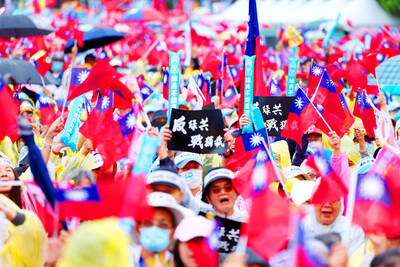
‘WORSE THAN COMMUNISTS’: President William Lai has cracked down on his political enemies and has attempted to exterminate all opposition forces, the chairman said The legislature would motion for a presidential recall after May 20, Chinese Nationalist Party (KMT) Chairman Eric Chu (朱立倫) said yesterday at a protest themed “against green communists and dictatorship” in Taipei. Taiwan is supposed to be a peaceful homeland where people are united, but President William Lai (賴清德) has been polarizing and tearing apart society since his inauguration, Chu said. Lai must show his commitment to his job, otherwise a referendum could be initiated to recall him, he said. Democracy means the rule of the people, not the rule of the Democratic Progressive Party (DPP), but Lai has failed to fulfill his

OFF-TARGET: More than 30,000 participants were expected to take part in the Games next month, but only 6,550 foreign and 19,400 Taiwanese athletes have registered Taipei city councilors yesterday blasted the organizers of next month’s World Masters Games over sudden timetable and venue changes, which they said have caused thousands of participants to back out of the international sporting event, among other organizational issues. They also cited visa delays and political interference by China as reasons many foreign athletes are requesting refunds for the event, to be held from May 17 to 30. Jointly organized by the Taipei and New Taipei City governments, the games have been rocked by numerous controversies since preparations began in 2020. Taipei City Councilor Lin Yen-feng (林延鳳) said yesterday that new measures by


 RSS
RSS