


A TSU lawmaker claimed yesterday that the vocabulary used in many elementary and junior-high school English textbooks is too difficult for students and exceeds Ministry of Education guidelines.
TSU Legislator Cheng Chen-lung (
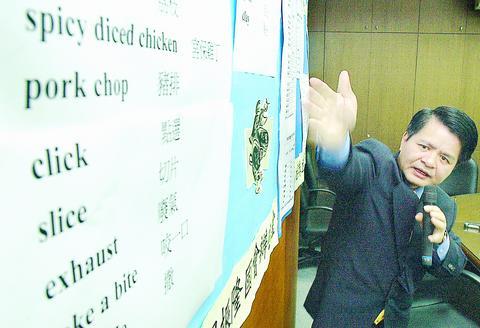
PHOTO: CHU PEI-HSIUNG, TAIPEI TIMES
The ministry's word list is used as the basis for the Basic Competency Test that junior-high students must take to enter senior-high school.
"I don't think words like `eternal love,' `fading love' or `absent-minded' are necessary for children to learn. These words are just too hard to understand and pronounce," Cheng said, citing examples from the textbooks for first year junior-high students.
Other words and phrases, such as "zodiac sign," "spicy diced chicken," and "breaking the ice" were also on the list for those students, while sixth-grade students are being asked to learn words such as "exhaust," "push-ups" or "stinky tofu," he said.
"If children cannot understand those words, they are forced to just memorize them," Cheng said.
Using a book for sixth-graders published by the Kuang-fu Publishing Co as example, he said that about 47 percent of the book's vocabulary exceeds the range of the ministry's word list. That, he said, might confuse both students and teachers.
"There is also a wide disparity in the difficulty level of the textbooks, Cheng said.
"This probably forces children [who find the books too difficult] to go to cram schools," he said, adding that many of the textbooks were compiled and published by cram schools.
He said the disparity in elementary level textbooks meant junior-high teachers would face difficulties trying to teach students who had attended different elementary schools.
"If a student who used Kuang-fu's elementary-school textbooks then goes to a junior high that uses Nan-I Publishing Co's books, which are much easier than their Kuang-fu counterparts, the student would find the text too easy and vice versa," Cheng said.
"We also discovered that the more difficult a book's content, the better it sells," he said.
Due to market demand, he said, the content of English textbooks has become increasingly difficult, especially those books used by city schools.
"Although learning vocabulary is a small part of learning English, the teaching materials are a pivotal factor in determining the success of the instruction," Cheng said.
Ministry officials responded to the legislator's complaints later in the day, saying that the National Institute for Compilation and Translation has asked publishers to adjust the content of junior-high textbooks to meet the needs of students with differing English abilities.

Starlux Airlines, Taiwan’s newest international carrier, has announced it would apply to join the Oneworld global airline alliance before the end of next year. In an investor conference on Monday, Starlux Airlines chief executive officer Glenn Chai (翟健華) said joining the alliance would help it access Taiwan. Chai said that if accepted, Starlux would work with other airlines in the alliance on flight schedules, passenger transits and frequent flyer programs. The Oneworld alliance has 13 members, including American Airlines, British Airways, Cathay Pacific and Qantas, and serves more than 900 destinations in 170 territories. Joining Oneworld would also help boost

A new tropical storm formed late yesterday near Guam and is to approach closest to Taiwan on Thursday, the Central Weather Administration (CWA) said. Tropical Storm Pulasan became the 14th named storm of the year at 9:25pm yesterday, the agency said. As of 8am today, it was near Guam traveling northwest at 21kph, it said. The storm’s structure is relatively loose and conditions for strengthening are limited, WeatherRisk analyst Wu Sheng-yu (吳聖宇) said on Facebook. Its path is likely to be similar to Typhoon Bebinca, which passed north of Taiwan over Japan’s Ryukyu Islands and made landfall in Shanghai this morning, he said. However, it

Taiwan's Gold Apollo Co (金阿波羅通信) said today that the pagers used in detonations in Lebanon the day before were not made by it, but by a company called BAC which has a license to use its brand. At least nine people were killed and nearly 3,000 wounded when pagers used by Hezbollah members detonated simultaneously across Lebanon yesterday. Images of destroyed pagers analyzed by Reuters showed a format and stickers on the back that were consistent with pagers made by Gold Apollo. A senior Lebanese security source told Reuters that Hezbollah had ordered 5,000 pagers from Taiwan-based Gold Apollo. "The product was not

COLD FACTS: ‘Snow skin’ mooncakes, made with a glutinous rice skin and kept at a low temperature, have relatively few calories compared with other mooncakes Traditional mooncakes are a typical treat for many Taiwanese in the lead-up to the Mid-Autumn Festival, but a Taipei-based dietitian has urged people not to eat more than one per day and not to have them every day due to their high fat and calorie content. As mooncakes contain a lot of oil and sugar, they can have negative health effects on older people and those with diabetes, said Lai Yu-han (賴俞含), a dietitian at Taipei Hospital of the Ministry of Health and Welfare. “The maximum you can have is one mooncake a day, and do not eat them every day,” Lai


 RSS
RSS