


A KMT lawmaker yesterday branded the party's mobilization policy "improper" after he disobeyed a caucus order at Friday's legislative assembly.
"The party caucus should not impose political ideology upon lawmakers for issues that should be above politics, such as the confirmation date for grand-justice nominees," Chen Hung-chang (
On Friday, Chen refused to vote with his party for a postponement on the confirmation date for nominees. He sided with pan-green legislators by voting for the Legislative Yuan to finish the confirmation by extended session.
"I had made my position clear against the order to caucus whip Liu Cheng-hung (
"The KMT is not a party in which one person alone has the say. The mobilization politicized the legislative jurisdiction," he said.
Despite the vote orders issued by the KMT and PFP, four pan-blue lawmakers -- one from the PFP and three from the KMT -- were absent from the legislative showdown.
Chen, meanwhile, ignored his caucus' instructions when the legislative assembly dealt with the resolution requiring state-owned companies to withdraw their investment from the Taiwan High Speed Railway. He voted no to the resolution.
"The high speed railway project was started in the previous KMT government. I regret the oppositions' stance, which will plunge the construction project into financial difficulty if approved," Chen said. Chen's opinion was met with hostility by the KMT caucus. Party whip Liu said that all mobilization violators will face a disciplinary review after the vote.
The other two KMT absentees were Lee Sen-zong (李顯榮) and Tseng Tsai Mei-tso (曾蔡美佐) who both said they were unable to make the vote.
As for Legislator Yang Fumei (
Chung blasted Chen's decision to vote against his party.
"The lawmaker should carry out his legislative power in accordance with the fact that he is a member of the KMT and he must follow the caucus' decision since the caucus represents the majority opinion," the PFP whip said.
Chung disagreed with Chen's view that the justice review was above the party's political ideology.
"The political chaos within the country demonstrates that no disputes can be resolved without ideological rivalry," he said.
Another controversy relating to the mobilization order took place on Wednesday when members of the Home and Nations Committee engaged in a review of the controversial referendum draft bill.
The review ended with a surprise first reading declared by the convener Chen Chien-ming (陳建銘), a TSU lawmaker whose party is devoted to promoting the referendum legislation.
Chen said he announced the approval in accordance with the legislative procedure law, stipulating that the committee may announce the wrap up of the first examination and pass unfinished draft articles to the second round review at the legislative assembly when members of the committee requested to adjourn the meeting ahead of time.
"I carried out a convener's duty and coped with the request from seven opposition lawmakers to dissolve the meeting by a vote. The opposition have no need to question about the vote credibility since it was the legislative staff, not me, who counted the votes," Chen said.
The opposition alliance, with a majority of 11 seats on the committee, unexpectedly submitted to the vote.
Chen said the absence of five opposition lawmakers' from the review gave the pan-greens an advantage.
The forming of a pan-blue alliance for next year's presidential election has given the opposition a numerical edge of 112 seats at the legislature. The pan-greens have a total of 101 seats.
Chen said there was pressure within his party as well as in the pan-green parties concerning mobilization orders.
"The numerical confrontation has worsened the legislative efficiency in this session after the pan-blue alliance applied the tactic to the Procedure Committee and successfully boycotted a number of bills presented by the DPP and TSU," he said.

FUKUOKA SITUATION: Japanese media reported that the pathogen is expected to be identified by the summer, while the CDC downplayed the idea that it was hMPV A “mysterious cold-like illness” reported in Japan’s Fukuoka Prefecture does not seem to be a new disease, but Japanese authorities have been asked about the situation, the Centers for Disease Control (CDC) said yesterday. The Fukuoka Prefectural Medical Association on Wednesday told a news conference that a “mystery cold” that has become a hot topic on social media is “highly likely to be caused by some kind of viral infection,” Japan’s KBC News reported. “Many people are experiencing symptoms starting with a sore throat, followed by a runny nose, phlegm and a severe cough,” KBC News reported, citing association officials. Health authorities are

Nvidia Corp CEO Jensen Huang (黃仁勳) arrived in Taiwan yesterday ahead of upcoming AI and technology events, saying he plans to meet with clients and Taiwan Semiconductor Manufacturing Co Chairman C.C. Wei (魏哲家) during his visit. After landing at Taipei Songshan Airport, Huang posed for photos with fans and handed out Yakult drinks to reporters and supporters waiting at the scene, saying he has “a lot to do” during the trip. Asked about reports that Nvidia’s planned headquarters site in Taipei’s Beitou Shilin Technology Park could break ground on May 27, Huang said that if the company holds an event, he would

The Ministry of Finance this afternoon announced the winning numbers for the March-April uniform invoice lottery. The winning number for the NT$10 million (US$318,060) special prize is 19531471, and the winning number for the NT$2 million grand prize is 85941329. Three numbers were drawn for the NT$200,000 first prize: 07225810, 20231230 and 83518781. Those with receipts matching the last seven digits of any of the first-prize numbers will win the NT$40,000 second prize, while those matching the last six digits will win the NT$10,000 third prize. Those whose receipts match the last five digits of the first-prize numbers can claim the NT$4,000 fourth prize,
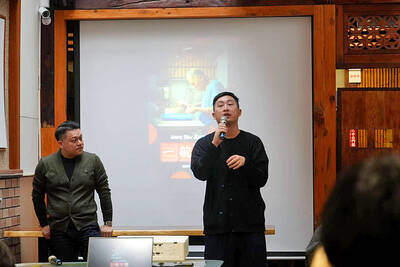
Taiwan Travelogue (臺灣漫遊錄), which earlier this week became the first Taiwanese novel to win the International Booker Prize, is to be adapted into a television series through a Taiwan-Japan coproduction, producer Chang Chen-yu (張辰漁) said yesterday. Chang, a producer at World Softest Production Film Co, wrote on Facebook that the company had been searching for projects with international appeal that retain a strong Taiwanese identity after colleagues and Japanese partners strongly recommended the novel. After reading the book, Chang said he immediately decided to pursue the screen rights. “A great story has the power to transcend time and borders, and connect countless people,”


 RSS
RSS