

Taipei Times: Could you sketch the atmosphere in the US Congress in early 1979 after the switch in diplomatic relations from Taipei to Beijing and how that spawned the Taiwan Relations Act?
Harvey Feldman (
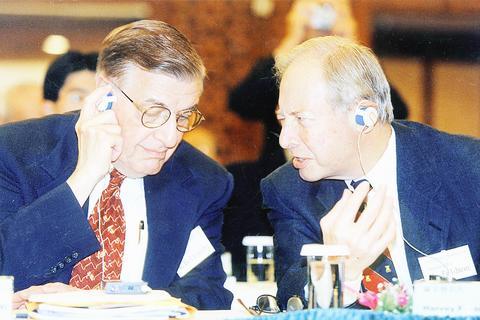
TAIPEI TIMES FILE PHOTO
TT: Why was a Taiwan Relations Act needed?
Feldman: We had to have an act because we also intended to go on selling arms to Taiwan for its self-defense. And the law said you could sell arms only to friendly governments. We also intended to continue supplying enriched uranium for their electric nuclear-power reactors because we were their only source of enriched uranium, and the law said you could sell enriched uranium only to friendly states.
Moreover, we had something like 70 treaties and executive agreements between the United States and the ROC covering everything from double taxation to airline travel, tariffs, friendship, commerce and navigation, and so on and so forth. So the question was, "What do you do with all of these things?" So we had to write a bill that would straighten all of this out.
The bill also dealt with the establishment of the American Institute in Taiwan (AIT) and how it would function, and what its powers would be. So, all of that was in the bill, but what was not in there, and what Congress added, were the security guarantees.
TT: So there was some great sense of urgency in getting the bill passed?
Feldman: There was a great sense of urgency because we had a staff in Taiwan that basically lost its status on Jan. 1, 1979, and we couldn't even pay them. We couldn't pay the rent. We couldn't pay our electricity bill. We couldn't do anything until the legislation got enacted.
TT: Certainly the bill is a very nuanced document. And, it's unique among the foreign policy legislation that I've seen.
Feldman: Oh, yes. It is unique. There was never anything like it before. For example, how did we deal with this question of arms sales and enriched uranium sales? Lee Marks, who was my co-chair and was senior deputy legal adviser, and I came up with a simple sentence that said for all purposes of American law, the government previously recognized as the government of the Republic of China shall be considered a friendly government and Taiwan shall be considered a friendly state. In that one sentence, it solved it all.
But what Congress did was very important. They took this, and they in effect wrote a security treaty between the United States and Taiwan. Here was a security treaty that was not negotiated by the executive branch. It was created by the legislative branch. It is completely unique.
TT: Over the years, have there been any efforts to amend the law at all?
Feldman: Every once in a while, someone, usually not in Congress, gets up and says, "We need to strengthen this or we need to weaken that," and fortunately successive administrations have always said, "We're not going to tamper with it. Leave it alone."
TT: Tell us how you came about writing some of these provisions. How did you come up with the idea of the AIT and some of the security provisions?
Feldman: What happened is I started my assignment as country director for the Republic of China at the State Department a day or two after Labor Day in 1977. I was immediately called up to [US Ambassador to the UN Richard] Holbrooke's office. He was then the Assistant Secretary for East Asia. And he said, "Your initial task, and you may consult no-one at all about this, is, you need to figure out a way of retaining all the essential relationships with Taiwan in the absence of a diplomatic relationship." He told me to assume that we cannot have a diplomatic relationship, or in fact any official relationship with Taiwan. How can we continue to carry out everything that we need to carry out in terms of trade, culture, immigration, representation of interests, and so on and so forth.
So I sat down, and I got a copy of what the Japanese had created when they shifted relations. They established an "unofficial office in Taiwan." They were the first to do this. I took a look at what they had done and felt it was okay as far as it went, but it was totally inadequate for our purposes. And then, I just sat down and wrote and wrote and wrote and wrote. Holbrooke had given me four to six weeks to come up with this, and that's what I did.
And that was the essential framework of what later became the Taiwan Relations Act. The part that I wrote concerned continuity of treaties and agreements, establishment of the AIT, how it would function, how it would be staffed, how it would be funded and other ancillary things.
TT: So you were responsible for the State Department act?
Feldman: First I did this draft solo for Holbrooke in October 1977. I sat back and then nothing happened. It was only in September of 1978 that the negotiations restarted in Beijing. What had happened, as I learned subsequently, was that Cyrus Vance had gone to Beijing in August of 1977, and had said that the Carter administration was prepared to "complete normalization," a codeword for switching diplomatic relations.
Then he said, because of the complexity of our relationships with Taiwan, that we would have to maintain a small consulate or something like that to handle our business.
Whereupon Deng Xiaoping (鄧小平) clapped his hands three times and called for the minutes of conversations with Gerald Ford and Henry Kissinger when President Ford had visited in early 1976.
And he read the part where Ford said that following the establishment of relations with the People's Republic of China (PRC), we would not have any officials relations with Taiwan. And Deng said to Vance that, "we will absolutely not proceed on the basis that you suggest. Are you prepared to go back on the word of a previous president, and disown what a previous president of the United States has said? We have been promised there would be no official anything, and now you're talking about a consulate. We reject that."
And Vance came back and said to Holbrooke, who said to me, "Go figure out how to do this without anything official." So that's how that started.
Then nothing much happened. The Carter administration at the time was involved with the Panama Canal treaty. It wasn't until after they had settled the Panama Canal treaty that the negotiations really restarted in Beijing, and then went very quickly. So one day, on Dec. 15, 1978 to be exact, I was called up to Holbrooke's office and told that at 9pm that night president Carter would announce the switch in diplomatic relations. So, immediately afterwards, we established this working group co-chaired by Lee Marks and myself, to take what I had done and rework it.
TT: So you decided to rework it?
Feldman: We decided there had to be more to it -- the arms sales and a bunch of other stuff. And that became the Taiwan Omnibus Act. And then it went to Congress, and they added the preamble, the Findings and Declarations of Policy, and they added the business about strengthening arms sales and the fact that this was to be done solely on the basis of Taiwanese needs, not discussion with the PRC -- something that several administrations have violated.
The sentence that Lee Marks and I added, of which we are very proud, is, "Whenever authorized or pursuant to the laws of the United States to conduct and carry out programs, transactions or other relations with respect to foreign countries, nation states, governments or similar entities, the president or any agency of the United States government is authorized to conduct and carry out ... such programs, transactions and other relations with respect to Taiwan." That may be the most creative thing we did. That, and the AIT.
TT: If you had to go back and redo it, is there anything you would have done differently, or written differently, or is there any way that you would have reacted differently to what Congress added?
Feldman: You have to remember that this was a document of the time. And, although Congress was very angry that they had not been consulted, nevertheless, they were strongly in favor of having a diplomatic relationship with the PRC.
Their point was that they did not want it to be at the expense of the diplomatic relationship with Taiwan. So, at the time, this was very rough stuff. The PRC said it did not accept this. They threatened that if Carter did not veto the bill, they might never establish relationships at all.
And Carter threatened to veto it. He said the language had to be changed. But the votes were there, despite Carter's bluff, there was no way he could veto it, because it would be overridden, and that would make him look doubly stupid.
TT: Now, with a democracy in Taiwan, and with what was an opposition party now being the government, do these recent developments in Taiwan call for any changes in the act to reflect the new political realities?
Feldman: No, I don't think so. I don't think the act requires any change at all. The next step would be to accord diplomatic recognition to Taiwan.

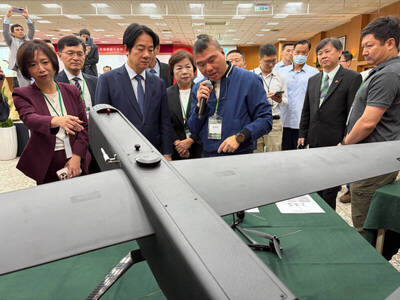
Two executives of drone supplier Jiin Ming Industry Co (錦明實業) have been detained and held incommunicado over the company's alleged use of prohibited China-made chips and camera lenses in drones supplied under recent military contracts, the Taoyuan District Prosecutors' Office said today. In a statement, prosecutors said they raided the offices of Jiin Ming — headquartered in Taoyuan — as well as those of its subsidiaries and its suppliers on Thursday last week. The raids followed a report that the company had breached its procurement contracts by putting the prohibited components into drones delivered to the military. During the raids, prosecutors summoned
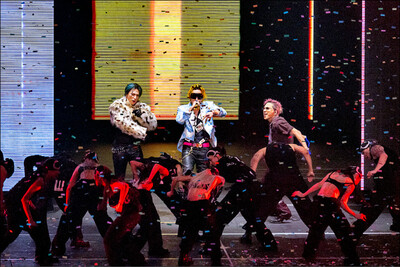
South Korean boy band BigBang drew 120,000 fans to three concerts at Taipei Dome from Friday through yesterday, as the band thanked them for their support over their 20-year career. The Taipei Dome concerts were part of BigBang's "2026-2027 World Tour XX: Cosmos." Friday's concert was BigBang's first performance in Taiwan in 11 years. During the encore, group leader G-Dragon (GD) shouted "I love you" in Chinese and said he was especially happy to perform in Taiwan with bandmates Taeyang and Daesung. "Taipei, I'm very grateful to you all," GD said in Chinese, asking fans to wait for the band's return. Daesung thanked
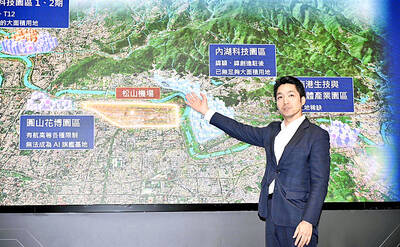
DETAILED PLAN NEEDED: Relocating the airport would affect not just travelers, but also undermine national defense and emergency medical services, a legislator said Taipei Mayor Chiang Wan-an (蔣萬安) yesterday proposed relocating Taipei International Airport (Songshan airport) and turning the site into an artificial intelligence (AI) park, drawing opposition from politicians across party lines. Chiang’s plan would turn the 300 hectares into an AI park featuring tech clusters, residential communities and green space. The industrial cluster would host 200 domestic enterprises, generate NT$12 trillion (US$376.47 billion) in output, and accommodate 65,000 jobs and 35,000 residents, he said. Cabinet spokeswoman Michelle Lee (李慧芝) said the Executive Yuan was surprised by the announcement, as the Taipei City Government did not discuss the proposal with the central government before making
The government would continue monitoring online rumors that a pneumonic plague outbreak has spread from Russia into China and could enhance existing quarantine measures, Premier Cho Jung-tai (卓榮泰) said today. During a legislative meeting, Democratic Progressive Party Legislator Wang Ting-yu (王定宇) said rumors were circulating that the disease had spread across several Chinese provinces. He asked Cho whether the government was prepared to prevent the disease from spreading to Taiwan, given the frequent exchanges between Taiwan and China, and how concerned the government was about the alleged outbreak. The Ministry of Health and Welfare implemented border quarantine measures after briefing the Executive Yuan


 RSS
RSS