


The 75-year-old Liao Te-sung (
He was a 19-year-old student at the Taipei Commercial School and chairman of the student union. He and 700 students joined a march to protest against the KMT troops.
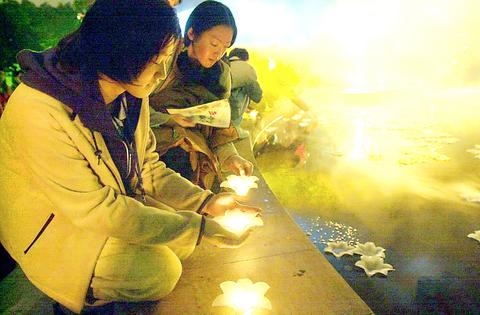
PHOTO: CHIANG YING-YING, TAIPEI TIMESN
"I saw military police armed with machine guns and deployed on top of the police headquartersbuilding," he said. "They started to fire shots at the crowd. I can still remember the smoke coming out of the machine guns and the panic of the crowd."
Liao, chairman of Taipei City's 228 Incident Association (台北市二二八協會), has dedicated his life to helping victims of the incident and their families to come to terms with their past and to seek compensation for the persecution they had to endure during the martial law era.
Born to a 11-member family in Taichung County, Liao's interest in social movements had a lot to do with his late father, Liao Chin-ping (
In 1921, the elder Liao met Chiang Wei-shui (
Together, they formed the country's first political party, the Taiwan People's Party (
The association, however, to split into two factions -- a socialist faction and an anti-imperialism faction -- in 1927 and eventually disbanded in 1931.
In addition to his many previous arrests, the elder Liao was eventually taken away by military police in 1947 and never returned. Liao Te-sung was 20 at that time.
Liao Te-sung also played an active role during the 228 Incident. He was one of the student representatives who negotiated with the government and made the "32 requests."
He was also one of the leaders of a volunteer community squad set up to maintain social order.
Because of his involvement in the 228 Incident, Liao Te-sung was arrested in October 1947 and put in custody for 50 days.
The government's effort
As the first appointed executive director of the Cabinet's ad hoc Memorial Foundation of the 228 Incident (二二八事件紀念基金會) since the peaceful transfer of power in 2000, Lee Wang-tai (李旺臺) knows first-hand about the true feelings of the victims' families.
Three or four times a week, Lee visits victims' families across the nation to show them how the DPP-led government identifies with their pain and how it cares about the loss of their loved ones.
"I feel like a nurse healing the wounds of the injured," said Lee sitting in his ninth-floor downtown Taipei office. "I remember a victim living down in Hualien County. He was put behind bars for two years simply because he was singing Japanese songs and wearing Japanese clogs."
He also talked about a family in Tainan County.
"I vividly remember the frightened look on the face of one of the old ladies. She thought I was someone from the Investigation Bureau or National Security Bureau to question her about the 228 Incident," he said.
After he managed to gain her trust, the woman burst into tears and started to tell him how much she and her family had suffered over the years after the death of her husband, who was executed because of his involvement in community patrols.
"She and her family had literally lived an isolated life for more than half a decade because not a single member of her relatives dared to have any contact with her," Lee said. "In addition to the constant visits of police and investigators, they were blacklisted and banned from going abroad or getting a promotion."
Mission of the foundation
Visiting victims' families is just part of the 16-member foundation's mission. Issuing compensation is another.
According to the statistics made available by the foundation, it has distributed over NT$6.8 billion to nearly 8,028 victims' families since its establishment in 1995.
As of Feb. 21, the foundation has received 2,492 compensation claims, 1,975 or 85 percent of which have been deemed valid, while 353, or 15 percent, were denied because of insufficient evidence.
"The lack of official documents and eye witnesses has made the identification process difficult," Lee said. "Sometimes we have to turn down a claim just because one or two small pieces of evidence are missing, although we're 90 percent sure about the reliability of their stories."
According to Lee, about a quarter of the claims filed are denied because of insufficient evidence.
To help tackle the problem, President Chen Shui-bian (
With nearly 6,000 government documents collected so far, the foundation has paid compensation to half of the victims' families whose claims had earlier been denied.
Nevertheless, there are a lot more people out there who are eligible to make claims but fail to file.
"Some have emigrated to foreign countries and know nothing about the claims and others refuse to file the claims because they don't want to collect the money which they say is an exchange for the lives of their loved ones," he said.
The amount of compensation for a victim's family ranges between NT$6 million for a victim who is dead or missing to NT$600,000 for those receiving six months' imprisonment.
The application deadline is October next year.
The foundation published eight out of 15 volumes of the 6,000 government documents last year and plans to publish four more next month and another three in May.
In addition to compensation, the foundation also plans to invite the president to present certificates to victims and victim's families to reverse the miscarriage of justice.
Establishment of the foundation
When Lee Teng-hui (
In 1995, the government erected a monument in New Park, which later became the 228 Peace Park in Taipei City. Lee also signed a law requesting the Executive Yuan to set up the Memorial Foundation of the 228 Incident to deal with compensation and consolation for victims' families. The foundation also conducts studies, collects related documents on the incident and organizes events.
Among the foundation's 22-member board of directors, seven are government officials, seven are from victims' families and eight are academics and experts.
To help the public remember the tragic incident, the foundation spends between NT$6 million and NT$7 million a year to hold events and organize activities.
"The 228 Memorial Day has become more and more important because it's the only national holiday commemorating a local historic event," Lee said.
During KMT rule, all of the national holidays were created in remembrance of Chinese events. This brainwashing scheme gradually collapsed after the lifting of martial law in 1987.
"It's definitely insufficient for Chen to advocate the `one country on each side' of the Taiwan Strait and Lee to promote the `state-to-state' theory, while the rest of society identifies more with China than with Taiwan," Lee said. "Taiwan desperately needs something that will hold them together as firmly as the root of a tree."
The incident
Although it may seem that the government has been doing a lot for the victims' families, they have endured much to have come this far.
The 228 Incident was a military crackdown on civilian protests that broke out on Feb. 27, 1947, against the KMT administration. Historians estimate that around 30,000 people were killed.
A a female cigarette vendor who was selling illegal cigarettes to make ends meet was caught by KMT revenue agents on Yen-ping North Road in Taipei City. The Tobacco Monopoly Bureau agents injured her and mistakenly killed a bystander.
Crowds demonstrated in protest, demanding punishment of the killers. They were, however, met with gunfire, igniting a fury of widespread public protest across the island the following day. To resolve the conflict, Chen Yi -- then chief executive officer of the Taiwan Provincial Government -- requested military assistance from Generalissimo Chiang Kai-shek, who later dispatched troops to Taiwan.
As tens of thousands were either killed, injured or went missing within months of the crackdown, residents of Keelung, Taipei, Chiayi and Kaohsiung suffered the greatest losses.
Although the provincial government offered compensation after the incident, it benefited only those civil servants or schoolteachers who were injured or suffered property damage. Compensation was also offered to the families of civil servants or school teachers who were killed.
"It didn't make sense at all because it offered compensation to perpetrators instead of victims," Lee said. "The amount of compensation was outrageous -- NT$200,000 for someone's death, equivalent to NT$10 million nowadays."
The government did not apologize to victims' families until Lee came to power in 1988. Although Chen had also apologized on behalf of the government, some relatives still cannot forgive the government because surviving perpetrators of the KMT's regime of repression remain unknown.
Others have also urged the government to amend school textbooks -- which remain tainted by the KMT's efforts to gloss over the event -- to reflect the facts of the incident.
In a bid to promote ethnic integration, Premier Yu Shyi-kun has also announced that Feb. 28 is a national holiday.
The date was proclaimed an optional day off last year, but on the condition that organizations observing it work the following Saturday instead.
Influence on the DPP
If the 228 incident has any influence at all on the DPP, it is the "32 requests" made by then-influential grassroots campaigners after the incident.
They called on the KMT-controlled Taiwan Provincial Government to hold popular elections for regional government officials; respect the freedom of assembly, speech, publication and right to strike; and hire Taiwanese as heads of state-run enterprises, district court directors, chief prosecutors and other judicial personnel.
The "32 requests" are considered the fundamental spirit of Taiwan's democratic movements including the tang wai movement initiated by daring dissidents before the DPP was formed in 1986.
Following the 228 Incident was the White Terror era in which thousands of Taiwan's most prominent citizens and leading intellectuals were dragged from their homes and killed or disappeared without explanation.
During the subsequent half century, private citizens have maintained a discreet silence, not daring to mention the taboo event.
The situation did not improve until the tang wai movement emerged. The tang wai movement gradually gained steam after Lee came to power in 1988.

NATIONAL SECURITY: Authorities are working to confirm the identities of the military personnel involved and investigating possible illegal conduct and regulatory violations Authorities are probing possible national security implications after Kinmen police and immigration officers on Sunday found a Chinese woman allegedly posing as a tourist while engaging in prostitution involving more than 10 military personnel. The woman, surnamed Chen (陳), has since been deported, authorities said, adding that investigators are still working to confirm the identities of those implicated, as the records only listed code names and aliases. The case stemmed from a report received by the Kinmen District Prosecutors’ Office on Friday last week from the Jinhu Precinct of the Kinmen County Police Bureau. On Sunday, police, along with the National Immigration

GLOBALGIVING: ‘ Caving to external pressure is not acceptable for an organization that has cultivated justice reform and human rights for 30 years,’ one NGO said A slew of non-government organizations (NGOs) have withdrawn from the GlobalGiving fundraising platform after it announced it would use “Chinese Taipei” instead of “Taiwan” from next month. The Taiwan Good Rice Association wrote on Facebook on Friday that it was informed on April 28 via a teleconference call of the change, which was made because the platform wanted to operate in China. Taiwan Good Rice is to terminate all cooperative relationships with GlobalGiving in response to the platform’s “unilateral and non-negotiable” decision to remove references to Taiwan, the NGO said. “Taiwan is in the official name of Taiwan Good Rice Association and the

HEAVY WEATHER: Typhoon Jangmi is due to crash straight into the Ryukyus as airlines look to shift flights to larger aircraft or cancel flights to Okinawa entirely Taiwan’s international air carriers announced flight adjustments over the weekend as Typhoon Jangmi is forecast to hit the Ryukyu Islands today and tomorrow. The Central Weather Administration (CWA) upgraded Jangmi from a tropical storm to a typhoon at 8am yesterday, with the eye located 580km south of Naha city. It was moving north at 19kph. Today, China Airlines’ CI-120, CI-121, CI-122 and CI-123 flights between Taoyuan and Naha, Okinawa, have been canceled as well as CI-132 and CI-133 between Kaohsiung and Naha. EVA Air’s BR-112, BR-113, BR-186 and BR-185 flights between Taoyuan and Naha are also canceled. Low-cost carrier Tigerair Taiwan canceled IT-230,

Chinese Nationalist Party (KMT) Chairwoman Cheng Li-wun (鄭麗文) yesterday briefed her party’s Central Standing Committee regarding her scheduled visit to the US between Monday next week and June 16, saying that her purpose would be to persuade the US that the Republic of China (ROC) Constitution was a “one China” constitution that would foster stable and peaceful cross-strait relations. The ROC Constitution is the most important defense for all Taiwanese citizens, as it upholds our democracy and has contributed to our robust economy, which aligns with international and US interests, she said. “We would not be troublemakers and drag the US under,”


 RSS
RSS