

The hard-fought race for positions on Taipei City Council wrapped up on Dec. 7 with many unexpected results.
The poll, which featured a record of number of candidates, saw the election of 27-year-old Lu Ying-ying (
Lu, the DPP's councilor-elect in Taipei's Shihlin and Peitou district, outshone her more senior candidates in a tight race.

PHOTO: CHIANG YING-YING, TAIPEI TIMES
In an interview with the Taipei Times, Lu discussed how, despite her young age and being a freshman on the political scene, she overcame the odds by developing her campaign strategy to win over voters.
"Politics was strange to me before. I started to get in touch with it when I worked as an activity coordinator at President Chen Shui-bian's (陳水扁) campaign office three years ago," Lu said.
"Through that job, I saw the passion and devotion of supporters at rallies, and that often made me wonder what they were crazy about," she said.
Lu said it struck her that she might be able to do something for them, motivating her to become more involved in politics.
Lu's campaign banners and flags featuring her image prompted the public to wonder just who this young woman with such a squeaky-clean image was.
"A smiling face is the only look you would see on my banners. Unlike other candidates, who appealed for the voters' sympathy with sad and poor looks, I insisted on bringing happiness, hope and warmth for people," Lu said.
The final series of Lu's campaign materials featured a Christmas message for voters.
"We gave candies and rode bicycles everyday to greet the public. I hoped everyone was in a happy mood in this election; that was the basic tone for my campaign strategy," Lu said.
Hard worker
Lacking an extensive political background, Lu relied on a hard-working attitude and a humble manner to succeed in the campaign.
"People often asked me who my father is, supposing that an influential family was why I could run in the election at such a young age," the councilor-elect said.
"My father is a taxi driver and my mother is a homemaker. I grew up in a simple family that has no pull with political circles," Lu said.
As a political freshman and a young member of the DPP, Lu said that she does not have any faction affiliation within the party as she does not see such an affiliation as necessary for gaining an edge.
"I visited all DPP legislators to gain their support. Among them, lawmaker Chen Sheng-hung (
"Chen and I sort of help each other. He voted for me in the party's primary and I voted for him in the party's election for the Central Standing Committee as I am one of the representatives of the DPP's National Assembly," Lu said.
"For me, to seek a faction link is simply a means to get a share of booty," Lu added.
Lu's husband, Hsu Chih-cheng (許志成), is a former legislator's assistant in charge of providing service for constituents. Lu said that her husband's role in providing service to the public deepened her determination to seek an official position to represent people's needs.
"It would be more difficult to serve the public without an official post. As a councilor, I'm entitled to speak for the people so that we can carry out our service both more effectively and efficiently," Lu said.
Lu was an English teacher before participating the councilor election. She owned a Sesame Street English school in Shihpai and devoted her time to children's education.
Teacher certification
After she assumes her post on Dec. 25, Lu plans to propose a mechanism to scrutinize and certify the qualifications of foreign English teachers, considering the current poor management of foreigners who teach English in Taipei.
"This the very first thing I want to do, to set up a training center for foreign English teachers. Foreign laborers have to undergo strict regulations before working in Taiwan, so should foreigners who wish to teach English in Taiwan," Lu said.
According to Lu, the training center would provide courses for foreigners to learn about children's psychology and teaching methods. Foreigners would have to submit documentation to the center for scrutiny.
Regulators would then issue certificates to qualified teachers, who would then be entitled to gain employment. The city government's Bureau of Education could also re-examine the validity of the certificate on a regular basis.
"Taiwanese English teachers have to take exams to get a teachers' certificate with slim chances of passing the exams. Why shouldn't foreign teachers do the same?" the councilor-elect said.

A Chinese military drone was spotted conducting reconnaissance off Taitung County as President William Lai (賴清德) visited Pingtung County this morning to inspect a drill of the armed forces’ precision-strike capabilities, prompting the military to closely monitor its actions. Today was the final day of a three-day military exercise at Jioupeng Base (九鵬基地) to test the joint combat capabilities of the armed forces and coast guard. The exercise began on Wednesday simulating air defense interception and yesterday tested long-range strike capabilities and new air defense weapons. This morning, the military conducted a final exercise involving air defense, anti-ship and drone operations. Military sources said

OCT. 31: The antiviral drugs Tamiflu and Eraflu have been distributed to about 4,000 medical facilities nationwide for people in seven groups who develop flu-like symptoms As the domestic influenza epidemic enters its peak season and continues to escalate, the Centers for Disease Control (CDC) yesterday announced that publicly funded influenza antiviral drugs for seven eligible groups have been extended to Oct. 31, allowing those who develop flu-like symptoms to receive the medication without undergoing a rapid influenza test. The CDC has extended the expanded use of flu antiviral drugs to seven groups: healthcare and influenza-prevention personnel; residents and staff at nursing homes, long-term care facilities and similar institutions; kindergarten and daycare workers and home-based caregivers; students from kindergarten through high school, vocational high school and the
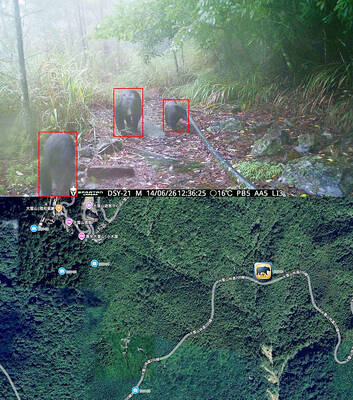
RARE PEEK: The footage released showed one of the bears staying in a cave for as long as 70 days, providing the first record of Formosan black bear’s overwintering The Forestry and Nature Conservation Agency yesterday released tracking records of released Formosan black bears for the first time, showing that they get much closer to human settlements than previously thought. The agency said it had captured two bears, Da Qu-ali (達古阿里) and Aziman (阿里曼), in indigenous villages in Hualien County and began to track them with a camera-mounted satellite collar after releasing them back into the wild. The results confirmed that the bears have moved from deep mountain areas into lowland hills closer to human communities, leading to an increase in human-bear conflicts, it said. The agency has introduced artificial intelligence-assisted early

DIPLOMATIC TOUR: Chinese President Xi Jinping began a series of overseas visits last month to Kyrgyzstan, Egypt and India, aimed at securing leverage, an official said Recent Chinese diplomatic and military moves are aimed at creating pressure ahead of a planned meeting between Chinese President Xi Jinping (習近平) and US President Donald Trump, National Security Council adviser Huang Chung-yen (黃重諺) said. Trump when visiting China in May extended an invitation to Xi to visit Washington on Sept. 24. China is yet to officially announce plans for Xi’s visit to the US. In an interview with the Liberty Times (sister paper of the Taipei Times) on Thursday, Huang said Xi’s overseas visits, China’s “gray zone” activities along the First Island Chain and efforts to expand its trade surplus with the


 RSS
RSS