


After spending 48 years in a wheelchair, writer and national policy advisor Liu Hsia (劉俠), celebrated her 60th birthday yesterday.
Liu, who took the post in the Presidential Office last May, is better known by her pen name Xing Lin Tzu (
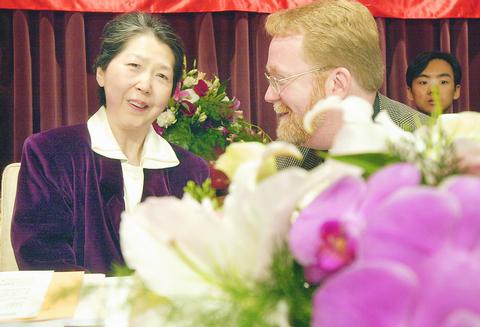
PHOTO: CHIANG YING-YING, TAIPEI TIMES
During her birthday celebration, amongst many of her life-long friends, she called herself a "walking quadriplegic fossil," since she has been suffering from a rare disease for almost five decades.
Though enjoying a high-profile and well-paid position as a national policy advisor for President Chen Shui-bian (
"I think it is a sign that our country is in good shape," Liu quipped.
This is vintage Liu -- permenantly ill and physically suffering -- but with a strong sense of humor and an inspirational attitude toward life.
"She never stops brainstorming," said Lin Chi-ping (林治平), a professor from the Chung Yuan Christian University (中原大學).
"I have known her for more than 30 years. While her bizarre disease may trap her, it seems to me that it never became an obstacle for her and never hindered her from writing beautiful articles and caring about people in need."
The Reverend Maurice Alwyn Sween III, an American missionary who has been residing in Taiwan for the past 15 years, said that Liu often inspires him with fresh ideas toward life.
"Reading her articles helped me calm down, think deeply and remain clear minded toward the challenges in my life," said Sween.
"She has a unique way of looking at things which causes people to see that there can always be hope if you never give up."
Liu's younger brother Liu Kan (劉侃), president of the Home of Victory (
Liu has a rare disease called atrophic arthritis which is related to rheumatoid arthritis. The disease made her a quadriplegic when she was 12 years old, a condition that limited her formal education. Her schooling ended after graduation from the Peitou Elementary School (北投國小) in 1954.
The disease hinders her from being able move around physically, but not from thinking and creating. She has written more than 1,000 short stories and articles.
The malady has destroyed the functioning of nearly 90 percent of her joints and forces her to lie down most of the time and utilize a wheelchair to get around.
The disease remains incurable. She controls the worst symptoms with prescription medication.
Most of Liu's articles are inspirational. She won a National Literature and Art Award with a book in 1982. In addition, her articles have been utilized in elementary and junior high school Mandarin-language textbooks.
Liu's writing also earned her a commendation as one of Taiwan's 10 most outstanding women in 1980. Two years later, she used the award's monetary prize of NT$200,000 to establish the Eden Social Welfare Foundation (伊甸殘障福利基金會) to care for the needs of people who suffer from disabilities.

UPGRADE: The Kang Ding-class frigate is replacing its Chaparall missiles with Tien Chien II and Hua Yang VLS, which would provide it with long-range, 360° air defense Taiwan plans to produce 1,200 to 1,376 Hai Chien II missiles (海劍二, Sea Sword II) — also known as TC-2N — to serve as the standard air defense system of the navy’s surface combatant fleet, a source said yesterday. Last week, the Hai Chien II, the naval version of the Tien Kung II missile (天劍二, Sky Sword II), completed a live-fire test in waters off the National Chungshan Institute of Science and Technology’s Jiupeng facility (九鵬) in Pingtung County’s Manjhou Township (滿州). The MIM72 Chaparral and other dated air defense missiles that currently arm Taiwanese ships have inadequate range to combat Chinese

REASONS FOR TRAVEL: An assistant professor said that proposed amendments to penalize drivers if they used drugs overseas would not deter people from traveling People who operate a motor vehicle under the influence of marijuana would have their driver’s license revoked, even if they used the substance while overseas, the Ministry of Transportation and Communications said yesterday, citing proposed amendments to the Road Traffic Management and Penalty Act (道路交通管理處罰條例). The amendments would also authorize the government to revoke the licenses of people determined to have used Category 1 or Category 2 narcotics, even if they were not operating a vehicle while under the influence of drugs, as well as ban them from taking the license test for three years, the ministry said. People aged 18 or

HEAVY WEATHER: Typhoon Jangmi is due to crash straight into the Ryukyus as airlines look to shift flights to larger aircraft or cancel flights to Okinawa entirely Taiwan’s international air carriers announced flight adjustments over the weekend as Typhoon Jangmi is forecast to hit the Ryukyu Islands today and tomorrow. The Central Weather Administration (CWA) upgraded Jangmi from a tropical storm to a typhoon at 8am yesterday, with the eye located 580km south of Naha city. It was moving north at 19kph. Today, China Airlines’ CI-120, CI-121, CI-122 and CI-123 flights between Taoyuan and Naha, Okinawa, have been canceled as well as CI-132 and CI-133 between Kaohsiung and Naha. EVA Air’s BR-112, BR-113, BR-186 and BR-185 flights between Taoyuan and Naha are also canceled. Low-cost carrier Tigerair Taiwan canceled IT-230,
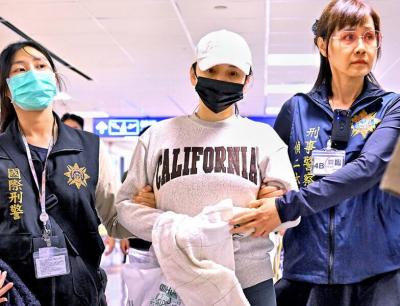
Johanne Liou (劉喬安), a Taiwanese woman who shot to unwanted fame during the Sunflower movement protests in 2014, returned to Taiwan last night after being deported from the US. She is to stand trial in Taiwan for charges involving embezzlement, fraud and drug crimes. The Criminal Investigation Bureau (CIB) said it took her into custody at Taiwan Taoyuan International Airport and would first question her before transferring her to the New Taipei District Prosecutors’ Office. She was arrested upon disembarking a flight from San Francisco that landed shortly before 7pm. Liou absconded to the US in 2019 after jumping bail


 RSS
RSS