

Keith Glass took the balls to serve during the second set of his match against Anthony Fawcett in the 1975 Surrey Grass Court Championships and served, and served and served... and served.
Eighty points — and 37 deuces — later, in which time an adjacent match started and finished, he finally won the game.
He lost the match, fatigue getting the better of him, but gained a place in the record books as having contested the longest single game ever recorded.
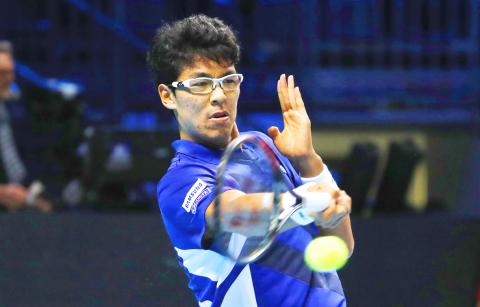
Photo: AP
Such freakish games are rare, but are what make the unique tennis scoring system, with origins in the 16th century, a thing of wonder.
The principal of winning a game by two clear points, or a set by two clear games, is ingrained in the psyche of club hackers and elite pros alike — so much so that the almost ubiquitous deciding set tiebreaks still rankle with many.
Wimbledon remains true to tradition, as demonstrated in 2010 when American John Isner and Frenchman Nicolas Mahut contested the longest match of all time — an 11 hour and 5 minute monster spanning three days in which the 138-game fifth set alone lasted 8 hours and 11 minutes.
Which is why the inaugural Next Gen ATP Finals, which concluded in Milan, Italy, on Saturday, caused such a stir.
The event, showcasing the best players in the world aged 21 and under, ripped an ace through the rulebook with a raft of innovations the ATP says can “reinvent” tennis.
Shot clocks enforced the 25 seconds between points rule, warm-ups were shortened and sets were to four games not six, with tiebreaks at 3-3. Even service lets were scrapped.
The crowd could eavesdrop as players discussed tactics with their coaches via enormous headphones and line judges were replaced by live Hawkeye calling.
Even the court looked different, with doubles lines removed and a huge mock-up of Milan’s La Scala at one end complete with a disk jockey pumping out tunes at changeovers.
It was tennis, but not as we know it.
Gimmicky perhaps, but the sizable crowds loved the rock-and-roll tennis served up by the exciting talents such as Denis Shapovalov, Andrey Rublev and Chung Hyeon — three players tipped to fill the void when Roger Federer and company retire.
The players bought into the experiment, producing some eye-catching duels, but while they were positive to some of the new rules, messing with the scoring system touched a nerve.
The first deuce effectively became a “sudden death” deciding point, meaning games could contain a maximum of seven points, 73 fewer than Glass’s epic.
ATP chief executive Chris Kermode, trying to balance tradition with the task of future-proofing the sport, said the quickfire scoring reduced “dead periods” in matches.
The players, willing guinea pigs, were lukewarm about it.
Rublev said it reduced a tight match to a “lucky dip.”
“With these rules, everyone can beat everyone and I don’t think that’s very fair,” he said. “The winner should be the guy who works harder for it.”
While the best-of-five set format meant players were still required to win 12 games for victory, matches often resembled a series of short sprints.
Missing were the elongated games, the mini-battles that often decide who wins the war.
In this brave new world, the mesmerizing 13-deuce game between Novak Djokovic and Stan Wawrinka in the 2013 US Open semi-final or the 20-minute game won by Steffi Graf in the 1995 Wimbledon final against Arantxa Sanchez Vicario would not exist.
“I think tennis would lose something, it would become more clinical, but they said the same about tiebreaks and they are appreciated now, but I would be sad if they decided this was the way to go,” Glass said.
Kermode said no changes to the scoring would happen in the next five years, but added that in 10 years it was conceivable, saying there had already been interest from tournaments directors of the often-struggling ATP 250 events.
It is unlikely to ever affect Federer, but the 19-time Grand Slam champion, while admitting to enjoying watching developments in Milan, has urged caution, saying it could rob the sport of its variety.
“Longer sets allow you to stretch a lead, try different things,” he said. “You can work on stuff, whereas, when every point counts so much, there’s no room for anything.”
The debate will rage on, but in this time-hungry technological age, tennis cannot afford to stand still.
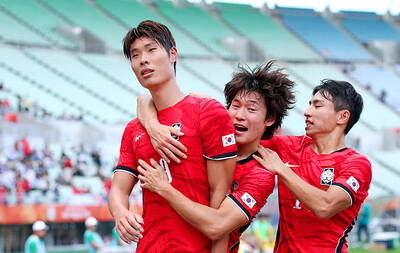
Reigning champions South Korea yesterday struck with eight minutes left to seal a 2-1 win over a “proud” China to reach the Asian Games men’s soccer final. The South Koreans are to face either hosts Japan or Uzbekistan for gold on Saturday as they pursue a fourth consecutive title. Uzbekistan and Japan were tied 1-1 as of press time last night. Bae Jun-ho was their hero, ghosting in at the back post to head in a dramatic 82nd-minute winner at Nagai Stadium. Men’s soccer at the Asian Games consists of under-23 squads with three overage players. “We were expecting a challenging match but we persevered,”
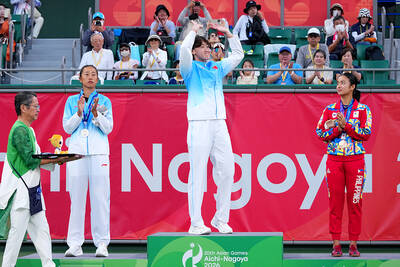
China’s Wang Xiyu, fresh from conquering top seed Alexandra Eala, toppled Zhang Shuai to win Asian Games women’s tennis singles gold yesterday — and a ticket to the Los Angeles Olympics. The 25-year-old Wang breezed past her compatriot 6-2, 6-1 in 66 minutes at the Higashiyama Park Tennis Center in Nagoya. Tennis is one of seven sports at the Games where the winners receive an Olympic qualification place. Wang paid tribute to the 37-year-old Zhang, who has won multiple Grand Slam doubles titles and has now added a second Asian Games singles silver medal to the one she won in 2018 in
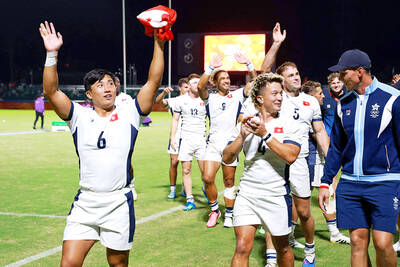
Hong Kong’s men’s rugby sevens team romped to a third consecutive Asian Games gold with a dominant display in a 26-0 victory over China yesterday. Wing Harry Sayers scored a pair of first-half tries, added to by Dafydd Phillips to put Hong Kong in charge 21-0 at the break. When flying wing Juan Esono Mba Oyana scored Hong Kong’s fourth try straight from the second-half kick-off the result was beyond doubt. “Amazing, amazing. The Asian Games has been a dream of mine for so long now,” said Sayers. Hong Kong’s success was built not only on scoring prowess but also a defense that conceded
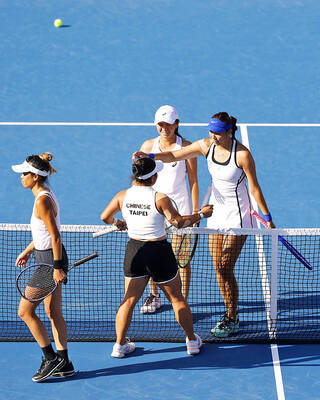
Taiwanese tennis players Hsieh Su-wei and Chan Hao-ching on Saturday revived their feud at the Asian Games, with Chan fuming at Hsieh for a handshake snub at the end of their women’s doubles final in Nagoya, Japan. The pair last month did not shake hands following a tense US Open doubles match in which Hsieh’s playing partner Jelena Ostapenko roared at Chan’s coach, who is also her older sister, in the player’s box after sealing victory. The Taiwanese rivals later traded barbs on social media about the incident. Chan on Saturday said she had been willing to put all that


 RSS
RSS