


During Bawitha Tling’s tumultuous journey fleeing war and forced labor in Myanmar — first to a Malaysian refugee camp and eventually to Philadelphia — one of the few constants in his life was soccer.
“We played every day in our country at school ... in recess time or after school,” Tling said. “I came here, and play every day, every weekend. Soccer is my favorite way to relax myself, to escape depression.”
Tling, 18, now a business major at a community college, is one of about 800 players participating in a newly created soccer tournament for immigrants organized by the city of Philadelphia. The 32 teams represent countries from India to Ireland and Cambodia.
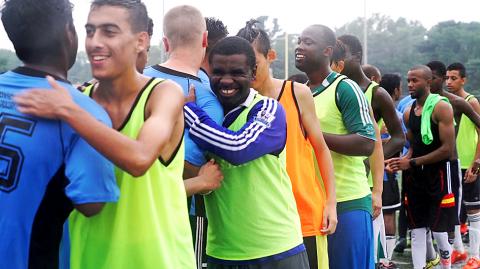
Photo: AP
In the months leading up to the tournament, named the Unity Cup, they have been practicing several times a week and holding dozens of friendly matches.
Interest in the inaugural event was strong. Within five days of opening registration, all the team slots were taken, with captains delivering commitment letters by hand to the city’s Office of Immigrant Affairs.
“There were people waiting outside the office before they opened at 8 o’clock in the morning,” said Bill Salvatore, Unity Cup organizer with the city’s Department of Parks and Recreation. “It was pretty intense.”
Philadelphia’s foreign-born population has been booming, growing from barely 100,000 in 1990 to more than 200,000 this year — about 13 percent of the population, according to a report by the Pew Charitable Trusts.
Still, the city’s professional soccer team, the Union, gets only a fraction of the attention showered on its football and baseball franchises.
The Unity Cup championship is to be held on Nov. 5 at Citizens Bank Park, home of Major League Baseball’s Philadelphia Phillies, and city officials expect at least 5,000 people to attend. The winning team is to receive a trophy modeled on the National Hockey League’s Stanley Cup, with names of the victors engraved each year.
Organizers are planning an international festival in the stadium’s parking lot, with food trucks, craft stalls and performances.
The Unity Cup is the brainchild of Philadelphia Mayor Jim Kenney, who said he got his inspiration from the FIFA World Cup.
“Remember, soccer is in every neighborhood,” said Kenney, a descendant of Irish immigrants fleeing famine. “The trash talking and the competitions already started between Mexico and Italy, between the Irish and the Polish, the Germans are calling out the Senegalese — I mean it’s awesome, it’s going to be fun.”
The teams are not restricted by nationality, either. The Indian team has players from Uzbekistan, Bangladesh, Morocco and Egypt — giving Indian players a chance to build comradery with other immigrants, not just play against them.
“I really enjoy meeting new guys, forming new networks. The game is a really beautiful game for bringing people together,” said Thorne Holder, a Trinidadian living in Philadelphia and the goalkeeper for team Germany. “Soccer is a team sport. I think that’s what gives it its allure — friends, friendship, common interests.”
Immigrants have long played soccer through grassroots organizations, but the Unity Cup appears to be the first immigrant soccer tournament organized by a government body in the US, according to city officials and US Soccer, the national body.
Demand has been so high that plans are already being drawn up for next year, with the potential for knockout preliminary rounds by continent — Africa, Asia, Europe and the Americas — to accommodate more teams.
The city envisions the Unity Cup will become a yearly event, Salvatore said.
Players are enthusiastic about the chance to chat with people from ethnic enclaves all over Philadelphia whom they never would have met otherwise.
“It’s like family,” said India team captain Matthew Varughese, an engineer who moved to the US as a child. “We’re not competing for money... We’re like brothers. It’s good, it’s fun, you know — it’s family.”

Luka Doncic on Monday scored 36 points as the in-form Los Angeles Lakers powered to their sixth straight victory with a 100-92 defeat of the Houston Rockets. A crucial showdown between the third and fourth-ranked NBA Western Conference teams ended with the Lakers pulling away in the final minute of the fourth quarter to claim an impressive win on the road. The victory gives the Lakers (43-25) a valuable cushion over the Rockets (41-26) as they jostle for post-season positions in the West. Doncic was once again instrumental in dragging the Lakers over the line while a hard-nosed defensive effort
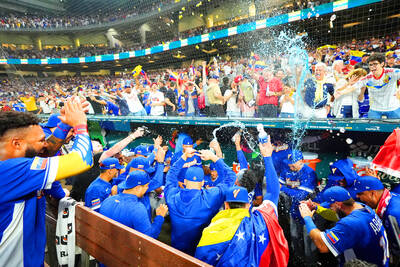
‘THAT’S US’: Before each WBC game, Venezuelan players gather around a drum in the dugout for the tambor, coastal Afro-Venezuelan music and dance Venezuelan players on Monday night danced in the dugout before the first pitch, then pranced past Italy and into their nation’s first World Baseball Classic (WBC) final. Ronald Acuna Jr, Maikel Garcia and Luis Arraez hit run-scoring, two-out singles in a rapid seventh-inning rally that sparked a 4-2 victory and vaulted Venezuela into a title matchup against the US. Players celebrated in the clubhouse before quickly turning focus to the final. “A lot of dancing,” Garcia said. “We have to show the world who Venezuela is.” Before each WBC game, Venezuelan players gather around a drum in the dugout for

Japan’s national baseball team manager Hirokazu Ibata has said he would step down following Japan’s 8-5 loss to Venezuela in Miami in the quarter-finals of the World Baseball Classic. The newspaper Sports Hochi reported Ibata saying it was his “intention to resign.” Japan are the defending champions and had won the event three times. It marked Japan’s first failure to reach the WBC semi-finals despite a team stacked with MLB talent including Shohei Ohtani. “The result is everything,” Sports Hochi reported Ibata as saying. “Although we lost this time, I hope Japan will grow stronger and win next time.” Japan

Retired NBA big man LaMarcus Aldridge, a seven-time All-Star, is to visit Taiwan early next month for the first time to promote an NBA event, the league’s Taiwan Web site said on Monday. During his visit, Aldridge would meet fans on April 4 and 5 at Banciao Stadium in New Taipei City during the Rising Stars Invitational Taiwan Regional Qualifiers, NBA Taiwan wrote on Facebook. Tickets became available on FamiTicket on Monday at noon and can be reserved until 11:59pm on March 31, with a maximum purchase of two tickets per person, it said. The tickets are divided into three


 RSS
RSS