

Detectives were investigating allegations that a British player at the Wimbledon tennis tournament was poisoned, after she fell ill with a bacterial infection that can be spread through rat urine, London’s Metropolitan Police said on Thursday.
Gabriella Taylor was playing in Wimbledon’s junior tournament when she became sick on July 6 and had to drop out.
Her family says she was diagnosed with leptospirosis, a bacterial infection spread by animals.

Photo: AP
Her mother, Milena Taylor, told the Daily Telegraph newspaper that the 18-year-old athlete was hospitalized in intensive care and that “the bacteria the infection team found is so rare in Britain that we feel this could not have been an accident.”
She said Gabrielle “was staying in a completely healthy environment” during the tournament and would not likely have been accidentally exposed to the bacteria.
London’s Metropolitan Police said detectives were investigating “an allegation of poisoning with intent to endanger life” or cause bodily harm.
It said the incident was “alleged to have taken place at an address in Wimbledon” between July 1 and July 10.
The force said no one had been arrested and police are awaiting medical information about what, if any, poison was involved.
Britain’s National Health Service says leptospirosis is uncommon in the UK, with fewer than 40 cases reported per year. It can be caught by touching soil or water contaminated with the urine of infected animals, including cattle, pigs, dogs and particularly rats.
It usually causes mild flu-like symptoms, but in some cases can lead to organ failure and internal bleeding.
Scientists cast doubt on suggestions that Taylor was deliberately infected with the bug.
Kimon Andreas Karatzas, assistant professor of food microbiology at the University of Reading, said it might be difficult to track down the source of the infection because leptospirosis has a long incubation period. It takes between five and 14 days, and in rare cases up to a month, before symptoms appear.
And he said the rare bacterium was not an obvious candidate as a poison.
“There are other bacteria that are much easier to find,” such as salmonella, often found in raw chicken,” Karatzas said.
“Trying to find leptospirosis, it’s a much more difficult task,” Karatzas said.
David Mabey, professor of communicable diseases at the London School of Hygiene and Tropical Medicine, said that leptospirosis “is not a bug you can grow in the lab” and is most often caught by swimming in contaminated water.
“If you were wanting to poison someone, this would be an extremely roundabout way of going about it,” Mabey said. “You’d have to catch a rat, make sure it was infected and get it to pee in her bathwater or something.”
Taylor on Wednesday tweeted a picture of herself on a tennis court with the caption: “So happy to be back on court!! Taking it step by step!”

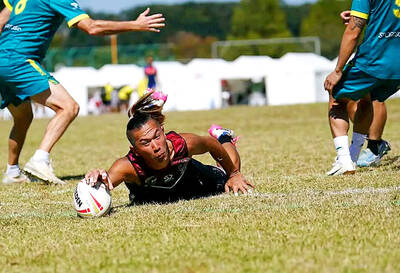
TOUCH Taiwan team dominated Taiwan’s men’s over-45 team are winless so far at the Asia Pacific Seniors Touch Cup in Japan over the past few days. Taiwan face New Zealand, England, Japan and Australia in the grade, one of nine at the Federation of International Touch-run tournament in Utsunomiya. Taiwan opened their campaign with a 14-1 loss to New Zealand on Wednesday before falling 12-0 to England later on the first day. The challenge continued on day two yesterday. Taiwan were defeated 10-0 by the hosts before taking on Australia, one of the sport’s traditional powerhouses, losing 14-1. In a second meeting

NBA superstar LeBron James on Thursday delivered a solid first half in his first pre-season game for Philadelphia, although the new-look 76ers fell 114-108 to the New York Nets in Brooklyn. James, the NBA’s all-time leading scorer, in July announced that he had signed a two-year, US$8 million deal with the 76ers, ending weeks of speculation over where the four-time NBA champion would land as a free agent after eight seasons and one title with the Los Angeles Lakers. The 41-year-old, entering a record-extending 24th NBA season, won two titles with the Miami Heat, another with the Cleveland Cavaliers and a fourth
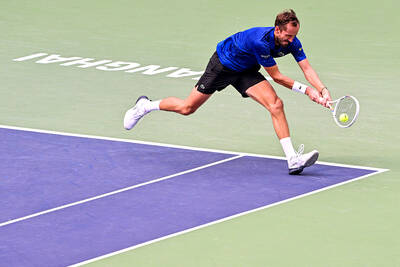
SHOCK KNOCKOUT: US Open finalist Ben Shelton was caught off-guard by Arthur Gea yesterday, after skipping the Japan Open, which ended last week, due to fitness concerns Daniil Medvedev has won his first match since being disqualified at the China Open for hitting a spectator in the eye with a ball he hit into the stands. Medvedev beat Jan-Lennard Struff 4-6, 6-4, 6-3 in a second-round match on Saturday at the Shanghai Masters, an ATP 1000 tennis event. Medvedev, who now holds a 10-2 career edge over Struff, had been disqualified during his semi-final on Monday last week against Novak Djokovic for hitting the spectator with a ball the Russian player had hit into the stands at Beijing. Medvedev, who apologized after the incident, saying it was an accident, lost
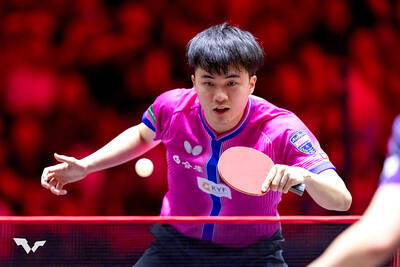
COMPETiTIVE FINISH: Powering through the tournament in China, Lin Yun-ju finished second, losing in the final to the world No. 1 in a close-fought match Taiwan’s Lin Yun-ju finished second in the men’s singles at the World Table Tennis (WTT) China Smash on Sunday in the final against world No. 1 Sora Matsushima of Japan. Lin, the world No. 6, recovered from a loss in the first two games to take a 3-2 lead, but was overtaken by Matsushima, who won the match 4-3. In the 55-minute final at Shougang Park in Beijing, Lin finished as the runner-up, with game scores of 7-11, 9-11, 11-7, 11-8, 11-5, 7-11, 9-11. Lin entered Sunday’s final with a 6-1 career record against Matsushima, although the Japanese player had won their


 RSS
RSS