


After 26 years guiding Manchester United, Alex Ferguson knows better than most that one should always think carefully before breaking up a winning team. Perhaps that helps explain why he donated money to the campaign urging voters in his native Scotland to say “no” to independence in the historic ballot this week.
Because, when teamed together in sports — notably at the Olympics — Scottish, English, Welsh and Northern Irish athletes are proven winners, often a world-beating combination. Britain’s most decorated Olympian is a Scot, track cyclist Chris Hoy. Fact is, if the Scots pull out, what remains of Team Great Britain will not be quite so great.
The future of sports in Scotland and how competitive it might be as an independent nation probably will not be foremost on voters’ minds today. They have got bigger questions — Can we keep the pound sterling? Remain in the UN, the EU and NATO? Finance and defend ourselves? — to weigh in the potential break-up of their 307-year-old union with England.
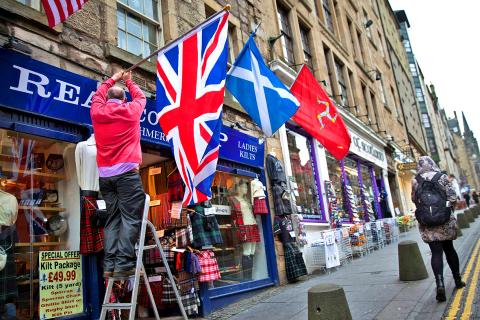
Photo: Bloomberg
Some athletes might jump at the chance to compete with the Saltire, the Scottish flag, on their jerseys and hear Flower of Scotland played at medal ceremonies.
“We believe very strongly that the prize of being an athlete competing for the first time for Team Scotland in the Olympics and Paralympics will be something that is hard to resist for the vast majority of athletes,” pro-independence Scottish politician Shona Robison said.
Robison, who also serves as the Scottish government’s minister for sport, was speaking in a telephone interview.
For Scots teamed with non-Scots, who get British funding and train in England with non-Scots coaches, unpicking such links could be tough. Athletes will not be forced to join Team Scotland, so some might prefer to stick with the “status quo” in Team Great Britain, if they can, as the easier and possibly safer option.
Take Luke Patience, one of Britain’s top Olympic sailors. Born in Aberdeen, Scotland, his partner in the 470 class of dinghies is Elliot Willis, from Kent in southern England.
They are competing this week at the world championships in Spain, a qualifying event for the 2016 Olympic Games in Rio de Janeiro. Patience won Olympic silver teamed with another Englishman, Stuart Bithell, at the 2012 London Games. As a potential top competitor for Great Britain in 2016, Patience also gets a slice of the £25 million (US$40 million) Britain’s funding body for elite sport allotted to sailing to harvest more medals in Rio.
Would Patience give up all this to represent an independent Scotland? He would not comment.
“Sorry, it is not something that I wish to speak about during my Worlds. Perhaps afterwards,” he said on Twitter in response to reporters’ questions.
Still, it sounds anything but a straightforward choice.
“Great Britain has a lot more strength than Scotland does, just from pure numbers,” said Susan Egelstaff, who competed in badminton both for Scotland and, at the London Games, for Great Britain.
She also spoke to reporters in a telephone interview.
“If I was in a team with English people, I’d be worried about Scotland going independent,” she said.
And if Scots become Olympic adversaries, instead of allies, would English coaches still work and share training secrets with them?
One of the coaching wizards behind all six of Hoy’s Olympic golds — from Athens in 2004, Beijing in 2008 and in London — was an Englishman who grew up in Wales, Dave Brailsford. He oversaw the so-called “marginal gains” philosophy that helped turn British cyclists into Olympic champions — the idea being that many small improvements, even minutiae like making athletes wash their hands properly to prevent illness, can all add up to big performance gains.
Hoy is retired. When the next Hoy comes along, it would be self-defeating for Great Britain to help him or her, or any Scottish adversary, if they are going to compete for an independent Scotland.
“A lot of Scottish athletes train down south. Would that be open to them if Scotland became independent, if Scotland was a separate country?” Egelstaff asked.
“You would guess England probably wouldn’t be quite as accommodating,” she said.
Robison argued against concerns that athletes in an independent Scotland could want for funding, coaching and facilities, saying: “We will make sure that our athletes absolutely receive the support that they require to enable them to compete at the highest level.”
Just since World War II, Britain has collected more than 400 medals at summer Olympics, dozens of them won by Scots. That is a rich history of shared achievement and emotion.
For those growing up south of the border, it will barely have registered that the likes of Allan Wells, 100m champion at the 1980 Moscow Games, and swimming triple medalist David Wilkie were Scots. To many Britons, they were simply British champions. And the story of flying Scotsman Eric Liddell, 400m champion in 1924, will have moved anyone who watched Chariots of Fire, not simply moviegoers north of the border.
Sporting success makes countries feel good about themselves. The same will be true for Scotland if it becomes independent. Scottish medalists in Rio or later games will be nation builders. For this reason, if Scotland votes “yes,” we should all wish them well.
“The history, whether that’s sporting or otherwise, that has been shared is not something we want to dismiss in any way. It’s just that we want, going forward, to start a new period, a new story, a new chapter of Scotland’s future,” Robison said.
Because this would be a peaceful separation, without the bloodshed that divided other nations and led to the likes of Serbia or Croatia now fielding separate Olympic teams, it would be nice to think that Britons would still cheer for their Scottish cousins, at least for old times’ sake.
Unless, of course, they are competing against Britain.
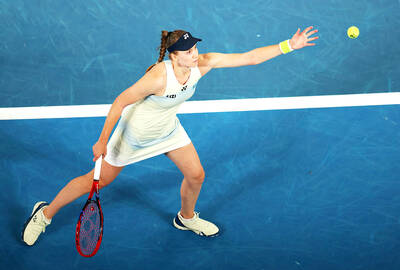
HEATED RIVALRY: The pair had met 14 times previously, with Sabalenka winning eight of the encounters and entering the final as the favorite to take the title Elena Rybakina took revenge over world No. 1 Aryna Sabalenka to win a nail-biting Australian Open final yesterday and clinch her second Grand Slam title. The big-serving Kazakh fifth seed held her nerve to pull through 6-4, 4-6, 6-4 at Rod Laver Arena in Melbourne in 2 hours, 18 minutes. It was payback after the Belarusian Sabalenka won the 2023 final between two of the hardest hitters in women’s tennis. The ice-cool Rybakina, 26, who was born in Moscow, adds her Melbourne triumph to her Wimbledon win in 2022. It was more disappointment in a major final for Sabalenka, who won the US Open
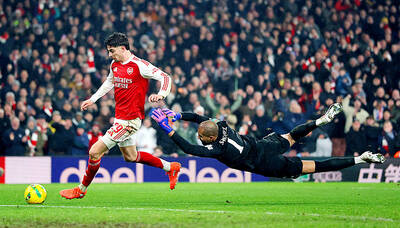
GUNNING FOR A WIN: The victory sending Arsenal to the final for the first time in six years was cathartic for a team who had lost their previous four semi-finals Arsenal on Tuesday reached the League Cup final for the first time in eight years as Kai Havertz sealed a 1-0 win against Chelsea in the semi-final second leg. Mikel Arteta’s side had put themselves in pole position in the first leg and Havertz came off the bench to finish the 4-2 aggregate victory in the closing moments at the Emirates Stadium. It was a cathartic triumph for the Gunners, who had lost their previous four semi-finals in last year’s UEFA Champions League and League Cup, the 2022 League Cup and the 2021 UEFA Europa League. In their first final for six years,

Denver superstar Nikola Jokic returned from a 16-game injury absence to post a 31-point, 12-rebound double-double on Friday and propel the Nuggets to a 122-109 NBA victory over the Los Angeles Clippers. Three-time NBA Most Valuable Player Jokic had not played since suffering a bone bruise in the left knee he hyperextended in a game against Miami on Dec. 29 last year. The Serbian big man did not miss a beat. He led all scorers, connecting on eight of 11 shots from the field, and also handed out five assists with three steals while playing just 24 minutes, 32 seconds as the

DEADLINE DAY: Rennes’ Jacquet had been linked with a transfer to Chelsea earlier this month, but was reportedly put off the move due to the Blues’ bloated squad Liverpool on Monday won the race to sign Stade Rennais defender Jeremy Jacquet on the quiet final day of the English Premier League transfer window, while Crystal Palace swooped for Wolverhampton Wanderers striker Jorgen Strand Larsen despite the collapse of Jean-Philippe Mateta’s move to AC Milan. The Reds agreed a reported fee of up to £60 million (US$82 million) for the highly rated Jacquet. However, the 20-year-old will not join the Premier League champions until the summer despite Liverpool’s need for defensive reinforcements. Jacquet had been linked with a transfer to Chelsea earlier this month, but was reportedly put off


 RSS
RSS