


The Olympics have weathered world wars, boycotts and corruption scandals. These days, the International Olympic Committee (IOC) has a new crisis on its hands: finding cities willing to host the Games.
The troubled race for the 2022 Winter Olympics is a case in point. High costs and internal political opposition prevented several potential contenders not to bid. Two candidate cities withdrew and two others could still drop out.
The way things are going, the winner could be decided next year by default. Take the Games, please.
“I have not seen anything like this before,” senior Norwegian IOC member Gerhard Heiberg said. “This is urgent. We need to sit down and discuss what is going on. We are at a crossroads here.”
It is a challenge the IOC and new IOC president Thomas Bach need to resolve quickly to ensure the long-term viability of the world’s most prized sports event.
Changes to the bidding process and efforts to reduce the cost of the Games are among the key issues being addressed by the IOC as part of Bach’s “Agenda 2020,” his blueprint for the future of the Olympic movement that will be voted on in December.
Watching closely are countries and cities considering whether to bid for the even bigger and more expensive Summer Olympics of 2024.
The financial burden is worrying potential host cities. Specifically, the US$51 billion price tag associated with February’s Winter Olympics in Sochi. Olympic officials say most of that huge sum went to long-term projects and that the operations costs of the Olympics were no higher than previous Games.
No matter. The public perception is that the Games cost too much.
Concerns over Rio de Janeiro’s delayed preparations for the 2016 Olympics have further dampened enthusiasm for hosting the Games.
The Olympics continue to succeed as a spectacle, with huge audiences on television and online. However, the field for 2022 has taken one hit after the other.
Munich and St Moritz-Davos withdrew planned bids when voters in Germany and Switzerland voted “no” in referendums. Stockholm, one of the five declared candidates, pulled out in December last year after the city government declined to offer financial backing. On Monday, Krakow, Poland, dropped out after 70 percent of voters rejected the bid in a referendum.
That leaves four cities in contention for now: Almaty, Kazakhstan; Beijing, China; Lviv, Ukraine; and Oslo, Norway.
The bid from Lviv has been on hold because of the turmoil in Ukraine.
It is possible that only three bids will still be in play when the IOC executive board meets in Lausanne, Switzerland, from July 7-9 to decide which cities go to the final stage. Rather than cut the field, the board would likely keep the remaining three. The host city is to be selected by the full IOC in Kuala Lumpur, Malaysia, on July 31 next year.
Most worrying for the IOC is the uncertain status of the Oslo bid. Polls show 60 percent of Norwegians are opposed. One of the two parties in the governing coalition came out against the bid earlier this month. The government will not decide until the autumn whether to provide the required financial guarantees.
Amid all the instability, Almaty and Beijing stand as the most solid bids.

Nottingham Forest FC are to go into the Europa League play-off round after a 4-0 win over Ferencvaros TC on Thursday, while Celtic FC secured their place in the knockout phase with a victory over FC Utrecht. Aston Villa FC finished second in the league phase after recovering from two goals down to beat FC Red Bull Salzburg 3-2 with their spot in the last 16 already assured. Forest stood an outside chance of climbing into the top eight going into the final round of matches, but needed to beat Robbie Keane’s Ferencvaros and rely on other results going their way. Sean Dyche’s

HEATED RIVALRY: The pair had met 14 times previously, with Sabalenka winning eight of the encounters and entering the final as the favorite to take the title Elena Rybakina took revenge over world No. 1 Aryna Sabalenka to win a nail-biting Australian Open final yesterday and clinch her second Grand Slam title. The big-serving Kazakh fifth seed held her nerve to pull through 6-4, 4-6, 6-4 at Rod Laver Arena in Melbourne in 2 hours, 18 minutes. It was payback after the Belarusian Sabalenka won the 2023 final between two of the hardest hitters in women’s tennis. The ice-cool Rybakina, 26, who was born in Moscow, adds her Melbourne triumph to her Wimbledon win in 2022. It was more disappointment in a major final for Sabalenka, who won the US Open

Denver superstar Nikola Jokic returned from a 16-game injury absence to post a 31-point, 12-rebound double-double on Friday and propel the Nuggets to a 122-109 NBA victory over the Los Angeles Clippers. Three-time NBA Most Valuable Player Jokic had not played since suffering a bone bruise in the left knee he hyperextended in a game against Miami on Dec. 29 last year. The Serbian big man did not miss a beat. He led all scorers, connecting on eight of 11 shots from the field, and also handed out five assists with three steals while playing just 24 minutes, 32 seconds as the
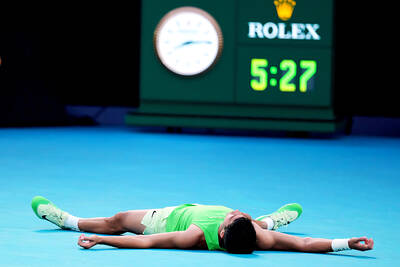
BATTERED AND BRUISED: Alcaraz suffered a cramp in the third set, but was allowed treatment despite Zverev’s protests, and continued on to win in five-and-a-half hours An ailing Carlos Alcaraz battled past Alexander Zverev yesterday in five epic sets to reach his first Australian Open final and move within a match of becoming the youngest man to complete a career Grand Slam. The world No. 1 outlasted the German third seed 6-4, 7-6 (7/5), 6-7 (3/7), 6-7 (4/7), 7-5 over a titanic 5 hours, 27 minutes in hot conditions to head to tomorrow’s title match. He only narrowly avoided crashing out after a huge fright at 4-4 in the third set when he pulled up in pain with what appeared to be cramp. He was allowed to have treatment


 RSS
RSS