


On the eve of the Sochi Winter Olympics, the World Anti-Doping Agency (WADA) has condemned evidence of the availability in Russia of a new, undetectable muscle-growth drug as “shocking.”
German broadcaster WDR, which has a strong track record in investigating doping in sport, sent undercover reporters to meet a scientist from the Russian Academy of Sciences in Moscow. The journalist was offered a drug called Full Size MGF, which is currently being tested legitimately in Russia on animals by scientists investigating its biochemical effects.
The scientist reportedly told the journalist that the drug “works two times faster than a normal muscle tonic and cannot be detected by the doping authorities.”
The undercover reporter, who was given 1mg of the drug to test, was then told that it would cost 100,000 euros (US$135,000) to “prepare” an athlete adequately for the Winter Games.
Question marks over the willingness of the Russian authorities to clamp down on doping were a recurring theme in the run-up to last year’s World Athletics Championships in Moscow and this year’s Winter Olympics, which begin in Sochi tomorrow.
Senior International Olympic Committee sources are convinced that, following warnings four years ago in Vancouver from then-committee president Jacques Rogge, the Russians are now taking the problem seriously. They also cite as key deterrents the stringent testing program around the Games and the ability to keep frozen samples for a decade to be retested at a later date as new techniques are discovered.
However, WADA director-general David Howman said it would be “naive” not to suspect that some athletes would be cheating.
“It would be naive to believe that all athletes in Sochi are clean. There are many who are convinced that the substance they’re taking cannot be detected,” he told WDR. “It is shocking that a scientist would offer substances that have never been tested in people. The athletes are the experimental animals.”
Following tests in Germany that confirmed the drug’s authenticity, doping expert Mario Thevis from the WADA-accredited test laboratory at the German Sports University said it would be in high demand and could be used to accelerate intensive muscle growth.
“It is similar to the IGF 1 growth factor and is classified as very highly effective,” Thevis said.
The committee has promised “the most stringent anti-doping program in the history of the Winter Olympics” at the Sochi Games.
A spokesman said that 2,453 tests would be carried out during the Games, a 14 percent increase on the number carried out in Vancouver four years ago. A further 1,184 targeted tests will be carried out post-competition, with a focus on “higher-risk” sports and team sports such as ice hockey.
Two Russian biathletes, including Irina Starych, who finished sixth overall in the World Cup standings, tested positive at the beginning of this week. Starych, who has asked for her B sample to be tested, was replaced in the Olympic team.
Russian Anti-Doping Agency managing director Nikita Kamaev told the Associated Press this week that it conducted 20,000 tests a year and had dramatically increased the number of “intelligent” targeted tests.
He said the result was an almost 70 percent year-on-year increase in positive cases to about 180 last year, showing that its crackdown was working.
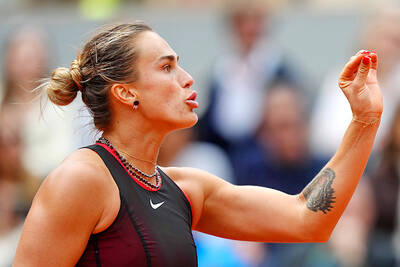
After letting another big lead slip with an error-strewn performance at the French Open on Wednesday, top-ranked Aryna Sabalenka felt like getting as far away from the courts as possible. “Just want to quit tennis right now,” Sabalenka said after wasting a lead of a set and two breaks in a 3-6, 7-5, 6-0 loss to Diana Shnaider in the women’s singles quarter-finals. “We’ll see in few days. Hopefully I’ll get back on track mentally.” Sabalenka’s wait for a first French Open title continues despite the four-time major winner leading 4-1 in the second set and being two points from victory while

BIG NAMES GONE: Zverev is the clear favorite for a maiden Grand Slam title, reaching semi-finals for the fifth time in six years and finishing second on three occasions Alexander Zverev on Tuesday breezed past Rafael Jodar to stay on course for an elusive Grand Slam title at the French Open, while Jakub Mensik halted Joao Fonseca’s scintillating run in the quarter-finals. Zverev, the highest-ranked player left in the men’s draw, put an end to Spanish teenager Jodar’s impressive Roland Garros debut, easing into the semi-finals with a 7-6, (7/3), 6-1, 6-3 win. The 29-year-old Zverev is the clear favorite for a maiden Grand Slam title. He has finished runner-up on three occasions, including at the 2024 French Open. “I want to win the matches that are ahead of

For some, Cristiano Ronaldo remains the essential spearhead for Portugal’s FIFA World Cup bid, while others believe his presence would prevent Roberto Martinez’s strong side from flourishing. The debate around the five-time Ballon d’Or winner rages on, as it did at UEFA Euro 2024 and four years ago in Qatar — yet Ronaldo endures, ready to play in a record sixth World Cup. The 41-year-old remains a global superstar despite swapping the European elite for Saudi Arabia’s Al-Nassr, and is the leading men’s international goalscorer with 143 strikes. With 25 of those coming in 30 games under Martinez, the coach

Taiwanese sprinter Chen Yi-cen on Friday won the silver medal in the women’s 400m final at the Asian U20 Athletics Championships in Hong Kong, with a time of 53.16 seconds. Chen, 15, was the youngest among the eight finalists, and her performance also met the qualifying standard of 53.50 seconds for the Nagoya Asian Games in Japan in September and October. Chen first made her mark at the National Games in Tainan in 2023, at the age of 13, winning the women’s 400m final in 55.55 seconds to become the youngest gold medalist in the history of the event. Meanwhile,


 RSS
RSS