


Japan’s police chief has vowed to smash the murky links between sumo and yakuza organized crime after a widening scandal over illegal gambling led to the arrest of a former wrestler.
The biggest scandal to tarnish Japan’s ancient national sport in years has led big-name sponsors to pull out millions and put in doubt whether national broadcaster NHK will show the summer tournament next month.
Governing body the Japan Sumo Association has said 29 unnamed wrestlers had admitted to illegal gambling, although media reported that 36 others also had bet on cards, baseball, golf and other pursuits.
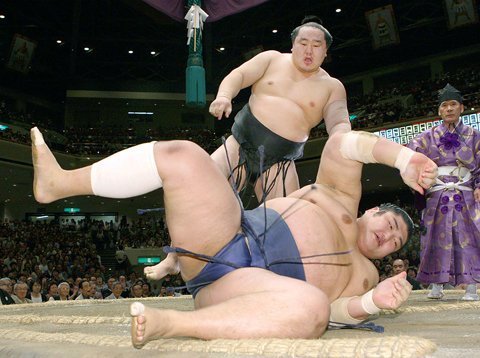
PHOTO: AFP
As investigators seek to untangle the links between the big boys of sumo and the bad boys of the Japanese mafia, police on Thursday arrested a former wrestler, Mitsutomo Furuichi, 38, on extortion charges.
Furuichi, who reportedly told police that he is a former gangster, allegedly demanded hush money from a sumo wrestler who had been involved in widespread gambling on baseball matches and other sports.
“He is suspected of blackmailing the victim ... and received ¥3.5 million [US$39,000] in cash,” a police spokesman said.
Media reported the victim of the extortion attempt was wrestler Kotomitsuki — ranked second only to the yokozuna, or grand champion.
“We have to clean yakuza crime links out of the sumo world,” National Police Agency chief Takaharu Ando said after the latest news to tarnish the sport that has been at the heart of Japanese culture for 2,000 years.
Those links became apparent last month when sumo officials were disciplined after it emerged that they had given ring-side seats at a sumo tournament to top bosses of the Yamaguchi-gumi, Japan’s largest crime group.
Because NHK broadcasts of tournaments are shown in Japan’s prisons, the ring-side seats allowed crime bosses to send a silent message of support to their members doing time behind bars, commentators said.
The sumo association censured those who made the tickets available to the gangsters — but the case highlighted connections between two of Japan’s most macho and mystery-shrouded institutions.
Sumo, based on ancient Shinto rituals, puts its wrestlers through punishing workouts and an austere and strictly hierarchical lifestyle in the isolation of their “sumo stables.”
Once populated by tough country boys, and increasingly by foreign-born wrestlers, it is a world of 3am roll calls and grueling workouts where only the toughest fighters last to reach the top.
About 90 percent of stables have allowed beatings of trainees and punishments such as forcing salt or sand into their mouths, the sumo association has said.
Many Japanese were shocked by the 2007 case of a stable master who ordered the “hazing” of a 17-year-old wrestler who died after being beaten with a beer bottle and a baseball bat. The stable master was jailed.
While sumo is a tough and cloistered world of male athletes, the true bad boys of Japan have long been the yakuza, whose heavily tattooed gangsters have spawned numerous movies, manga comics and fanzines.
The yakuza, who trace their roots to samurai gone astray during the 17th-century Edo period, traditionally relied on gambling, prostitution, loan-sharking and protection rackets as their bread and butter.
In recent decades they have turned to money laundering, deposit fraud, cybercrime and extorting huge sums from blue-chip companies by threatening to show up at their shareholder meetings.
They have operated relatively openly, entertaining close ties with politicians, and police have tolerated their existence as long as they have stayed on their turf and kept down street crime.
Amazingly for outsiders, yakuza groups themselves are not illegal and openly operate from large corporate headquarters.
Japanese organized crime counts about 82,600 members, according to the National Police Agency — nearly half of them with the Kobe-based Yamaguchi-gumi, dubbed the “Wal-Mart of crime syndicates.”

Bayer 04 Leverkusen go into today’s match at TSG 1899 Hoffenheim stung from their first league defeat in 16 months. Leverkusen were beaten 3-2 at home by RB Leipzig before the international break, the first loss since May last year for the reigning league and cup champions. While any defeat, particularly against a likely title rival, would have disappointed coach Xabi Alonso, the way in which it happened would be most concerning. Just as they did in the Supercup against VfB Stuttgart and in the league opener to Borussia Moenchengladbach, Leverkusen scored first, but were pegged back. However, while Leverkusen rallied late to

If all goes well when the biggest marathon field ever gathered in Australia races 42km through the streets of Sydney on Sunday, World Marathon Majors (WMM) will soon add a seventh race to the elite series. The Sydney Marathon is to become the first race since Tokyo in 2013 to join long-established majors in New York, London, Boston, Berlin and Chicago if it passes the WMM assessment criteria for the second straight year. “We’re really excited for Sunday to arrive,” race director Wayne Larden told a news conference in Sydney yesterday. “We’re prepared, we’re ready. All of our plans look good on

The lights dimmed and the crowd hushed as Karoline Kristensen entered for her performance. However, this was no ordinary Dutch theater: The temperature was 80°C and the audience naked apart from a towel. Dressed in a swimsuit and to the tune of emotional music, the 21-year-old Kristensen started her routine, performed inside a large sauna, with a bed of hot rocks in the middle. For a week this month, a group of wellness practitioners, called “sauna masters,” are gathering at a picturesque health resort in the Netherlands to compete in this year’s Aufguss world sauna championships. The practice takes its name from a

When details from a scientific experiment that could have helped clear Russian figure skater Kamila Valieva landed at the World Anti-Doping Agency (WADA), the leader of the organization’s reaction was unequivocal: “We have to stop that urgently,” he wrote. No mention of the test ever became public and Valieva’s defense at the Court of Arbitration for Sport (CAS) went on without it. What effect the information could have had on Valieva’s case is unclear, but without it, the skater, then 15 years old, was eventually disqualified from the 2022 Winter Olympics after testing positive for a banned heart medication that would later


 RSS
RSS