


Chen Cheng-po, a coach of the Kueishan Elementary School baseball team, never imagined that he would someday take his team to Williamsport, Pennsylvania, the Mecca of Little League Baseball, to compete in the Little League World Series.
After all, the school faces a fundamental limitation: it doesn’t have a baseball field. Chen and head coach Li Cheng-tah must scramble around the area looking for games with other schools or take his team to a public park to get access to legitimate baseball diamonds.
The main training ground where the team developed the skills underpinning its improbable run from Kueishan, a small hilly town in Taoyuan County, to runner-up in the Little League World Series this past summer is the school’s cement basketball court.
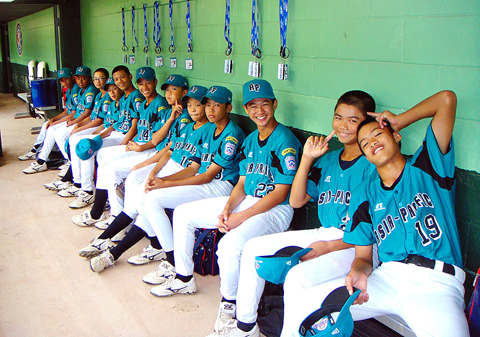
PHOTO: CNA
The team has been gearing up for two more tournaments — the Guan Huai Cup Little League Tournament that began in Hualien on Friday and a tournament that will feature more than 100 teams from across Asia in Taipei next month.
To many baseball players in Taiwan, Williamsport holds special significance because it represents the site of the country’s greatest run of international baseball success. For years Taiwan dominated the annual tournament, taking 17 championship titles between 1969 and 1996.
Local teams had been in a tailspin since then, not reaching a Little League World Series title game between 1997 and last year.
Kueishan won the international half of the World Series draw before letting a three-run third-inning lead slip away in a 6-3 loss to US champions West Chula Vista, California, in the championship game.
Just to get to the World Series, it had to capture the national title in May and then win the Asia-Pacific Regional Tournament in July.
The players trained every day on the school’s basketball court — often suffering bruises and holes in their pants when they slid on the cement court — but the team played enough games against other schools with legitimate fields to keep its players in one piece.
Head coach Li was particularly upset with Kueishan’s lack of facilities.
To him teams should be able to practice on a baseball diamond with a dirt infield, a backstop and preferably an automatic pitching machine.
The situation improved slightly in September last year when a baseball stadium was built in Kueishan Township, 8km from the school, and Li and Chen have taken the players to practice there ever since.
The team first made a name for itself in 2007, when it won the Guan Huai Cup tournament.
The annual tournament is open to elementary school teams from around the country where at least 70 percent of the players are Aborigines. Many of the players on the Kueishan team are from the Amis or Rukai tribes.
After winning the Guan Huai Cup event that year, Kueishan stepped up its participation in baseball competitions.
The Guan Huai tournament also proved to be a turning point in the team’s funding crisis. Despite strong performances in previous years, the school did not have enough money to send its team to Hualien.
Chen Kuo-chen, an alumnus of Kueishan Elementary School and chairman and chief executive officer Taiwan Wacoal Co, one of the leading lingerie makers in the country, received an appeal for help a week before the team’s planned departure and donated NT$100,000 so that the team could make the trip.
Since that tournament victory, financial support from private benefactors and the local government has helped keep the team afloat.
Once his team captured this year’s national Little League title, Li pushed his players harder, refusing to use the school’s dilapidated facilities as an excuse.
He brought in junior and senior high school pitchers to pepper his players with breaking balls to get them ready for the Asia-Pacific regional.
The practice was needed because only two Little League tournaments in Taiwan allow players to throw breaking balls, but no such restrictions exist in international play.
Li also made sure the players got accustomed to playing on a grass infield, a luxury in Taiwan even at the professional level but something they would have to deal with in Williamsport.
Though the team lost in the World Series final, it inspired many.
The wife of coach Chen, Huang Yu-ching, who traveled with the team to Williamsport, wept when she saw the players crouched down on the field after losing the championship game, crying and scooping clay into bottles.
“Because of the boys’ perseverance, we adults dared to have dreams,” she said.

Greek swimmer Kristian Gkolomeev was the only athlete to “beat” a world record on Sunday at the Enhanced Games, winning the men’s 50m freestyle at the divisive competition where athletes were free to take performance-enhancing substances. His time of 20.81 seconds — which is not considered official — came in the final event of the night in Las Vegas, sparing the blushes of organizers who made claims that multiple world records would be surpassed due to a sophisticated doping regime. Gkolomeev, who was wearing a synthetic “supersuit” long banned at events such as the Olympics, outpaced Australia’s Cameron McEvoy’s 20.88 set in
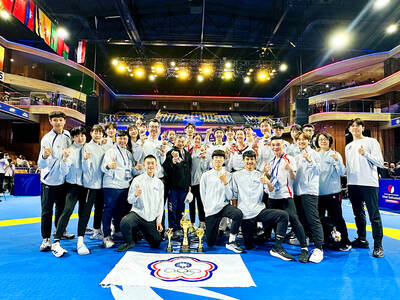
VICTORY ABROAD: The team took home a fistful of medals and secured spots for the autumn’s Asian Games, scheduled for September in Nagoya Taiwan’s women’s team captured the overall title at the Asian Taekwondo Championships in Mongolia on Sunday, finishing with two golds, one silver and one bronze medal. The strong showing, led by gold medalists Wang Chieh-ling and Chang Jui-en secured the full quota of available spots for Taiwan at the Asian Games in Nagoya, Japan, in September. Wang opened Taiwan’s medal run by winning gold in the women’s under-46kg class on Thursday, the first day of competition. Liu Yu-yun later earned a silver in the under-49kg class. On the final day on Sunday, Chang won Taiwan’s second gold medal in the under-62kg event, and
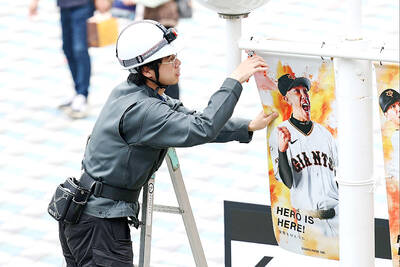
The manager of the Yomiuri Giants, one of Japan’s most popular baseball teams, resigned yesterday after he was arrested for allegedly physically attacking his teenage daughter. Shinnosuke Abe allegedly grabbed the 18-year-old and forced her to the floor at their home in central Tokyo on Monday evening, reported national broadcaster NHK and Kyodo News, citing unnamed police sources. “Leaving like this really means I’m causing you a lot of trouble, and I feel truly sorry about that,” Abe told a hastily arranged news conference, his eyes red with tears. The former star catcher, who is among baseball-obsessed Japan’s most recognized sports figures,

Taiwanese tennis star Hsieh Su-wei on Wednesday advanced to the second round of the mixed doubles at the French Open, after she and German partner Mark Wallner defeated Slovenian Andreja Klepac and Briton Lloyd Glasspool in straight sets, despite temperatures exceeding 32°C in Paris, while Taiwan’s top men’s doubles player Ray Ho also reached the second round. Hsieh, who made it to the semi-finals in the mixed doubles at Roland Garros in 2024, and Wallner defeated Klepac and Glasspool 6-3, 7-5 in just more than an hour, converting three of five break points, while holding their opponents to just one conversion


 RSS
RSS