


When Nonito Donaire fights Panama’s Rafael Concepcion in Las Vegas today, the recent IBF flyweight champion will take the next step toward a US dream he started as a picked-upon 10-year-old in the Philippine province of Bohol.
After moving with his family from the Philippines to the working-class East Bay suburb of San Leandro, California, Nonito took the opportunity to reinvent himself. He decided to fight.
“I was a little snotty-nosed, big-eared kid who didn’t believe that there was a tomorrow for me, and look where I am now,” Donaire said while wrapping his hands before a recent workout.
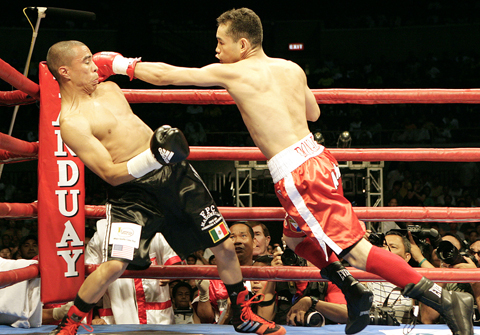
PHOTO: AP
Donaire (21-1, 14 KOs) has progressed up the list of the world’s top pound-for-pound boxers while winning his last 20 fights. His fame is still in its nascent stages, both in his adopted home and back in the Philippines, yet his headlining spot atop the “Pinoy Power” card at the Hard Rock suggests promoter Top Rank expects the Filipino Flash to get a whole lot bigger.
After years of struggles to get fights and management, Donaire actively pursues every opportunity, switching promoters and trainers — even when that trainer is his father. Although his relationship with Glenn Donaire Sr collapsed along the way, Nonito is still chasing that first dream despite a few mixed feelings about the sport.
“I’m not a fighter,” he said. “When I was growing up, I was very timid, shy, quiet. One time, my dad showed me [Arturo] Gatti fighting on TV. He said, ‘Do you want to box?’ I said, ‘Hell, no!’”
Donaire learned about boxing from his father, who listened to fights on the radio in their simple home in the Philippines. The family survived on his mother’s salary as a teacher and the meager profits from selling homemade candy. Meat and soda were rare feasts, and the kids often wore slippers and ragged clothes to school so they wouldn’t wear out their nice shoes and shirts.
Shortly after the family moved to San Leandro, living in a tough neighborhood near East Oakland, Donaire’s older brother, Glenn Jr, began collecting trophies from amateur tournaments, getting attention that proved irresistible to Nonito.
Donaire eventually fought in the 2000 US Olympic trials, but lost to Brian Viloria — now the IBF junior flyweight champion — in a discouraging decision that nearly drove him out of the sport. After turning pro in 2001, he spent about five years simply scrambling to cover his training expenses, often fighting on short notice, but still winning all but one decision, way back in his second pro fight.
“When I had a chance to sign with managers in the past, I would hear that Filipinos are just not marketable,” Donaire said. “In boxing chat rooms, they would make fun of Filipinos, say that they couldn’t break an egg. That really inspired me to work hard to prove them wrong.”
Manny Pacquiao changed all that in recent years, and Donaire realizes the debt he owes to the Philippines’ most famous man — who once attended the school where Donaire’s mother taught fourth grade.
“I train hard, but it’s not as hard as Manny,” he said. “He lives in a whole different world. I don’t think anybody else is going to get to that point, but I’m going to keep working hard.”
Fighting as a big underdog, Donaire won his title in July 2007 with a brain-bruising knockout of Vic Darchinyan, the veteran flyweight champ who had broken Glenn Jr’s jaw nine months earlier.
Donaire’s final punch — a gorgeous left hand thrown from his backstep — knocked senseless one of the lower weights’ toughest fighters.
Three defenses later, Donaire is ready to move up to 52.2kg and the challenges beyond, both in and out of the ring.
Donaire readily acknowledges feeling the immigrant’s familiar split between two worlds. He considers himself Filipino first, yet his life is mostly in the Bay Area. He has trained for previous fights in the Philippines, where his celebrity attracts constant attention, but he prepared for Concepcion in the comparative anonymity of San Carlos.
“This is my home,” he said, looking around the tidy gym. “I have a lot of friends out here. I feel at home here, but I’m proud to be Filipino. In the Philippines, it’s like every day is vacation.”
Donaire has formed friendships with the other two big names in Bay Area boxing: Oakland’s Andre Ward, the 2004 Olympic gold medalist, and Robert Guerrero, the former featherweight champion from Gilroy. He has trained in the East Bay hills with Ward, whose father sometimes slipped Donaire a few extra bucks.
Things aren’t as familial with Glenn Sr, who trains fighters in the Philippines.
Though Donaire no longer speaks to his father by phone or even text messages, he said they’re on good terms when they’re around each other: “My family is weird.”
After years of waiting, Donaire seemingly can’t slow down, even for his father. If he beats Concepcion, Donaire is determined to get fights with Fernando Montiel and Jorge Arce, the two biggest names at 52.2kg, before moving up, perhaps eventually to lightweight.

Bayer 04 Leverkusen go into today’s match at TSG 1899 Hoffenheim stung from their first league defeat in 16 months. Leverkusen were beaten 3-2 at home by RB Leipzig before the international break, the first loss since May last year for the reigning league and cup champions. While any defeat, particularly against a likely title rival, would have disappointed coach Xabi Alonso, the way in which it happened would be most concerning. Just as they did in the Supercup against VfB Stuttgart and in the league opener to Borussia Moenchengladbach, Leverkusen scored first, but were pegged back. However, while Leverkusen rallied late to

The lights dimmed and the crowd hushed as Karoline Kristensen entered for her performance. However, this was no ordinary Dutch theater: The temperature was 80°C and the audience naked apart from a towel. Dressed in a swimsuit and to the tune of emotional music, the 21-year-old Kristensen started her routine, performed inside a large sauna, with a bed of hot rocks in the middle. For a week this month, a group of wellness practitioners, called “sauna masters,” are gathering at a picturesque health resort in the Netherlands to compete in this year’s Aufguss world sauna championships. The practice takes its name from a

Japanese players are moving to English soccer in record numbers and more look set to follow with clubs attracted by their quality, strong work ethic and value for money. Kaoru Mitoma is the standout talent of five Japanese players in the English Premier League, with eight more in the Championship and two in League One. Liverpool midfielder Wataru Endo, the captain of Japan, believes his compatriots are “being held in higher esteem” by English clubs compared with the past. “The staff at Liverpool ask me about lots of Japanese players, not necessarily with a view to a transfer, but just saying this or

Taiwan yesterday survived Bosnia and Herzegovina to win their Davis Cup World Group I tie at the Taipei Tennis Center. The tight series started on Saturday with world No. 123 Jason Tseng losing 3-6, 7-5, 6-4 to Mirza Basic in the opening singles matchup. However, teammate Tony Wu kept the tie even, dominating world No. 86 Damir Dzumhur 6-2, 6-1. Yesterday, 24-year-old Ray Ho and partner 25-year-old Hsu Yu-hsiou kept up the momentum, making short work of Basic and Nerman Fatic, winning 6-3, 6-4. Tseng then suffered another defeat, losing 6-4, 2-6, 6-2 to Dzumhur in a brutal match that lasted more than two


 RSS
RSS