


Manny Pacquiao is losing.
And he’s having a good time.
The intensive training regime for his next fight, on May 2 against Ricky Hatton in Las Vegas, is a couple of weeks away. Now the man considered by many to be the world’s best pound-for-pound boxer can relax and take a break from the relentless demands on him: As family man, actor, advertiser and fledgling politician, not to mention the requests for his autograph, his money, his mere presence.
The scene is a concrete basketball court, swept of pebbles, in hardscrabble Labangal. That’s a neighborhood of mostly dirt roads where the 30-year-old Pacquiao grew up poor in General Santos City, in the southern Philippines.
He and a group of friends are taking on all comers in five-on-five, first to 15 baskets. Word spreads fast, drawing teams from other areas, some players shod only in flip-flops. Friendly side bets are made.
A hundred or so people, accustomed to seeing Pacquiao come and play during breaks in his training — he paid for the basket supports and rims — watch as late afternoon turns to dusk and the lights come on.
The only real signs that this is anything other than a regular game are three camera crews and three armed security guards — two toting submachine guns — flanking the court.
The Philippines is known as Asia’s kidnap capital and home to long-running Muslim and communist insurgencies, not to mention criminal gangs, and it’s no secret that Pacquiao earned at least US$11 million for pounding Oscar de La Hoya into submission in December.
For three-and-a-half hours, Pacquiao plays with only brief breaks to towel off, grab sips of water or take a call on his cellphone.
Rain ends play at 8pm, and Pacquiao heads to his former house, where his brother Bobby lives now, to change from his sweaty No. 17 jersey. His respite over, he has to head home to his sprawling mansion. Guests are waiting.
It’s hard to imagine Pacquiao finding time to even sleep these days.
He flew to Britain on Feb. 27 to promote his fight for Hatton’s IBO junior welterweight belt, which Pacquiao swears will be one of his last.
Can Pacquiao really quit when the paychecks are so big? The De La Hoya fight generated about 1.25 million pay-per-view buys in the US, according to numbers released by HBO, only the fourth time such a fight got at least 1 million buys.
Pacquiao, who has won his last nine fights to run his record to 48-3-2 with 36 knockouts, seems to be at the peak of his skills and international fame. He has become a national icon — the Philippine Senate recently passed a unanimous resolution honoring him as the “greatest Filipino boxer of our time.”
But Pacquiao insists he won’t spend long in the sport.
“I will retire this year,” he said. “Maybe after Hatton, one more fight, and then that’s it. Win or lose.”
He would leave quite a legacy, already winning titles in five weight classes. A year ago, he was fighting at 129 pounds (58.5kg), then moved all the way up to 147 (67kg) for De La Hoya.
It also may help that Pacquiao has so many outside interests, including raising roosters for cockfighting, a popular event in the Philippines, along with playing darts, billiards and chess.
His endorsement contracts include Nike, and his parents and advisers say he has managed his money well.
“What people don’t understand about Manny is even though he is not a Harvard-educated person, he is a very intelligent person,” said Michael Koncz, who has helped Pacquiao manage a boxing promotion company in the US state of Nevada.
“He absorbs his surroundings. He knows what’s going on around him, what people’s intents are, who’s got ulterior motives and who doesn’t, because we’ve had discussions on that. His comment is, ‘You think I’m stupid? I know.’ And he does.”
“Most times he is a very shrewd businessman. Then at times, too, his kindness comes out. If you push the right buttons, you are able to invade his kindness and get to his heart, and sometimes he makes a lesser deal than he could have got,” Koncz said.
Pacquiao’s popularity is so overwhelming — traffic is much lighter and crime declines when his fights are on TV, regularly drawing ratings of about 50 percent of viewers — that he talks about a run for office in the poverty-wracked country of 90 million people even though his first campaign for Congress fell short.
“Especially my province, there are a lot of poor people,” Pacquiao said. “I want to help them because I know what they feel right now. It is not easy to help other people. That is a big responsibility. I will focus on that for the meantime.”
He already helps out friends like Sonny Panding, a former sparring partner who shared a house with Pacquiao and other boxers in the early 1990s. Panding, who now drives a motorcycle taxi for a living, said Pacquiao regularly gives him about US$200 whenever they see each other.
He recalls the determination that set the champion apart.
“Manny was very excited with training and he trained very hard,” Panding said. “While I and the others were just getting ready to dress, he was already up and running. When we got halfway in the road run, he was already at the end, and when we got to the end, he was already back.”
While Pacquiao’s parents praise his help for others, they worry about him getting involved in politics.
“It’s really dirty,” said Pacquiao’s mother, Dionisia, who recalled how, with her husband unemployed, her son used to do odd jobs for US$3 a day to help out. She is deeply religious, a trait she has passed on to her son.
“I think I have been blessed by God,” Pacquiao said. “I think because I believe in God, I work hard in my profession, so that’s why my dreams come true.”
This week, it was time to fly to Los Angeles and start preparations for the fight with Hatton. Trainer Freddy Roach convinced Pacquiao a couple of years ago that he needs to train away from the distractions at home, and the results have been hard to argue with — Pacquiao has looked stronger, quicker and more focused in his last few fights.
“When I am in training, there is nothing that can disturb me,” Pacquiao said. “Once I start, there will be no distractions.”

Taiwan’s top women’s badminton doubles duo, Hsieh Pei-shan (謝沛珊) and Hung En-tzu (洪恩慈), achieved a straight-sets victory over Japan’s Kaho Osawa and Mayui Tanabe at the Badminton World Federation (BWF) Super 300 Macau Open on Sunday. The Taiwanese pair won the final 21-18, 21-12, marking the duo’s second title this year after their win at the BWF Super 300 Taipei Open in May. The match on Sunday was their first encounter with the Japanese duo, ranked No. 63 in the world. Hsieh and Hung, ranked No. 12, began the opening game well. Hung, who plays left-handed, performed strongly at both the net and the
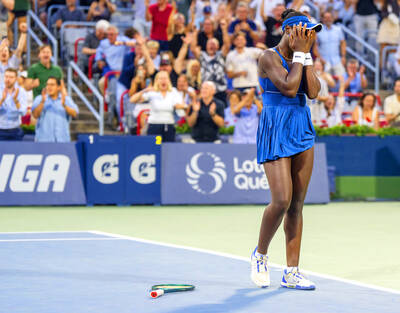
Canadian teenager Victoria Mboko upset top-seeded Coco Gauff 6-1, 6-4 on Saturday night to reach the National Bank Open quarter-finals. “Your support was incredible,” Mboko told the crowd in French after a chorus of “Ole, Ole, Ole” chants echoed around the venue. “I’m really happy to win today ... It’s incredible. I’m so happy to beat such a great champion.” Gauff dropped to 2-3 since winning the French Open. She followed the major victory with opening losses in Berlin and Wimbledon, then overcame double-fault problems to win two three-set matches in Montreal. Gauff had five double-faults on Saturday after having 23 in
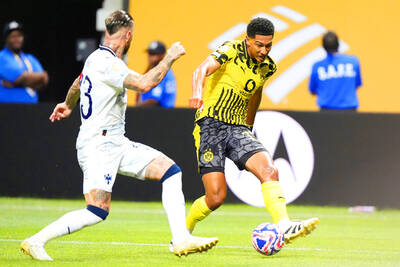
Jobe Bellingham on Tuesday admitted to having “anxieties” on following in brother Jude’s footsteps after joining Borussia Dortmund in the summer. Jobe Bellingham, 19, is two years younger than Jude Bellingham, who joined Real Madrid in 2023 after three years at Dortmund. A centerpiece of the England national team, Jude Bellingham has emerged as one of the best players in the world in recent seasons. The younger Jobe Bellingham joined Dortmund in June from Sunderland after their promotion to the English Premier League. He admitted he understood what the perception would be ahead of the move to Germany. “It’s something you do think about.
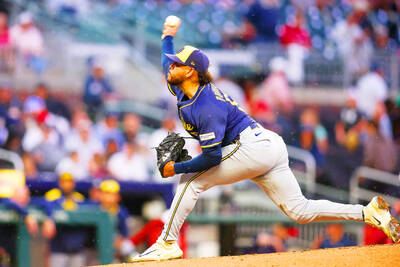
Before Tuesday’s 7-2 win at the Atlanta Braves, Milwaukee Brewers manager Pat Murphy suggested “most people couldn’t tell you five players on our team.” A look at the standings would indicate more Brewers players soon will be recognized by more fans. After all, it is difficult to overlook a team that not only continues to extend their lead in the National League Central, but also boasts the best record in the majors. “What we’re doing in here right now is special,” right-handed pitcher Freddy Peralta said after allowing only four hits and one run in five innings, while setting a career high with


 RSS
RSS