


“New China” is introducing itself to the world through the Beijing Games, and since it is banking on the Olympics being a success it has spent an unprecedented US$40 billion to ensure this will be the biggest and best edition yet.
The numbers tell the story. In addition to spending on venues, transport and infrastructure, security costs are an estimated US$6.5 million. The Olympic flame has traveled further, 137,000km, and higher, Mount Everest, than ever before, transported by a record 20,000 torchbearers.
It is the International Olympic Committee (IOC) that profits most from this effort and expenditure. It charges a dozen firms US$74 million each to be an official sponsor and makes billions more from ticket sales, merchandising, domestic advertisers and broadcasting rights.
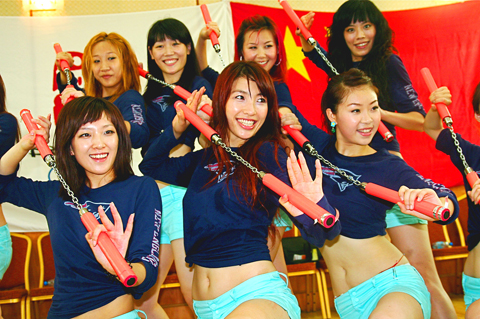
PHOTO: JOHN HANCOCK
Though it invests much of this cash back into sport through the national Olympic committees, it is not a charity and is by far the richest sporting organization in the world, and with the largest overheads.
While the IOC makes money, China makes political capital by burnishing its national brand. With so much at stake it is easy to forget the Olympics was originally about running, throwing and wrestling, or “faster, higher, stronger” — the motto Baron Pierre de Coubertin borrowed more than a hundred years ago to describe the achievements of athletes when the Games were revived.
On a recent visit to liaise with Olympic organizers, the Greek secretary general of information Panos Livadas commented that commercialization of the event was at times contrary to its real purpose.
“The Olympics, for many, many years now, has been circulating around marketing and sponsors, TV and glamorous athletic stars. And money. The Athens Olympics contradicted that approach. Our Olympics was also about culture, peace and truce,” Livadas said in a speech.
If anyone has a right to say what the Olympics is really all about it is Greece’s information minister. But he realizes, and we know, that in reality it would not survive without sponsors’ cash and be the widely watched, high recognition event it is today.
The Olympics is more than just sport. Though the athletes seem central to the action, they are just star performers in a giant play. The supporting cast includes 30,000 journalists, 1.5 million volunteers and an expected audience of 4 billion.
Added to which are the cheerleading squads that have been marshaled and drilled to perform at the drop of a hat, the scoring of a point or an interval in a match. Spectators enjoy it and, as they say, the customer is always right.
Then there is the fanfare of the opening and closing ceremonies, which are so highly charged with political significance that the details are a state secret. This has little to do with athletics, but the Olympics just wouldn’t be the same without drama and fireworks.
Sports historians call the Helsinki Games of 1952 “the last real Olympics,” as the country was recovering from World War II and couldn’t put on much of a show. Since then organizers have cast out amateurism to embrace professionalism and commercialization. But if you mention the c-word to local Games organizers or journalists they screw up their collective noses.
Why? According to one reporter from a state-owned newspaper this is because acknowledging commercialization would be tantamount to admitting the central tenets of communism were a mistake and the materialistic attitudes of the West — in Taiwan and elsewhere — are now an accepted part of life. Get rich quick.
So, American cheerleaders train the locals how to hit up the atmosphere and drive up the ratings. Mascots and other licensed products sell like hotcakes. It is a payday for manufacturers of national flags and T-shirts. Advertisers benefit from record ratings and winning athletes are made for life.
Everyone is happy. Just don’t mention the c-word.
“John Hancock” is the Taipei Times’ correspondent for the Beijing Olympics.
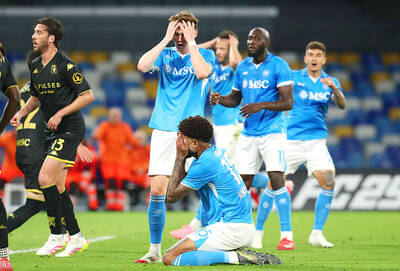
SSC Napoli’s Italian Serie A title hopes suffered a late setback on Sunday when they were held to a 2-2 draw at home against Genoa, setting up a thrilling season finale with closest rivals Inter just one point behind. The hosts remain top with 78 points, holding a slim lead over Inter, who won 2-0 at Torino earlier on Sunday, with two rounds remaining. To make matters worse for Napoli, midfielder Stanislav Lobotka, struggling with an ankle injury, was forced off just minutes after the match began. Scott McTominay delivered a perfect pass into the box where Romelu Lukaku got
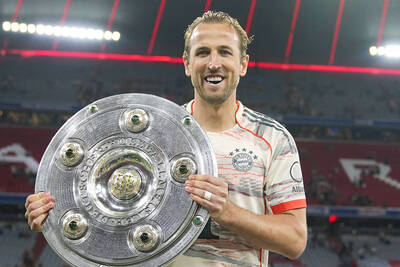
Harry Kane opened the scoring ahead of lifting his first career silverware as Bayern Munich beat Borussia Moenchengladbach 2-0, with veteran Thomas Mueller playing his last home game for the club. Bayern officially won the title on May 4 when defending champions Bayer Leverkusen were held to a 2-2 draw at Freiburg, but were presented with the Bundesliga shield in front of their home fans at full-time. Dripping wet after being showered with beer by teammates, Kane said the title win was “an incredible feeling,” and hoped it would be “the first of many.” “It’s been lot of hard work, a lot of
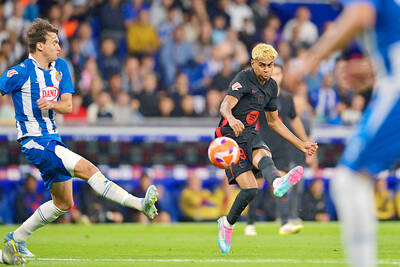
A stunning Lamine Yamal strike on Thursday helped crown Barcelona La Liga champions with a 2-0 win over local rivals RCD Espanyol, with victory ensuring Real Madrid cannot catch them at the top of the table. Yamal’s effort and Fermin Lopez’s goal took Hansi Flick’s side seven points clear of Los Blancos with two matches remaining, to clinch Barcelona’s 28th title and complete a superb domestic treble. Only the UEFA Champions League title escaped an exciting young Barca side this season, as they won the league for the second time in six years, at Espanyol’s ground again just as in 2022-2023. Back then,
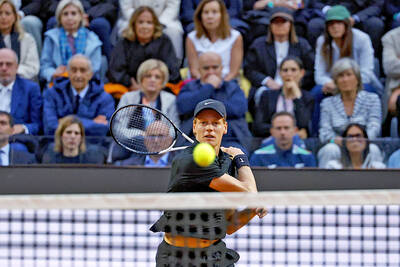
Jannik Sinner on Thursday marched into the semi-finals of the Italian Open after destroying Casper Ruud in straight sets 6-0, 6-1, while Coco Gauff won a marathon three-set battle with China’s Zheng Qinwen to advance to the women’s singles final. American Gauff is to face Italy’s Jasmine Paolini in today’s title match after pulling through 7-6 (7/3), 4-6, 7-6 (7/4) in a match that lasted over three-and-a-half hours. Ruud was supposed to be Sinner’s toughest test in Rome since he came back from his three-month doping ban, as the Norwegian came into the match in hot form on clay after winning in


 RSS
RSS