


Australian umpire Darrell Hair was prevented from umpiring in top-level international cricket to appease non-white cricketing countries, it was claimed in the Central London Employment Tribunal on Monday.
Hair is suing the International Cricket Council (ICC) for racial discrimination.
Together with fellow umpire Billy Doctrove of the West Indies, he took a joint decision to penalize Pakistan for ball-tampering on the fourth day of the fourth Test against England at The Oval in August last year.
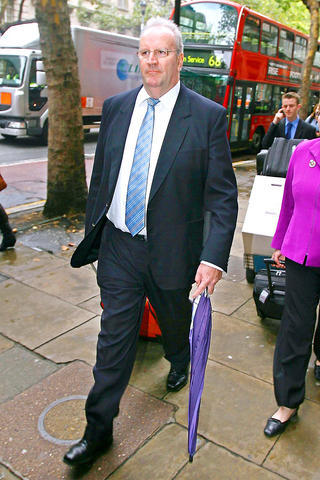
PHOTO: AFP
So enraged were Pakistan by this decision they refused to take the field immediately after tea.
By the time they were ready to play the umpires ruled they had forfeited the match -- the first and so far only time this has happened in the now 130 years of Test cricket.
Hair, 55, says since taking that decision the ICC have caved into pressure, primarily from cricket's Asian bloc (India, Pakistan, Sri Lanka and Bangladesh), which has seen him denied the chance to continue to stand in major international matches.
Hair explained why he accused Pakistan of ball-tampering, claiming that he felt the rough state of the ball "had been accelerated by human intervention."
He impressed upon the three-man tribunal panel that he had taken joint decisions throughout the Test with Doctrove.
"I was surprised by how much roughing up of the ball there had been," Hair told the tribunal. "There were quite a few scratch marks on it."
The burly Australian described how the match ended.
"Doctrove called time and I removed the bails at my end," signalling that their decision was taken in unison. He also said that "the abuse I received from Pakistan players continued unchecked by the ICC."
Hair's lawyer Robert Griffiths told the tribunal that Malcolm Speed, the chief executive of the ICC, wanted fellow Australian Hair to continue to stand in Tests and One-Day Internationals, but Pakistan and India were opposed.
"So he remained on its elite panel but he has suffered both personally and financially," Griffiths said.
"The ICC bowed to the racially discriminatory pressure that was brought to bear on it by the Asian bloc and ICC Board member countries. That has traumatized the world of cricket. The Asian bloc is dominant in cricket and sometimes it uses that dominance inappropriately. Everyone knows it, but most are afraid to say so," Griffiths said.
"A fundamental issue is whether this was done to save Pakistan's reputation and, or, to teach a lesson to a white Australian and any other umpires who dare take similar action," he said.
Griffiths said there had been a "Watergate" style cover-up of an ICC Board meeting last November.
Part of a tape-recording of this meeting, attended by Sir John Anderson (New Zealand), Peter Chingoka (Zimbabwe) and Dr Nasim Ashraf (Pakistan), at which it was decided that Hair should not continue to umpire at the highest level, had gone missing, he said.
Hair, who is contracted to the ICC until April next year, admitted he has suffered from depression and that, after 15 years of officiating at the highest level, he was missing the game.
Ray Mali, the ICC president, said before the hearing started: "Racism was never an issue. This is a bad day for cricket," Mali said.
Michael Beloff, the lawyer appearing for the ICC, declared that Hair was "the author of his own misfortune."
"Exactly the same decision would have been made by the ICC had he been black, brown or green," he said.

Bayer 04 Leverkusen go into today’s match at TSG 1899 Hoffenheim stung from their first league defeat in 16 months. Leverkusen were beaten 3-2 at home by RB Leipzig before the international break, the first loss since May last year for the reigning league and cup champions. While any defeat, particularly against a likely title rival, would have disappointed coach Xabi Alonso, the way in which it happened would be most concerning. Just as they did in the Supercup against VfB Stuttgart and in the league opener to Borussia Moenchengladbach, Leverkusen scored first, but were pegged back. However, while Leverkusen rallied late to

If all goes well when the biggest marathon field ever gathered in Australia races 42km through the streets of Sydney on Sunday, World Marathon Majors (WMM) will soon add a seventh race to the elite series. The Sydney Marathon is to become the first race since Tokyo in 2013 to join long-established majors in New York, London, Boston, Berlin and Chicago if it passes the WMM assessment criteria for the second straight year. “We’re really excited for Sunday to arrive,” race director Wayne Larden told a news conference in Sydney yesterday. “We’re prepared, we’re ready. All of our plans look good on

The lights dimmed and the crowd hushed as Karoline Kristensen entered for her performance. However, this was no ordinary Dutch theater: The temperature was 80°C and the audience naked apart from a towel. Dressed in a swimsuit and to the tune of emotional music, the 21-year-old Kristensen started her routine, performed inside a large sauna, with a bed of hot rocks in the middle. For a week this month, a group of wellness practitioners, called “sauna masters,” are gathering at a picturesque health resort in the Netherlands to compete in this year’s Aufguss world sauna championships. The practice takes its name from a

When details from a scientific experiment that could have helped clear Russian figure skater Kamila Valieva landed at the World Anti-Doping Agency (WADA), the leader of the organization’s reaction was unequivocal: “We have to stop that urgently,” he wrote. No mention of the test ever became public and Valieva’s defense at the Court of Arbitration for Sport (CAS) went on without it. What effect the information could have had on Valieva’s case is unclear, but without it, the skater, then 15 years old, was eventually disqualified from the 2022 Winter Olympics after testing positive for a banned heart medication that would later


 RSS
RSS