


He insists he has never used performance-enhancing drugs, but Jamal Patterson, a mixed martial arts fighter in the International Fight League (IFL), says he has been presumed guilty for years.
"People tell me, `You must have done something,'" he said in a telephone interview from Hoboken, New Jersey. "But genetically, I'm just a freak."
Patterson wrestled in high school and played football at Colgate University. He is 1.8m tall and has slimmed down to 93kg for his career in the IFL, a team-based mixed martial arts league, which is among several organizations striving to bring this once-underground sport into the mainstream.
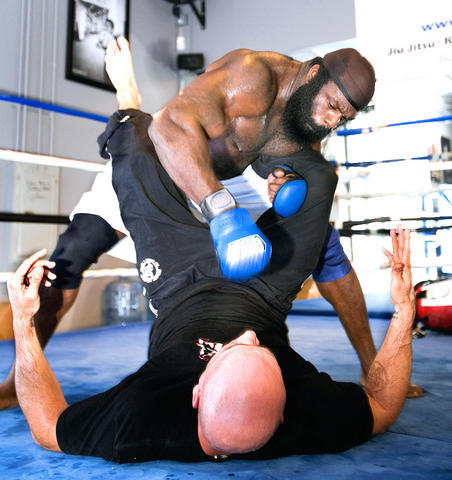
PHOTO: NY TIMES NEWS SERVICE
Patterson, who competes for the IFL's Pitbulls, says he knows how crucial public perceptions can be in a pursuit that combines punching, kicking and grappling, and that casual observers sometimes still confuse with the spectacle of professional wrestling.
The sport of mixed martial arts encountered doping problems last month at an event at Los Angeles Memorial Coliseum. Royce Gracie, one of the pioneers of the sport, tested positive for the steroid nandrolone; Tim Persey tested positive for methamphetamine; and Johnnie Morton, a former NFL receiver making his mixed martial arts debut, had a higher than normal ratio of testosterone to epitestosterone in a pre-fight test, then declined to take a required post-fight test. All three were later suspended.
Performance-enhancing drugs would certainly give mixed martial arts fighters a tremendous physical benefit because they can aid strength, endurance and recovery. But mixed martial arts, a young and booming sport, has no national or international governing body and lacks a rigorous drug-testing policy.
"Part of the problem is that there are all these small organizations that fight in garages and on Indian reservations and in strip clubs, and there's no drug testing, and the rules are very limited," said Kurt Otto, commissioner and founder of the IFL. "We need to legitimize every aspect of it."
But Gracie and Morton were competing in a major event, promoted by Fighting and Entertainment Group, which is based in Japan and also promotes K-1, one of the top mixed martial arts organizations.
K-1, like the IFL and the Ultimate Fighting Championship (UFC), the two most popular mixed martial arts organizations in the US, relies primarily on state athletic commissions, which sanction mixed martial arts events in the same way they do boxing and other combat sports, to handle drug testing immediately before or after fights. But this means that in some states, not every fighter will be tested, and those who are tested will know roughly when it is coming.
"In general, I think this should not be done by the government," said Gary Wadler, an associate professor of medicine at New York University who has served on several committees for the World Anti-Doping Agency. "It should be done by an independent and transparent agency that's invested in seeing a drug-free sport."
Drug-testing programs run by athletic commissions differ from state to state. In New Jersey, which has held several mixed martial arts events this year, all fighters are tested.
California recently began testing all fighters.
Gracie was suspended for a year from the date of the fight (June 2) and fined US$2,500, pending his appeal.
But at least one state does no drug testing at all.
"Our policy is that it's up to the promoter to do the testing," said Patrick Shaughnessy, a spokesman for the Texas Department of Licensing and Regulation.
The Ultimate Fighting Championship held its first event in Texas in April in Houston, and none of the fighters were tested, said Marc Ratner, the UFC's vice president for regulatory affairs.
"That doesn't make sense to me," he said.
Ratner, who spent 13 years as executive director of the Nevada State Athletic Commission, said the UFC hired an independent laboratory to test four fighters at an event last month in Ireland.
Neither the Ultimate Fighting Championship nor the International Fight League have a formal policy for the punishment and appeals process for fighters who fail a drug test.
Otto said he hoped the IFL would have a program in place before the 2008 season begins.
Patterson and Pitbulls coach Renzo Gracie, a cousin of Royce Gracie, said they hoped the IFL would adopt random testing.
"It's not a witch hunt," Gracie said. "It's what the sport asks for."

Bayer 04 Leverkusen go into today’s match at TSG 1899 Hoffenheim stung from their first league defeat in 16 months. Leverkusen were beaten 3-2 at home by RB Leipzig before the international break, the first loss since May last year for the reigning league and cup champions. While any defeat, particularly against a likely title rival, would have disappointed coach Xabi Alonso, the way in which it happened would be most concerning. Just as they did in the Supercup against VfB Stuttgart and in the league opener to Borussia Moenchengladbach, Leverkusen scored first, but were pegged back. However, while Leverkusen rallied late to

The lights dimmed and the crowd hushed as Karoline Kristensen entered for her performance. However, this was no ordinary Dutch theater: The temperature was 80°C and the audience naked apart from a towel. Dressed in a swimsuit and to the tune of emotional music, the 21-year-old Kristensen started her routine, performed inside a large sauna, with a bed of hot rocks in the middle. For a week this month, a group of wellness practitioners, called “sauna masters,” are gathering at a picturesque health resort in the Netherlands to compete in this year’s Aufguss world sauna championships. The practice takes its name from a

Japanese players are moving to English soccer in record numbers and more look set to follow with clubs attracted by their quality, strong work ethic and value for money. Kaoru Mitoma is the standout talent of five Japanese players in the English Premier League, with eight more in the Championship and two in League One. Liverpool midfielder Wataru Endo, the captain of Japan, believes his compatriots are “being held in higher esteem” by English clubs compared with the past. “The staff at Liverpool ask me about lots of Japanese players, not necessarily with a view to a transfer, but just saying this or

Taiwan yesterday survived Bosnia and Herzegovina to win their Davis Cup World Group I tie at the Taipei Tennis Center. The tight series started on Saturday with world No. 123 Jason Tseng losing 3-6, 7-5, 6-4 to Mirza Basic in the opening singles matchup. However, teammate Tony Wu kept the tie even, dominating world No. 86 Damir Dzumhur 6-2, 6-1. Yesterday, 24-year-old Ray Ho and partner 25-year-old Hsu Yu-hsiou kept up the momentum, making short work of Basic and Nerman Fatic, winning 6-3, 6-4. Tseng then suffered another defeat, losing 6-4, 2-6, 6-2 to Dzumhur in a brutal match that lasted more than two


 RSS
RSS