


"I never thought I'd be putting duct tape on shoes," Bret Scesa said.
But there he was, standing on the ice on Tuesday in Wollman Rink in Central Park with duct tape covering the soles of his US$500 Ferragamo loafers, for what amounted to Curling 101. Yes, curling, a Rodney Dangerfield of Olympic sports, one that gets no respect, one that has been mocked by David Letterman.
Also on the ice, ready to tutor Scesa and about 40 other Bank of America employees, were five people with experience, ability, agility and decidedly different shoe coverings: the members of the US women's curling team.
Next month, the team will be in Turin, Italy, trying to fend off Canadian and Danish competitors at the Winter Olympics. But on Tuesday, they were demonstrating the form needed to deliver a stone.
As Scesa learned, that is curling talk for what is supposed to happen in their sport. The stone is a 19kg weight made of granite. It is supposed to glide down the ice, aided by team members with brooms who furiously sweep a path for it, and come to a stop somewhere inside "the house," which to a non-curler looks like a bull's-eye that has three circles, close, closer and closest.
"An Olympic sport -- that's how I explained it to my wife," Scesa said. "It's like shuffleboard on ice. She said, `You're nuts.' She told me to get out my old football pads. I'm a mess on ice."
But he was not one of those who fell on his backside. Scot Meyer, who handles risk management for fixed-income trading, shrugged after he was back on his feet.
sophisticated soles
"These girls are amazing," he said. "They make it look so easy."
The team has the equipment. Where he and Scesa had duct tape, the Olympians had more sophisticated soles. Four of them wear shoes with Teflon on what curlers call their sliding foot, which for a right-handed curler is the left foot. The fifth, Cassie Johnson, a 24-year-old curler from Bemidji, Minnesota, uses a shoe with stainless steel sole; she thinks it's better.
So had any of the bankers curled before? The question was put to a bank spokeswoman who said, "I curled my hair." She would not give her name -- "We're trained not to say anything," a spokesman standing nearby said, introducing Allison Gardiner, a vice president who said she had only curled on ice once.
"Curling has a long history," Gardiner said, "as does the bank."
Which goes back further, curling or the bank? "I bet the bank is older," she said.
a long, long time ago
The spokesman, who had said spokesmen were trained not to say anything, said that the bank's roots go back to 1784.
Gardiner checked with one of the Olympians, Maureen Brunt, who said that curling dates to at least the 1500s.
So much for the idea that the bank was older.
Gardiner explained the purpose of the demonstration.
"People sort of laugh at this sport," she said. "They don't understand how much strength it takes to push the stone. The average television watcher thinks it's not that difficult."
If the demonstration was a first for the bank employees, whose bank is a sponsor of the Olympic curling team, it was also a first for the team members -- the first time they had curled out of doors.
Modern-day curling is mainly an indoor sport, the team members said.
"It doesn't make you cool in high school class," explained Cassie Johnson, a fourth-generation curler who has been competing with her sister Jamie, an Olympic teammate, since Cassie was in kindergarten.
But she said she was sure that she could turn Letterman into a fan, given the chance.
"For entertainment purposes, he'd still make fun of curling," she said, "but on his show curling would get more respect."
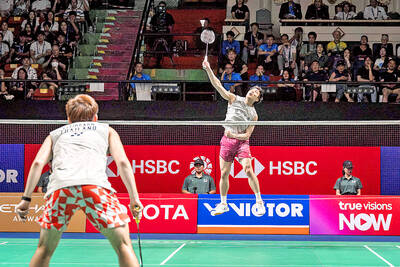
Taiwan’s top male badminton player, Chou Tien-chen, on Saturday bowed out in the men’s singles semi-finals at the Thailand Open after losing in straight games to Thailand’s Kunlavut Vitidsarn. The world No. 6 Chou, seeded fourth at the Super 500 tournament, lost to the world No. 2 Thai 21-7, 21-19 in 53 minutes. The victory improved Vitidsarn’s head-to-head record against Chou to 3-5. Chou, 36, trailed throughout the opening game after the score was tied 2-2. His relatively passive approach allowed the 25-year-old Thai to capitalize on Chou’s defensive clears with powerful smashes while committing few unforced errors. The Taiwanese
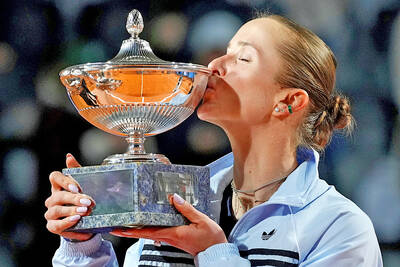
FRUSTRATION: Gauff smacked herself on the head with her racket before storming down the tunnel, emerging afterward to have a heated discussion with her coach Elina Svitolina on Saturday won the Italian Open after beating Coco Gauff 6-4, 6-7 (3/7), 6-2 to claim her third Rome title, while Jannik Sinner set a date with Casper Ruud in the men’s final. Ukraine’s Svitolina had not claimed a WTA 1000 title since her last victory at the Foro Italico eight years ago, but prevailed over the ever-erratic Gauff to claim her 20th tournament triumph. Saturday’s win over Gauff was her third in a row against a player in the top four of the world rankings — including Iga Swiatek and Elena Rybakina — ahead of the French

MLB is experiencing an epidemic of guys being dudes. At ballparks all across the US, groups consisting of mostly young men are joining in on the “Tarps Off” trend that is loud, goofy, infectious and new to the baseball world. Joining in on the fun is simple: Go to the section where the party is happening, take off your shirt and start twirling it above your head. Soccer-like chants or singing usually follow — injecting a jolt of energy for a sport that is occasionally chided for its lack of energy inside the stadium. After getting its start in St Louis, Missouri, on

West Ham United’s 3-1 defeat at Newcastle United on Sunday left Tottenham Hotspur realistically only needing one more point to win the battle for English Premier League survival, while Bruno Fernandes made history in Manchester United’s 3-2 win over Nottingham Forest. Spurs can avoid dropping out of the English top flight for the first time in nearly 50 years with victory at Chelsea today, but a draw would also likely suffice thanks to their much superior goal-difference over West Ham. “Overall bad performance. Too many things [went wrong], I think we gifted them the goals,” West Ham head caoch Nuno Espirito Santo


 RSS
RSS