


A low rumble fills the ice arena as the sound as 18kg granite stones slowly slide across a pebbled ice surface. The sound and visual sensation is like nothing else, like watching a glacier move or ice settle into a glass of vodka.
"On average, it takes each stone 26 seconds to travel across the ice," said Wally Henry, coach of the Chinese-Taipei Women's Curling Team.
He should know, as he routinely uses a stopwatch to measure the consistency throws made by his four-person curling team.
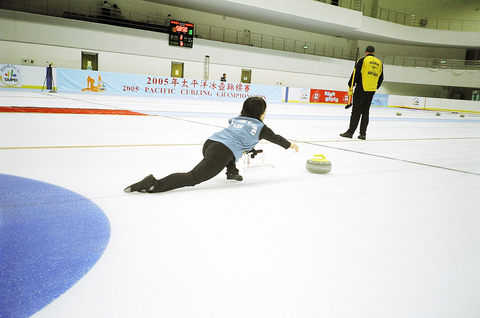
PHOTO: SEAN SCANLAN
Curling teams from South Korea, Japan, China, New Zealand, and Australia are in town for the 2005 Pacific Curling Championship, held at the Taipei Arena with championship round scheduled for Wednesday at 1:30pm.
On the days leading up to gold medal rounds, matches are open to the public and free of charge -- taking place every day with rounds scheduled at 8:30am, 1:30pm and 6pm. Each match takes a little over two hours to complete, and be advised the ice rink is a bit chilly.
Curling has a strategy and play similar to shuffleboard, in that the object of the game is to slide stones as close to the bulls-eye as possible. Each team throws eight stones (two stones per team member), with many throws either knocking-out an opponent's stones or striving for a defensive position.
There are up to 30 different throws a player can make, with each toss typically revolving two times before its reaches its final destination. To speed up the stone, or slow it down, two sweepers escort the stone to its final position.
"A good sweep can add 15 feet to a toss," Henry said. "It can also affect the spin or curl of a toss."
Only one team can score during one frame or "end" as it called in the sport -- with a team picking up between 1 to 4 points per end, depending upon the number of stones near the bulls-eye. Ten ends are played in each game with a cumulative score such as 8-6 or 10-2 determining the winner.
Curling received a major boost when the sport was included in the 1998 Winter Olympics in Nagano, Japan. This was the first time that the current Chinese-Taipei skipper, Cheng Li-lin, had seen the sport.
"I saw it on television, and later, I rented videos about it," Cheng said. "You can say that it was the Olympics that got me interested."
Cheng then recruited four Taiwanese friends to register at a local curling club in Madison, Wisconsin.
An annual membership fee of US$350 entitled her team to weekly matches and practice. There are 10 Taiwanese citizens in the curling club, which is the second largest in the US, with 6 sheets of ice, and nearly 500 members.
The Chinese-Taipei Men's Team operates out of a Vancouver, Canada curling club and is equally enthusiastic about this unique wintertime sport.
Canada boasts the largest curling population in the world with approximately 1.4 million participants who play in weekly sessions throughout the winter. Some estimate the number of global players outside of Canada to be just 100,000.
Although the sport was originally played on frozen lakes in Scotland, events began to move indoors in the early 1900s. The Scottish roots of the sport give the game a polite, well-mannered feel, with cheating almost completely unheard of.
"I'd rather lose a match than cheat. In the past 20 years, I have only seen or heard about one instance of cheating" said Doug Wright, the person responsible for maintaining the ice surface at this week's competition in Taipei.
Cheating, he said, can involve crossing the "hog's line," which is the point where players have to release the stone, or otherwise interfering or nudging the stone as it is traveling down the ice.
Wright says he has been "making ice" for curling for 20 years, and he began participating in the sport at the age of 9. He says most ice rinks are equipped for curling with a little alteration, such as painting a large blue and white bull's eye on the ice and "pebbling" the ice.
The latter is accomplished by laying a fine layer of water droplets on the ice from a back-pack sized spray applicator that may also be used to apply either pesticides or fertilizer.
After every match, the ice is cleaned and pebbled.
Fair play and a perfect playing service are some of the hallmarks of this sport which has drawn some of Asia's best curling teams to Taipei. And this week's competition will give local audiences a peak at potential Olympic medalists such as the New Zealand Men's Curling Team.
This group has qualified for one of 10 invitations into the men's competition -- a unique achievement made possible by the development of an indoor curling facility in New Zealand.
Other top contenders at this week's competition are a well trained Japanese team that has already sent players to Olympic competition, as well as an enthusiastic team from Australia.

Bayer 04 Leverkusen go into today’s match at TSG 1899 Hoffenheim stung from their first league defeat in 16 months. Leverkusen were beaten 3-2 at home by RB Leipzig before the international break, the first loss since May last year for the reigning league and cup champions. While any defeat, particularly against a likely title rival, would have disappointed coach Xabi Alonso, the way in which it happened would be most concerning. Just as they did in the Supercup against VfB Stuttgart and in the league opener to Borussia Moenchengladbach, Leverkusen scored first, but were pegged back. However, while Leverkusen rallied late to

If all goes well when the biggest marathon field ever gathered in Australia races 42km through the streets of Sydney on Sunday, World Marathon Majors (WMM) will soon add a seventh race to the elite series. The Sydney Marathon is to become the first race since Tokyo in 2013 to join long-established majors in New York, London, Boston, Berlin and Chicago if it passes the WMM assessment criteria for the second straight year. “We’re really excited for Sunday to arrive,” race director Wayne Larden told a news conference in Sydney yesterday. “We’re prepared, we’re ready. All of our plans look good on

The lights dimmed and the crowd hushed as Karoline Kristensen entered for her performance. However, this was no ordinary Dutch theater: The temperature was 80°C and the audience naked apart from a towel. Dressed in a swimsuit and to the tune of emotional music, the 21-year-old Kristensen started her routine, performed inside a large sauna, with a bed of hot rocks in the middle. For a week this month, a group of wellness practitioners, called “sauna masters,” are gathering at a picturesque health resort in the Netherlands to compete in this year’s Aufguss world sauna championships. The practice takes its name from a

When details from a scientific experiment that could have helped clear Russian figure skater Kamila Valieva landed at the World Anti-Doping Agency (WADA), the leader of the organization’s reaction was unequivocal: “We have to stop that urgently,” he wrote. No mention of the test ever became public and Valieva’s defense at the Court of Arbitration for Sport (CAS) went on without it. What effect the information could have had on Valieva’s case is unclear, but without it, the skater, then 15 years old, was eventually disqualified from the 2022 Winter Olympics after testing positive for a banned heart medication that would later


 RSS
RSS