


The fifth and final day of Asian Figure Skating Championships took place on Sunday at the Taipei Arena. Void of the nationalistic flag-waving controversies that marred the Asian Youth Judo Championships taking place in the same building, the skating event was deemed a success.
As with the judo competition, there were a number of Olympic hopefuls on hand, most notably a trio of Uzbekistan skaters competing in the ladies seniors short program and pairs free skate.
"Pairs" competition is similar to "ice dancing" though it allows "tosses and throws" and is more athletic than ice dancing, according to Rich Lee, secretary general of the Chinese Taipei Skating Union. Because of the extreme difficulty of pairs competition, just three teams entered the event.
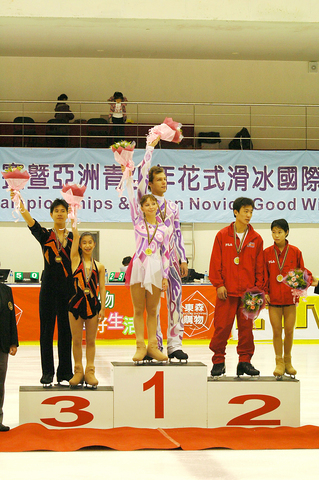
PHOTO: SEAN SCANLAN
The Uzbekistan team of Marina Aganina and Artyem Knazev took the gold medal with a program that included music ranging from classical strings to techno beats -- concluding with folk music.
The North Korean pair of Sung Mi-yang and Jong Yong-hyok seemed disappointed with their second-place finish, though the Taiwan pair, expatriate brother and sister duo Darryl Yang and Amanda Yang from Los Angeles, were overjoyed as they mounted the podium to receive their bronze award.
This year, Taiwan's national team counted on overseas compatriots to make up much of its roster, while Japan and South Korea had little trouble sending a full team, including a full retinue of coaches and trainers.
Seventeen-year old Choi Ji-eun of South Korea, who took third place in the Ladies Single Short Program, said she practices four hours a day, six days a week. She has been involved in this grueling training schedule for the past seven years.
Residing in Seoul, Choi acknowledges that figure skating in Asia still lacks the visibility of other sports, despite the fact that South Korea has no shortage of ice rinks and long, cold winters.
Choi spends much of her time in the rink working on her skills, such as improving the speed of her turns. She hopes to catch up with top finisher Nakano Yukuri of Japan.
"She is incredible," Choi said. "She can hit the triple-axle. I can only do a double-axle."
Choi said that this year's event was fun and well organized, although she felt that the ice surface was "uneven" and a "little bit soft" in some areas.
Choi seemed to welcome competition, as it provided a break from her training regiment. She mingled easily with the other pint-sized figure skaters.
The international figure skating community is a tight-knit group, and it is well represented by referee Eugeniy Rokhin who has judged international competitions for the past 20 years. This was his second visit to Taiwan, and in two weeks he will be traveling to the ISU Grand Prix of Figure Skating in Osaka, Japan.
Rokhin is part of the Uzbekistan delegation, though he has no experience in coaching. He said that refereeing these competitions is a full time job, especially given recent rule changes and the new scoring system implemented three years ago.
"Now, the scoring is a lot better," Rokhin said. "It's more accurate."
Each maneuver, such as a double axle jump, is given a pre-set base value, and the skater's ability or inability to execute that move may incur a point or negative point, Rokhin said. The other component of scoring is a general appraisal of choreography, interpretation and skating skills.
Many of the competitors taking part in the Taipei competition have their sights set on winning medals in the 2006 Winter Olympics to be held in Torrino, Italy, although some were still too young or inexperienced to qualify.

OUT AGAINST INDONESIA: Taiwan reached the semi-finals at the tournament for the first time by defeating Denmark, with Chou Tien-chen beating Viktor Axelsen Taiwan yesterday crashed out of the Thomas Cup team competition in Chengdu, China, but achieved their best result at the top-tier badminton event by reaching the semi-finals. Indonesia were too good in the semis, winning 3-0 to advance to today’s final against China, who eliminated Malaysia 3-1. In the opening singles of the men’s team clash at the Hi-Tech Zone Sports Center Gymnasium 2, Anthony Ginting defeated Taiwan’s Chou Tien-chen 21-18, 21-19 in 51 minutes, which put a huge hole in Taiwan’s aspirations to perhaps even make the final. In the men’s doubles, Fajar Alfian and Muhammad Ardianto downed Lee Yang and Wang

Rafael Nadal on Tuesday lost in straight sets to 31st-ranked Jiri Lehecka in the fourth round at the Madrid Open, while Taiwan’s Hsieh Su-wei advanced to the semi-finals in the women’s doubles. Nadal said that he was feeling good about his progress following his latest injury layoff. Nadal called it a “positive week” in every way and said his body held up well. “I was able to play four matches, a couple of tough matches,” Nadal said. “So very positive, winning three matches, playing four matches at the high level of tennis. I enjoyed a lot playing at home. I leave here with

A soccer jersey carrying a national map including disputed Western Sahara has become a hot commodity in Morocco after a diplomatic dispute with Algeria. Retailers said RS Berkane jerseys have been flying off the shelves after a Confederation of African Football (CAF) Cup match against Algerian club USM Alger was canceled last month over the jerseys. “We are overwhelmed by the influx of messages and requests,” said Brahim Rabii, representative of the official RS Berkane jersey distributor. Algeria broke off diplomatic relations with Morocco in 2021, partly over the issue of Western Sahara. The former Spanish colony is largely controlled by Morocco, but claimed
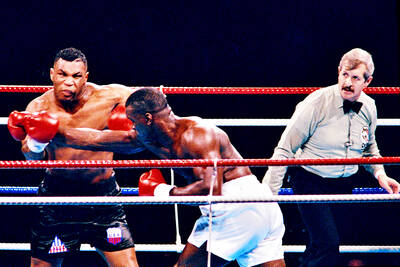
When 42-1 underdog James ‘Buster’ Douglas shocked ‘Iron’ Mike Tyson 34 years ago at the Tokyo Dome, the result reverberated worldwide. Spectators at the 45,000-plus seater venue witnessed one of boxing’s biggest upsets as unbeaten heavyweight champion Tyson was knocked out in the 10th round by the unheralded Douglas in February 1990. Boxing returns to the famous venue on Monday for the first time since that unforgettable encounter when Japan’s undisputed super-bantamweight world champion Naoya ‘Monster’ Inoue puts his belts on the line against Mexican Luis Nery. The 31-year-old Inoue (26-0, 23 KOs) is a huge star in Japan and is just


 RSS
RSS