


Friday was English as a Second Language Day at the Masters.
Not quite seven years after Tiger Woods made the locals forget how often players from the rest of the world left town wearing green jackets, there was no mistaking the message posted on the leaderboard at the end of the second round: The international crowd is back.
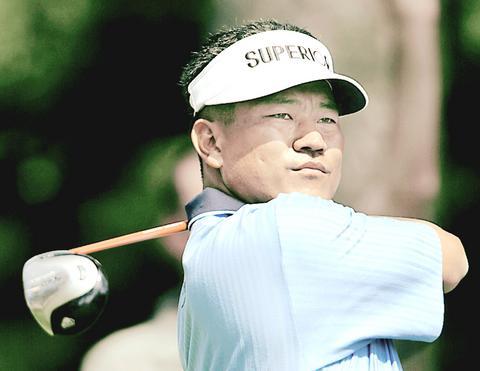
PHOTO: REUTERS
Four of the first five names atop it belonged, in order, to golfers born in South Africa, the Czech Republic, Spain and South Korea.
"The best players," said Alex Cejka, whose second straight round of 70 left him trailing leader Justin Rose by two strokes, "want to be where the best players are."
And during the first full week in April, they're always at Augusta National.
Like a lot of people, Spaniard Jose Maria Olazabal believed that run was the result of more creative players being developed on the other side of the Atlantic. Because the weather is rougher during the season over there and the courses not nearly as groomed, Olazabal said most international players were forced to develop better short games. But he doesn't think that explains this latest rush to the top of the board by foreigners.
"In those years, we were really good around the greens and maybe the other players, especially the US players, just catch up to us in that department on this golf course," said Olazabal.
Numbers might help explain it, since this year's field of 93 includes the largest international contingent ever -- 43 golfers -- and ties the record for most countries represented -- 19, including the People's Republic of China for the first time.
But that doesn't cover the resurgence completely, either. More likely, it's the same thing that's been drawing people to these shores some 250 years before there was a decent golf course on this side of the pond -- a hunger to succeed.
Rose, the young Englishman who was born in South Africa, was supposed to be the next big thing in the game after finishing fourth in the 1998 British Open as a 17-year-old. Instead, soon after launching his pro career, he missed 21 straight cuts and lost his father.
"Not to say that leading a major is easy," Rose said, "but I think I'm lucky in a lot of ways that, at age 23, I feel like I can draw on a couple of things that have happened to me going into the weekend."
Likewise for Cejka, a German citizen born in what used to be communist Czechoslovakia. At age 9, his father took him on a trip out of the country and at some point they swam across a river and into Germany to gain their freedom. Maybe that's why flying a golf ball across Rae's Creek doesn't seem so daunting.
"I think they would shoot us if they catch us, but I don't know," Cejka recalled. "It was communism. Nobody was allowed to get out."
No such dangers prevented K.J. Choi from seeking his fame and fortune. But as the son of a rice farmer in South Korea, he wasn't exposed to the game until he was 16, or the kind of topflight teaching professionals available at courses all over the US. But Choi bought a Nicklaus instructional book, strung together hour after hour of practice, traveled to a land where he didn't know the language, customs or food, and somehow won two PGA Tour events.
Already the first South Korean to do so, Choi is tied with Phil Mickelson for fourth place heading into the weekend. His next target is to become the first of his countrymen ever to win a major.
"I can't even imagine what the reaction of the Korean people will be, but it will be great," he said through an interpreter. "Some of them, perhaps, will even skip a meal."

Bayer 04 Leverkusen go into today’s match at TSG 1899 Hoffenheim stung from their first league defeat in 16 months. Leverkusen were beaten 3-2 at home by RB Leipzig before the international break, the first loss since May last year for the reigning league and cup champions. While any defeat, particularly against a likely title rival, would have disappointed coach Xabi Alonso, the way in which it happened would be most concerning. Just as they did in the Supercup against VfB Stuttgart and in the league opener to Borussia Moenchengladbach, Leverkusen scored first, but were pegged back. However, while Leverkusen rallied late to

The lights dimmed and the crowd hushed as Karoline Kristensen entered for her performance. However, this was no ordinary Dutch theater: The temperature was 80°C and the audience naked apart from a towel. Dressed in a swimsuit and to the tune of emotional music, the 21-year-old Kristensen started her routine, performed inside a large sauna, with a bed of hot rocks in the middle. For a week this month, a group of wellness practitioners, called “sauna masters,” are gathering at a picturesque health resort in the Netherlands to compete in this year’s Aufguss world sauna championships. The practice takes its name from a

Japanese players are moving to English soccer in record numbers and more look set to follow with clubs attracted by their quality, strong work ethic and value for money. Kaoru Mitoma is the standout talent of five Japanese players in the English Premier League, with eight more in the Championship and two in League One. Liverpool midfielder Wataru Endo, the captain of Japan, believes his compatriots are “being held in higher esteem” by English clubs compared with the past. “The staff at Liverpool ask me about lots of Japanese players, not necessarily with a view to a transfer, but just saying this or

Taiwan yesterday survived Bosnia and Herzegovina to win their Davis Cup World Group I tie at the Taipei Tennis Center. The tight series started on Saturday with world No. 123 Jason Tseng losing 3-6, 7-5, 6-4 to Mirza Basic in the opening singles matchup. However, teammate Tony Wu kept the tie even, dominating world No. 86 Damir Dzumhur 6-2, 6-1. Yesterday, 24-year-old Ray Ho and partner 25-year-old Hsu Yu-hsiou kept up the momentum, making short work of Basic and Nerman Fatic, winning 6-3, 6-4. Tseng then suffered another defeat, losing 6-4, 2-6, 6-2 to Dzumhur in a brutal match that lasted more than two


 RSS
RSS