


India and Pakistan have fought three wars and edged to the brink of nuclear attack. Now the bitter rivals will try to spur a fragile peace process with help from a common passion: cricket.
Work will come to a halt, restaurants and tea shops in big cities and remote villages will swell with people, and millions of TVs on both sides of the border will be tuned in.
It's India's first full cricket tour of Pakistan since 1989, although there were three one-day matches in 1997. It will feature five one-day matches starting tomorrow in Karachi and then three five-day test matches.
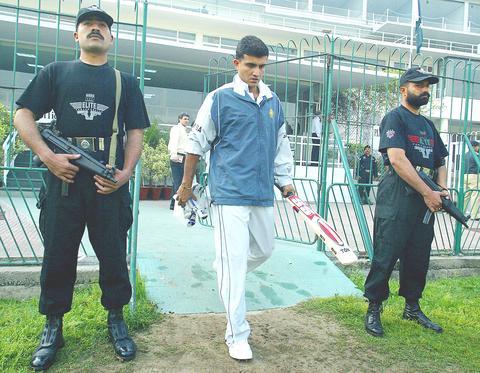
PHOTO: REUTERS
The Indian team arrived to a warm welcome and under heavy guard in Lahore on Wednesday,
Indian batsman Yuvraj Singh described it as "the mother of all games." Veteran Pakistani commentator Omar Qureishi called the series "war by other means."
The South Asian neighbors reached a broad agreement last month on a timetable for sustained peace talks over the disputed province of Kashmir and other tough issues. The talks represent the first real test of flexibility on long-entrenched positions, including Kashmir -- the cause of two of the countries' three wars since their 1947 independence from Britain.
In recent months, India and Pakistan have moved to restore transportation links and diplomatic ties. In November, soldiers halted cross-border firing in Kashmir.
The hope is that the cricket series can play a role similar to US table tennis players' traveling to China in the 1970s. That came to be known as "Pingpong diplomacy," paving the way for "normalized" relations.
The cricket tour was almost derailed by Indian fears over security after a wave of terrorist attacks in the past three years. But Indian Prime Minister Atal Bihari Vajpayee last month pressed for its go ahead.
"Cricket means ... a lot to people in Pakistan and India," said Qureishi, who has covered all but two of the India-Pakistan cricket series since the first in 1952. "It's the one colonial legacy that we are hanging onto. It's almost a secular religion on the subcontinent."
The countries' sporting ties often have been waylaid by politics. From 1960-1978 -- a period marked by wars over Kashmir and Bangladesh and failed peace talks -- there were no India versus Pakistan cricket matches.
Hope for change has emerged in recent months. Peace talks will stretch over months and possibly years, but observers say they offer the best chance in a generation for an end to five decades of enmity.
"People in both countries are sick and tired of the posturing and bogus belligerence," Qureishi said. "There's a genuine hunger for normalization in relations and this cricket series is a tremendous opportunity to build bridges."
Khalid Mahmood of Islamabad's Institute of Regional Studies said India's decision to make the tour was a goodwill gesture. "It will further help to ease tension," he said.
Pakistan's cricket team toured India in 1999, before New Delhi blocked further visits. That year, suspected Hindu extremists, angered at Pakistan's alleged support of Islamic separatist guerrillas in disputed Kashmir, dug up the cricket pitch in New Delhi and forced the first test to be rescheduled.
Militants also ransacked the Indian cricket board's headquarters.
During India's 1997 three-match visit to Pakistan, fans hurled stones at Indian players in Karachi.
"I'm sure the Pakistani crowd will give the Indians a warm welcome," said Pakistan's cricket coach, Javed Miandad. In 1999, "we went to India and had a lovely time. There were no differences between people. We were accepted simply as sportsmen."
The hosts have promised heavy security; attacks by Islamic extremists led to cancelations of a number of international cricket tours to Pakistan in 2002-2003. New Zealand cut short a tour in May 2002 after a deadly bomb blast outside its hotel in Karachi. No players were hurt.
C. Rajamohan, professor of South Asia Studies at New Delhi's Jawaharlal Nehru University, said sporting contacts were "good therapy" for relations between the two countries. "But they inflame passions and carry the risk of cutting both ways," he added.
Sports certainly can be politicized. The US boycotted the 1980 Moscow Olympics to protest the Soviet Union's invasion of Afghanistan. The Soviets replied by leading a boycott of the 1984 Los Angeles Olympics.
Sports also can be lucrative.
Pakistan Cricket Board spokesman Samiul Hasan said about 8,000 visas are being issued to Indian fans for the tour. He said the board would earn at least US$21 million from TV rights and sponsorship for eight matches, and up to US$1.25 million from ticket sales.
"It will be a complete sellout, no question about it," he said.


After letting another big lead slip with an error-strewn performance at the French Open on Wednesday, top-ranked Aryna Sabalenka felt like getting as far away from the courts as possible. “Just want to quit tennis right now,” Sabalenka said after wasting a lead of a set and two breaks in a 3-6, 7-5, 6-0 loss to Diana Shnaider in the women’s singles quarter-finals. “We’ll see in few days. Hopefully I’ll get back on track mentally.” Sabalenka’s wait for a first French Open title continues despite the four-time major winner leading 4-1 in the second set and being two points from victory while
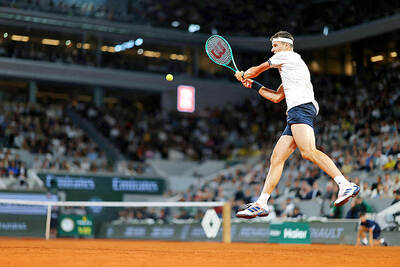
BIG NAMES GONE: Zverev is the clear favorite for a maiden Grand Slam title, reaching semi-finals for the fifth time in six years and finishing second on three occasions Alexander Zverev on Tuesday breezed past Rafael Jodar to stay on course for an elusive Grand Slam title at the French Open, while Jakub Mensik halted Joao Fonseca’s scintillating run in the quarter-finals. Zverev, the highest-ranked player left in the men’s draw, put an end to Spanish teenager Jodar’s impressive Roland Garros debut, easing into the semi-finals with a 7-6, (7/3), 6-1, 6-3 win. The 29-year-old Zverev is the clear favorite for a maiden Grand Slam title. He has finished runner-up on three occasions, including at the 2024 French Open. “I want to win the matches that are ahead of
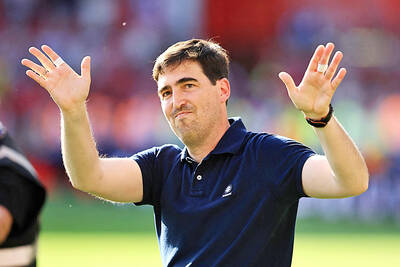
Liverpool are in advanced talks with former AFC Bournemouth manager Andoni Iraola as they seek a replacement for Arne Slot, reports said on Tuesday. Iraola has emerged as Liverpool’s top target to replace Slot, who was sacked on Saturday last week after a turbulent second season in charge. Liverpool have reportedly agreed a deal in principle to bring the Spaniard, who left Bournemouth at the end of this season, to Anfield. Sporting director Richard Hughes was heavily involved in hiring Iraola during his time at Bournemouth and is again spearheading the recruitment of the highly rated coach. The Reds are
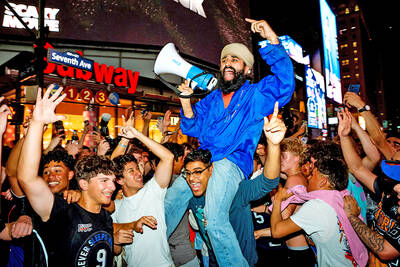
US President Donald Trump said he would attend Game 3 of the NBA Finals on Monday at Madison Square Garden, but said he does not have much sympathy for ordinary basketball fans who cannot afford sky-high ticket prices to do the same. “They can watch it on television,” Trump said aboard Air Force One on Friday as he flew to Wisconsin for an event with farmers, after he was asked about tickets that have climbed as high as US$8,000 each when the New York Knicks and San Antonio Spurs square off in Manhattan for the first time in the series. “It’s sorta


 RSS
RSS