


To anyone from Australia and New Zealand, it was too much to bear: Jonny Wilkinson kicking a drop goal 26 seconds from the end of extra time to clinch the World Cup for England.
The kick gave Clive Woodward's team a 20-17 victory over host and defending champion Australia at Sydney's Olympic Stadium as England became the first Northern Hemisphere team to win rugby's greatest prize.
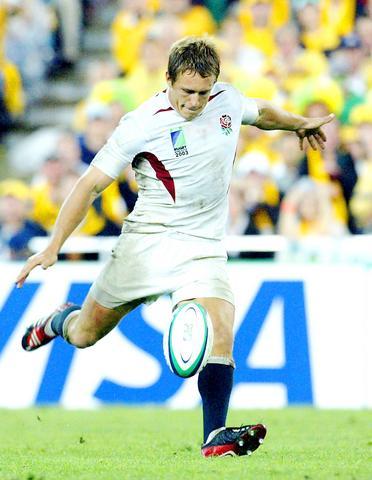
PHOTO: REUTERS
The fact that victory came seven months after an elusive Six Nations Grand Slam made it even more satisfying for Woodward, whose team had become the butt of rivals' jokes for so many near misses.
Organizers of the 20-nation World Cup were criticized for drawing it out over six weeks. But the final had so much drama it seemed almost worth the wait.
Australia hit back from 14-5 down at halftime, with Elton Flatley making it 14-14 on a penalty two minutes from the end of regulation time. Another penalty leveled it at 17-17 in extra time, and the final appeared to be headed for sudden-death scoring, until Wilkinson's right-footed drop goal ended 16 years of Southern Hemisphere domination.
The kick transformed Wilkinson into a megastar, and, when some 750,000 people clogged central London for an England victory parade, most eyes were on the modest flyhalf.
"I see it as something that's happened to me because of what everyone else has done," he said. "I keep putting that across, but it's true.
"Because of the individuality of the kicking, I seem to get singled out, but it's down to everyone else."
While the World Cup showed that English rugby continued to be on the rise, it gave the Australians, All Blacks and South Africans plenty to think about.
The Wallabies, until their heroics in the final and semifinals when they beat New Zealand 22-10, were lackluster and coach Eddie Jones was criticized for his team selections. In midyear, Australia lost three straight tests for the first time since 1995.
The All Blacks easily won the Tri-Nations, reeled off 11 successive wins, and were favored to meet England in the World Cup final, but were outplayed by the Wallabies in the semis.
New Zealand was credited with playing the most exciting rugby all year, and unveiled the heir apparent to great winger Jonah Lomu -- Joe Rokocoko, who scored 17 tries in 11 tests.
Lomu, battling a rare kidney illness for years, suffered full kidney failure in June and was on dialysis daily, but put off a transplant to try and resurrect his illustrious career.
Springboks
South Africa arrived at the World Cup under a cloud after a year's poor performances and a racial controversy ignited by two players who didn't make it to the finals. Geo Cronje, who is white, reportedly refused to room with black squad player Quinton Davids.
Crushed by New Zealand in the quarterfinals, the Springboks went home early to another scandal over a pre-World Cup military-style boot camp.
Photographs and video footage showed Springbok players stripped naked and huddled together in a pit. Others showed them crawling naked through the grass, lugging railway tracks, and lined up to have eggs cracked over their heads.
The revelations led to the resignations of coach Rudi Straeuli, managing director Rian Oberholzer and president Silas Nkanunu.
"For the recalcitrant, the unbending, the devious and the racist, we say there will be no place for you to hide anymore in our world of rugby," new South Africa president Brian van Rooyen said after his appointment. "Your departure starts right here, right now."
The French came out of the World Cup with bittersweet feelings.
Coach Bernard Laporte's young team had discovered a word which had been missing from the language of French rugby -- consistency.
In flyhalf Frederic Michalak, they unleashed a standout kicker as well as an imaginative passer. Centers Yannick Jauvion and Tony Marsh always looked capable of slicing through defenses -- except England's.
France's loss
The French lost 24-7 to England in a semifinal lashed by rain in Sydney, but their next campaign will be on home ground after the IRB's majority vote to give France the 2007 World Cup, ahead of England's bid.
The World Cup was a fan and financial success, ending with a US$32 million profit for Australia, but there was criticism of the IRB for not doing enough to help the lesser nations.
The likes of Samoa, Fiji, Tonga and Namibia were undermanned at the World Cup because their overseas players feared leaving their club employers. And a proposed nine-nation tournament featuring the Tri-Nations and Six Nations teams was received by the also-rans as the rich nations looking out for themselves again.
In the Tri-Nations, New Zealand swept the event and won it in consecutive years, highlighted by inflicting the worst ever home defeats to South Africa 52-16 in Pretoria, and to Australia 50-21 in Sydney.
England's Six Nations triumph was a near certainty from the moment Woodward's men beat France 25-17 on the opening day of the championship. They finished with a 42-6 crushing of Ireland on the final day to post a 12th Grand Slam.
for the first time
In between the Six Nations and the World Cup, England also posted its first ever victory over the Wallabies on Australian soil, 25-14 in Melbourne.
That was a week after a 15-13 victory over the All Blacks in Wellington. In that game, Woodward's men spent 10 minutes down to 13 players with two in the sinbin, yet didn't concede a score.
It was that sort of year for England. Woodward, strongly tipped to be knighted by Queen Elizabeth II, wants more.
"We will enjoy the moment until Jan. 1 and then we are looking forward to the Six Nations and beyond," he said. "And it will, of course, up the ante that the other teams will be playing the world champions."
In club action, Auckland Blues, with a backline featuring Spencer and All Blacks flyers Doug Howlett, Mils Muliaina and Rokocoko, won 10 of 11 games in the Super 12 regular season before beating four-time champion Canterbury Crusaders 21-17 in the final.
The European title went to Toulouse for the second time in an all-French final in Dublin. Toulouse raced into a 19-0 halftime lead before holding on for a 22-17 victory over Perpignan. Flyhalf Yann Delaigue kicked four penalties and converted Vincent Clerc's try.

The lights dimmed and the crowd hushed as Karoline Kristensen entered for her performance. However, this was no ordinary Dutch theater: The temperature was 80°C and the audience naked apart from a towel. Dressed in a swimsuit and to the tune of emotional music, the 21-year-old Kristensen started her routine, performed inside a large sauna, with a bed of hot rocks in the middle. For a week this month, a group of wellness practitioners, called “sauna masters,” are gathering at a picturesque health resort in the Netherlands to compete in this year’s Aufguss world sauna championships. The practice takes its name from a

Roger Federer on Wednesday said that staying involved with tennis in retirement helped him avoid feeling “like an alien” ahead of this week’s Laver Cup in Berlin. Federer, who helped create the tournament, retired at the Laver Cup in London two years ago and has since stayed involved with the competition as an ambassador. “I’m happy I went back right away to some tournaments,” the 43-year-old told reporters. “I feel I ripped the Band-Aid off quite quickly and when I walk around the tennis sites I still feel I belong there,” he said. “I don’t feel like an alien, which is a

Japanese players are moving to English soccer in record numbers and more look set to follow with clubs attracted by their quality, strong work ethic and value for money. Kaoru Mitoma is the standout talent of five Japanese players in the English Premier League, with eight more in the Championship and two in League One. Liverpool midfielder Wataru Endo, the captain of Japan, believes his compatriots are “being held in higher esteem” by English clubs compared with the past. “The staff at Liverpool ask me about lots of Japanese players, not necessarily with a view to a transfer, but just saying this or

Taiwan yesterday survived Bosnia and Herzegovina to win their Davis Cup World Group I tie at the Taipei Tennis Center. The tight series started on Saturday with world No. 123 Jason Tseng losing 3-6, 7-5, 6-4 to Mirza Basic in the opening singles matchup. However, teammate Tony Wu kept the tie even, dominating world No. 86 Damir Dzumhur 6-2, 6-1. Yesterday, 24-year-old Ray Ho and partner 25-year-old Hsu Yu-hsiou kept up the momentum, making short work of Basic and Nerman Fatic, winning 6-3, 6-4. Tseng then suffered another defeat, losing 6-4, 2-6, 6-2 to Dzumhur in a brutal match that lasted more than two


 RSS
RSS