


It was Jim Craig's second visit to Taiwan and he said that the place he visited yesterday is as dreadful as it was 56 years ago.
"The last time I was here, only once in a month did I see the light of day, because we had to go down to the copper mine in the morning when it was dark. I never came back up again until nighttime," said the 80-year-old Scot.
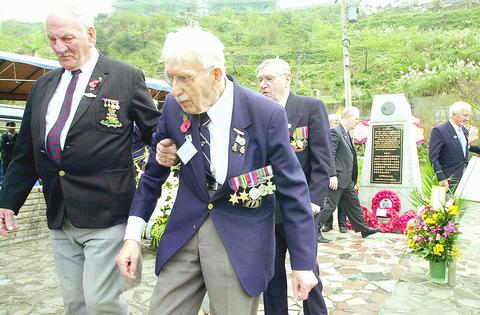
PHOTO: GEORGE TSORNG, TAIPEI TIMES
The place he is talking about is the site where the Japanese army's notorious Kinkaseki POW labor camp was situated during World War II.
Conditions in the camp's mine were very harsh, according to Craig. "It was so deep that the temperature down in the bottom was about 130 degrees Fahrenheit," he said. "We would work for about three minutes and then we had to come outside to where there was running cold water to cool us down. We'd go back in again and we did that all day."
Craig was one of the 1,100 British Commonwealth and Allied POWs interned at the Kinkaseki camp during World War II.
Yesterday morning he and four other POW survivors, who were interned in Kinkaseki and other camps in Taiwan -- as well as 15 family members of POWs -- came back to the site in remembrance of their time of torment.
"Although we were given three meals a day, it was a small bowl of rice and some sweet potatoes on top," he said. "When I left Taiwan, I was five and a half stone [about 35kg] in weight."
The 168cm-tall Craig now weighs 64kg.
Craig spent three years in Kinkaseki between 1943 and 1945. He was transported to another camp in Kukutsu, Taipei County, a few months before World War II ended.
Craig said that he is still haunted by the horrific experience 56 years later.
"It's very difficult to come to terms with it, but coming back here helps," he said.
It was Sid Dodds' third and possibly last attendance at the memorial service.
"Three times definitely are enough," said the 81-year-old Australian, chuckling. "I still get upset when I talk or somebody gets me to talk about it."
Dodds was interned in Kinkaseki between November 1943 and November 1944. He was later moved to Shirakawa camp in southern Taiwan to recover from pneumonia and pleurisy.
He was in the original group of POWs who came from Singapore to the Taichu camp in Taichung County in November 1942.
Reading his own poetry at the memorial service yesterday, British-born Australian Harry Leslie said that he was lucky to have had a special angel looking over him, which also helped him to survive difficult times at the camps.
Leslie was a tailor when he went to war and he spent three years in various detention camps in Taiwan where he said that Japanese soldiers tried to work him to death. He survived on rice and "pickings," such as snails and tree bark juice.
When Leslie was released in 1945, he was a 43.5kg walking skeleton, about half of what he weighed when he was taken prisoner in February 1942 in Singapore.
Janet Derham of Australia was at the ceremony to represent three members of her family who were all interned at the Karenko camp in Hualien County and Shirakawa camp in Chiayi County for 18 months -- her husband, her father and her father-in-law.
Derham said that, although her family knew that her father had been released, they did not hear from him until a package arrived.
"It was a closely written script on rice paper, which was carefully wound on the inside of a powder tin," said Derham, 77, adding that the script details her father's day-by-day life in the camp, what he had to do and what he ate.
Both Derham's father and father-in-law fought in both World War I and World War II.
David Catherall, 55, attended the ceremony on behalf of his father, who was interned at the Karenko camp and the Tamazato camp -- both in Hualien County -- and the Shirakawa camp in Chiayi County between August 1942 and September 1945.
"All of my life, my father has not spoken about it," said Catherall of the UK. "But now he's opening up, and that gives him a chance to start writing about what he did and how he suffered."
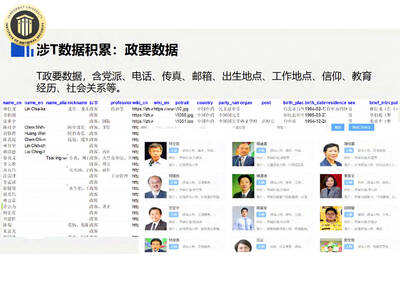
NETWORK-MAPPING PROJECT: The database contains 170 detailed files of Taiwanese politicians and about 23 million records of household registration data in Taiwan China has developed a network-mapping project targeting political figures and parties in Taiwan to monitor public opinion during elections and to craft tailored influence campaigns aimed at dividing Taiwanese society, according to documents leaked by Chinese technology firm GoLaxy (中科天璣). The documents, collected by Taipei-based Doublethink Lab, showed a database was specifically created to gather detailed information on Taiwanese political figures, including their political affiliations, job histories, birthplaces, residences, education, religion and a brief biography about them. Several notable Taiwanese politicians are in the database, including President William Lai (賴清德), former president Tsai Ing-wen (蔡英文), Minister of Foreign Affairs Lin Chia-lung (林佳龍),
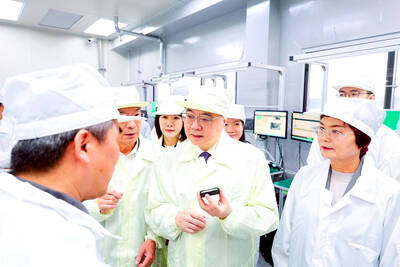
KEY INDUSTRY: The vice premier discussed a plan to create a non-red drone supply chain by next year, which has been allocated a budget of more than NT$7.2 billion The government has budgeted NT$44.2 billion (US$1.38 billion) to cultivate Taiwan’s uncrewed aerial vehicle (UAV) industry over the next five years, which would make the nation a major player in the industry’s democratic supply chain in the Asia-Pacific region, Premier Cho Jung-tai (卓榮泰) said yesterday. Cho made the remarks during a visit to the facilities of Cub Elecparts Inc (為升電裝). Democratic Progressive Party (DPP) Legislator Chen Su-yueh (陳素月) and Chinese Nationalist Party (KMT) Legislator Hsieh Yi-fong (謝依鳳) also participated in the trip. Cub Elecparts has transitioned from the automotive industry to the defense industry, which is the top priority among the nation’s
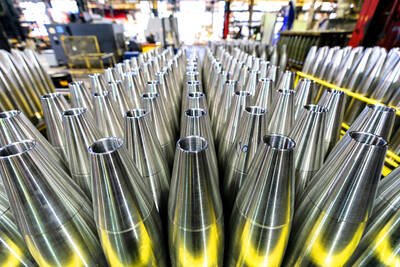
UPGRADED MISSILE: The Chungshan Institute of Science and Technology is reportedly to conduct a live-fire test of the Hsiung Feng III anti-ship missile on Thursday next week The US Army is planning to build new facilities to boost explosives production and strengthen its supply chain, a move aimed at addressing munitions shortages and supporting obligations to partners including Taiwan, Ukraine and Israel, Defense News reported. The army has issued a sources sought notice for a proposed Center of Excellence at the Blue Grass Army Depot in Kentucky, the report said. The facility would serve as a hub within the US industrial base for the production of key military explosives, including research department explosives (RDX) and high melting explosives (HMX), while also supporting research and development of next-generation materials. The proposed
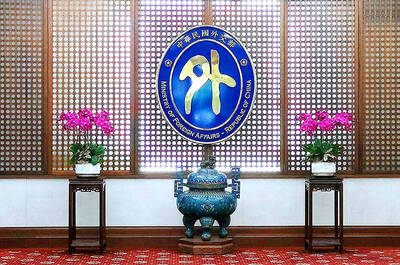
SOUTH KOREA DISPUTE: If Seoul continues to ignore its request, Taiwan would change South Korea’s designation on its arrival cards, the foreign ministry said If South Korea does not reply appropriately to a request to correct Taiwan’s name on its e-Arrival card system before March 31, the government would take corresponding measures to change how South Korea is labeled on the online Taiwan Arrival Card system, the Ministry of Foreign Affairs said yesterday. South Korea’s e-Arrival card system lists Taiwan as “China (Taiwan)” in the “point of departure” and “next destination” fields. Taipei has asked Seoul to change the wording. Since March 1, South Koreans who hold government-issued Alien Resident Certificates (ARC) have been identified as from “South Korea” rather than the “Republic of Korea,” the


 RSS
RSS