


The Independence Evening Post, the country's oldest evening newspaper, will walk into history and is expected to issue its last copy tomorrow, the paper's editorial department announced yesterday.
The paper is ceasing publication because it is running out of printing paper and the newspaper's delivery people are on strike after failing to get paid for months, an employee said.
On July 26, a new team was introduced to take over the cash-strapped newspaper from former chairman Wang Shih-chien (王世堅). But the changing of the guard has failed to save the paper from closing down.
When taking charge, the new team claimed to have amassed NT$150 million to run the paper. But according to a manager at the paper, who declined to be named, the financial situation under the new regime never appeared favorable because some financial supporters decided to bail out after discovering the paper's deplorable financial condition.
Labor problems intensified two weeks ago when the paper's union filed a lawsuit against Wang and Chang Fu-tai (張福泰), the paper's new chairman, for embezzling NT$8 million in workers' insurance fees and failing to issue paychecks in July and August.
Unwilling to assume responsibility, Chang claimed that his chairmanship was invalid because the process of electing him was flawed. He has stayed out of the business ever since.
The manager told the Taipei Times that Chang had invested more than NT$10 million in August, but he refused to contribute more because of a lack of other financial backers.
Since the dispute broke out in mid-September, most of the paper's managers have left and the workers' union has been taking charge of the paper's operation. Originally published with 20 pages, the paper has been cut down to eight and most of its content is aimed at attacking management for, in the union's words, their "irresponsibility." The circulation has shrunk from 45,000 copies to 2,000.
There are 240 employees at the Post, who cost the paper NT$18 million per month.
The manager said that the paper is running out of money and printing paper. It costs NT$500,000 every three days to keep the paper running.
On Saturday, a board meeting to discuss the paper's future and the employees' working rights was aborted because of the union's protest.
Founded in 1947, the Post was the first paper in the country to advocate "independence from political parties" during a time when Taiwan was under martial law.

‘NO SECURITY RISK’: The Railway Bureau reassured the public that the technicians’ activities were limited to technical guidance and did not involve sensitive systems The Railway Bureau yesterday said it had invited eight Chinese technicians to assist with an airport MRT construction project. The bureau issued the confirmation after an Internet user said Chinese nationals had entered the construction zone of Taiwan Taoyuan International Airport’s Terminal 3 project. They asked why “individuals from an enemy state” were allowed access to such a major national infrastructure project, which raised serious concerns over Taiwan’s industrial safety, sensitive systems and information security. The bureau’s Northern Region Engineering Branch Office said subcontractor Taiwan Handle Industrial Co (台灣手把工業) of the Taoyuan airport MRT’s “Contract No. CU05 Project A14 Station Civil, MEP &

A US uncrewed surface vessel (USV) encountered multiple Chinese warships during an autonomous transit of the Taiwan Strait, US defense company Seasats said in a statement on Wednesday. Seasats announced that a Lightfish USV had completed the first autonomous transit of the Taiwan Strait. Over five days, the USV traversed the entire length of the Strait while constantly monitoring surface vessel traffic, the company said. The Lightfish encountered multiple Chinese warships, one of which was a Chinese People’s Liberation Army Navy (PLAN) Type 056 corvette, it said. The Chinese vessels were operating “well within Taiwan’s exclusive economic zone without transmitting their identity via the

Taiwan is still in the process of assessing the possibility of recruiting workers from Eswatini, the Ministry of Foreign Affairs said yesterday, adding that its goal is to help Eswatini upgrade its vocational training centers. If there are plans to recruit workers from Eswatini, safeguarding national security, protecting public health and ensuring the employment rights of Taiwanese would be prerequisites, Department of West Asian and African Affairs Director-General Yen Chia-liang (顏嘉良) told a news conference. Key considerations would also include filling labor shortages in specific industries, and fostering bilateral professional and technical exchanges, he said. Yen was asked about the progress of labor
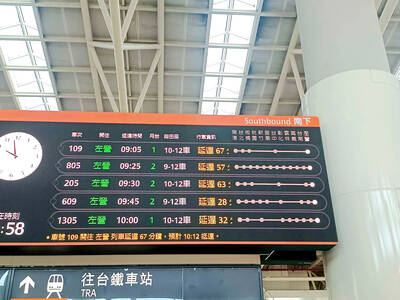
The nation’s usually punctual high-speed rail system yesterday was hit by major disruptions after all scheduled services were canceled and replaced with three hourly trains offering only non-reserved seating, affecting more than 200,000 passengers. Preliminary findings indicate the disruption was caused by a faulty power module in a track switch control cabinet, Taiwan High-Speed Rail Corp (THSRC) said, adding that as a full system inspection could only be conducted after operations end for the day, a decision on whether normal service would resume today would be announced before the first train departs. During a routine inspection early yesterday, a switch signal abnormality


 RSS
RSS