


A dispute between the Ministry of Education and school representatives from a school reconstruction project in Taiwan's 921 earthquake zone was apparently triggered when local interest groups began to worry that they would miss out on the project's lucrative profits, lawmakers said yesterday.
"The root of the conflict between the two parties is obvious: local interests groups [in the Taichung area] are upset that they may lose the bidding for an upcoming lucrative deal," said DPP lawmaker Wang Shih-hsun (王世勛), referring to the campus reconstruction project of Tungshi Vocational High School (東勢高工) in Taichung County.
Local ties
The interests groups, according to Wang, are Lee Ping-feng
(李炳豐), director of the school's parent's association, and KMT lawmaker Yang Wen-hsin (楊文欣), a Taichung County representative.
Lee, accompanied by Yang, filed complaints on Tuesday with the legislature and the Control Yuan, the country's supreme watchdog body.
They alleged that Vice Minister of Education Fan Sun-lu (范巽綠) and her husband Chang Fu-chung (張富忠) attempted to collect profits out of the school reconstruction project by intervening in the formation of a committee which was to select architects and construction companies favored by the ministry.
According to Wang, a lawmaker also from Taichung, Lee and Yang come from the same family and have deep connections with construction firms in the region, so "it is natural that they are protesting against the education ministry because it may spoil their original plan -- to win the bid for the school's reconstruction."
Yang is the vice president of the Changyi Group (長億集團), a renowned construction company, and Lee is his uncle.
Wang said it was commonly known that they took charge of many construction projects in the Taichung area.
"For an immense project valued at NT$860 million, the education ministry is only doing their job to ensure everything follows legal procedure," Wang said, adding that he hoped judicial departments would take immediate action to uncover the truth.
`Ungrounded accusations'
Furious over what he termed "the ungrounded allegations," Chang Fu-chung yesterday told the Taipei Times that what Fan had done at the ministry was regarded as a stumbling block by those accustomed to profiting from public construction projects.
"We've expected slander from the locals when [Fan] strived to weed out the longstanding unlawful conduct, but we that hope whoever has directed these accusations against us can present their evidence," Chang said.
"If I am found to have interfered with the internal affairs of the education ministry, Fan will immediately resign," he added.
Responding to the criticism, Yang said the reason that Fan and other lawmakers have so enthusiastically linked him with the Changyi Group at this sensitive time was to blur the focus of the issue.
Yang said his group was never engaged in any dealings with the public sector and that the only reason he was involved in the dispute was because the school is situated in his constituency.

‘NO SECURITY RISK’: The Railway Bureau reassured the public that the technicians’ activities were limited to technical guidance and did not involve sensitive systems The Railway Bureau yesterday said it had invited eight Chinese technicians to assist with an airport MRT construction project. The bureau issued the confirmation after an Internet user said Chinese nationals had entered the construction zone of Taiwan Taoyuan International Airport’s Terminal 3 project. They asked why “individuals from an enemy state” were allowed access to such a major national infrastructure project, which raised serious concerns over Taiwan’s industrial safety, sensitive systems and information security. The bureau’s Northern Region Engineering Branch Office said subcontractor Taiwan Handle Industrial Co (台灣手把工業) of the Taoyuan airport MRT’s “Contract No. CU05 Project A14 Station Civil, MEP &

A US uncrewed surface vessel (USV) encountered multiple Chinese warships during an autonomous transit of the Taiwan Strait, US defense company Seasats said in a statement on Wednesday. Seasats announced that a Lightfish USV had completed the first autonomous transit of the Taiwan Strait. Over five days, the USV traversed the entire length of the Strait while constantly monitoring surface vessel traffic, the company said. The Lightfish encountered multiple Chinese warships, one of which was a Chinese People’s Liberation Army Navy (PLAN) Type 056 corvette, it said. The Chinese vessels were operating “well within Taiwan’s exclusive economic zone without transmitting their identity via the
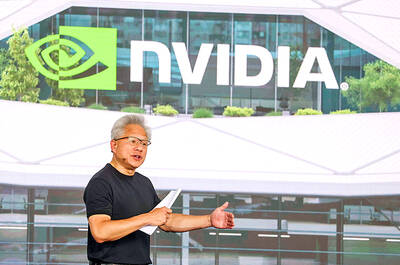
‘BOOMING’: ’ The number of partners we have here is incredible. You can see from their stock prices. They’re doing so well, they’re so happy,’ Jensen Huang said Nvidia Corp’s spending in Taiwan has ballooned to about US$150 billion a year, 10 times the US$10 billion to US$15 billion the company spent five years ago, Nvidia chief executive officer Jensen Huang (黃仁勳) said yesterday, suggesting Taiwan’s strategic importance in the global artificial intelligence (AI) supply chain. “Taiwan is the epicenter of the AI revolution. This is where the chips come, packaging comes. This is where the systems are made. This is where AI supercomputers were created,” Huang said at a meeting for the company’s employees in Beitou-Shilin Technology Park (北投士林科技園區) in Taipei, the planned site of Nvidia’s Taipei headquarters. “Taiwan
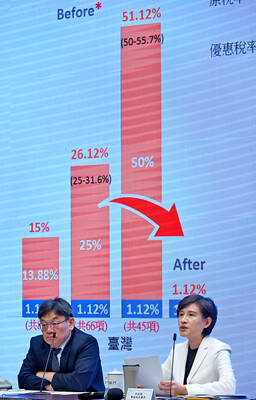
GREATER REACH? Auto parts and wood products would face tariffs of up to 15%, matching those targeting the EU, Japan and South Korea, Vice Premier said The US has announced that preferential tariff treatment for Taiwan’s non-semiconductor Section 232 goods would take effect retroactively from May 1, the Executive Yuan said yesterday. The US government yesterday posted a notice on the Federal Register’s public inspection Web site previewing tariff concessions for Taiwan under a memorandum of understanding (MOU) on Taiwan-US investment after two months of negotiations. The MOU signed on Jan. 15 stipulated three major preferential tariff arrangements: a 15 percent “reciprocal” tariff rate for Taiwan without stacking most-favored nation (MFN) rates; preferential Section 232 treatment for semiconductors and related products; and preferential Section 232 treatment for non-semiconductor


 RSS
RSS