


Living in exile has many challenges, especially in a place like Taiwan, which only recently began to hush its past claims -- not unlike China -- that Tibet is a part of China.
But gradually, through increased interaction, a second visit by the Dalai Lama and hard work, culture can be preserved rather than lost, Tenzin Phuntsok Atisha, the managing director of the Tibet Religious Foundation of His Holiness the Dalai Lama (
"It's very important to preserve our identity and culture. I notice that some young Tibetans who came here or were born here don't speak the language, not to mention read or write it. We all have to put in a lot of effort in this respect," said Atisha sitting in his 10th floor downtown Taipei office.
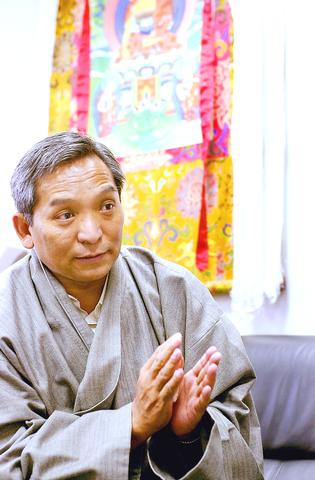
PHOTO: CHEN CHENG-CHANG, TAIPEI TIMES
Aside from a colorful silk embroidered painting of the Buddha or Thangka and some pictures of the Dalai Lama, his office is decorated modestly, with only a few items that give any hint of his past and homeland.
Like many Tibetans in exile, Atisha and his family had to go through a significant ordeal in order to escape from Tibet.
Atisha says he still remembers vividly how brightly the snow shined in his eyes when he and his family members were crossing the Himalaya range when he was six years old.
"It was a sunny spring day. My father, brother and I were taking a path near our village to cross the Himalayas, while my mother was in another group. We saw so many dead people along the way.
"It was very, very scary. We eventually ran out of food, but luckily we made it to Nepal," he said.
The five-day journey led him to a new world that promised good food, a new life, education and a career.
Ironically for some of the 700 Tibetans who live in Taiwan, the government organization that helped them get to the country is the biggest obstacle in preserving their heritage and giving them a helping hand, he said.
The Cabinet's Mongolian and Tibetan Affairs Commission (
"That's why the Tibetans say that there are two Chinas: Red China and Black China. Fortunately, the situation changed dramatically in 1997 when the Dalai Lama first visited Taiwan. Now Tibetans no longer consider Taiwan as a `black China' but as our friends, our brothers and sisters," he said.
The commission is still there, however, only with its work minimized.
"We actually have great trust in and respect for the incumbent chairman, Mr Hsu [Hsu Cheng-kuang,
The commission has made life for some Tibetan immigrants in Taiwan miserable, Atisha added.
"Most of them came to Taiwan with the commission's assistance but they are at risk of becoming illegal residents.
"Their illegal status prevents them from finding a job or finding a job with a good salary," he said, adding that the foundation has been in touch with the Chen administration regarding the problem.
"[The administration is] very sympathetic and willing to solve the problem. I believe within months this problem will be solved," he said.
Atisha said that about 130 Tibetans are currently residing illegally in Taiwan, mostly in the Taipei area.
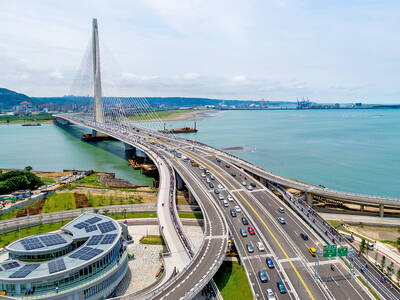
The Ministry of Transportation and Communications yesterday inaugurated the Danjiang Bridge across the Tamsui River in New Taipei City, saying that the structure would be an architectural icon and traffic artery for Taiwan. Feted as a major engineering achievement, the Danjiang Bridge is 920m long, 211m tall at the top of its pylon, and is the longest single-pylon asymmetric cable-stayed bridge in the world, the government’s Web site for the structure said. It was designed by late Iraqi-British architect Zaha Hadid. The structure, with a maximum deck of 70m, accommodates road and light rail traffic, and affords a 200m navigation channel for boats,
Taiwan Semiconductor Manufacturing Co (TSMC, 台積電), the world’s largest foundry service provider, yesterday said that global semiconductor revenue is projected to hit US$1.5 trillion in 2030, after the figure exceeds US$1 trillion this year, as artificial intelligence (AI) demand boosts consumption of token and compute power. “We are still at the beginning of the AI revolution, but we already see a significant impact across the whole semiconductor ecosystem,” TSMC deputy cochief operating officer Kevin Zhang (張曉強) said at the company’s annual technology symposium in Hsinchu City. “It is fair to say that in the past decade, smartphones and other mobile devices were
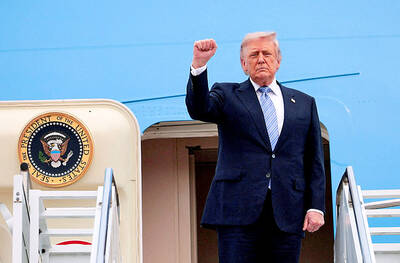
US-CHINA SUMMIT: MOFA welcomed US reassurance of no change in its Taiwan policy; Trump said he did not comment when Xi talked of opposing independence US President Donald Trump yesterday said he has not made a decision on whether to move forward with a major arms package for Taiwan after hearing concerns about it from Chinese President Xi Jinping (習近平). Trump’s comments on Taiwan came as he flew back to Washington after wrapping up critical talks in which both leaders said important progress was made in stabilizing US-China relations even as deep differences persist between the world’s two biggest powers on Iran and Taiwan. “I will make a determination,” Trump said, adding: “I’ll be making decisions. But, you know, I think the last thing we need right
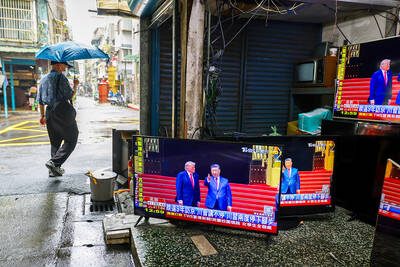
TAIWAN ISSUE: US treasury secretary Scott Bessent said on the first day of meetings that ‘it wouldn’t be a US-China summit without the Taiwan issue coming up’ There were no surprises on the first day of the summit between US President Donald Trump and Chinese President Xi Jinping (習近平), the Mainland Affairs Council (MAC) said yesterday, as the government reiterated that cross-strait stability is crucial to the Asia-Pacific region, as well as the world. As the two presidents met for a highly anticipated summit yesterday, Chinese state media reported that Xi warned Trump that missteps regarding Taiwan could push their two countries into “conflict.” Trump arrived in China with accolades for his host, calling Xi a “great leader” and “friend,” and extending an invitation to visit the White House


 RSS
RSS