


Nine KMT lawmakers and party heavyweights yesterday told journalists they may leave the KMT fold and serve as independents or join other political parties.
Other party members who did not want to be named said they may also follow suit. The lawmakers' departure could cost the KMT its lock on the Legislative Yuan. The KMT occupies 115 of the 225 seats in the legislature.
"I have observed all three major political parties since last March's presidential election, and they don't match my ideals," said KMT Legislator Huang Chao-shun (黃昭順).
"But I don't like the fact that KMT Chairman Lien Chan (連戰) still listens to only a few members," Huang added, saying that Lien was too far removed from the grassroots membership.
Huang said that she had discussed the KMT's development with her father -- former president of the Control Yuan, Huang Tsun-chiu (黃尊秋) -- many times before he died, and has now decided to leave the party.
Huang said she would not join any party for the time being, but Wu Ching-chih (吳清池), another disillusioned KMT lawmaker, said yesterday that he planned to run as a People First Party candidate in December's legislative elections.
"Other party lawmakers also intend to leave," Wu said.
Liu Ping-wei (
Hsu Den-koun (
In addition, former minister of the interior Huang Chu-wen (黃主文) and former party spokesman Huang Hui-chen (黃輝珍) recently both expressed their disappointment with the KMT's new platform.
"The party is betraying Lee Teng-hui's line, which still represents the mainstream thought of Taiwanese," Huang Chu-wen said.
KMT leaders said that they would maintain communications with the wavering lawmakers to persuade them into staying.
"As far as I know, only six party lawmakers have yet to re-register, and they have different reasons for considering not re-registering but we will try to satisfy them to keep them within our ranks," said director-general of the KMT's Organizational Development Committee, Chao Shou-po (
Meanwhile, Lien Chan said at the party's Central Standing Committee weekly meeting yesterday that he was moved to learn that more than 850,000 people have completed membership re-registration procedures.
The KMT, which once boasted two million members, carried out a re-registration drive between Sept. 1 and Dec.31, after its humiliating defeat in the presidential election last year.
The party's central headquarters has extended the deadline of the drive to Jan. 31 to give supporters more time to re-register.
In a related development yesterday, the KMT was preparing to welcome back one of its veteran members, Chen Li-an (
Chen, who quit the party to run independently in the 1996 presidential election, took the initiative to rejoin the party by contacting Lien to express his wishes.
The KMT attaches great importance to his return, and director-general Chao cut short his attendance at the KMT meeting to call on Chen and to bring him his re-registration forms.
According to Chao, Chen said he wants to return because he believes Taiwan and the KMT need him now.
Chen is expected to hold a press conference tomorrow to explain his motives in person.
Another KMT veteran, Lin Yang-kang (
Lin and former premier Hau Pei-tsun (

A signaling system malfunction disrupted high-speed rail (HSR) services beginning at 8am today, with trains temporarily reduced to three northbound and three southbound trains per hour as authorities conduct inspections. The malfunction occurred on a section of track in Miaoli County during pre-operation checks early this morning, forcing northbound and southbound trains to use a single track, the HSR operator said. The regular schedule has been replaced with three hourly trains offering only nonreserved seating in each direction, stopping at every station, it said, adding that business class cars would still have reserved seating. Departures from terminal stations are scheduled at the top
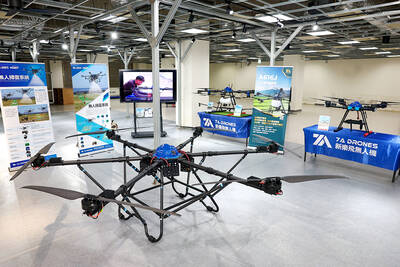
DRONE CENTRAL: Taiwan aims to become Asia’s democratic hub for drones, with most exports focused on high-quality military-grade models, an official said Taiwan’s drone industry is expected to expand significantly by 2030, producing 100,000 units per month and exporting half of them, the Ministry of Economic Affairs said yesterday. Current drone production capacity is about 15,000 units per month, but the industry can quickly scale up as demand increases, Industrial Development Administration Director-General Chiou Chyou-huey (邱求慧) told a news conference in Taipei. Taiwan’s drone output grew 2.5-fold last year to NT$12.9 billion (US$408.3 million) under a government program to develop the uncrewed vehicle sector, he said. The Executive Yuan in October last year approved plans to invest NT$44.2 billion into domestic production of uncrewed aerial

VERBOSE VESSELS: A CGA cutter and a China Coast Guard exchanged verbal barbs for more than a day in Taiwanese-controlled waters before the Chinese vessel left The Taiwanese and Chinese coast guards had a standoff near the strategically located Pratas Islands (Dongsha Islands, 東沙群島) in the north of the South China Sea, the Coast Guard Administration (CGA) said yesterday. The two sides engaged in intense radio exchanges over sovereignty claims during the 33-hour standoff. China Coast Guard vessel 3501 eventually left the restricted waters, 26.6 nautical miles (49.2km) west of the Pratas Islands, at 5pm yesterday, the CGA said. Lying approximately between southern Taiwan and Hong Kong, the Taiwan-controlled Pratas are seen by some security experts as vulnerable to Chinese attack due to their distance — more than
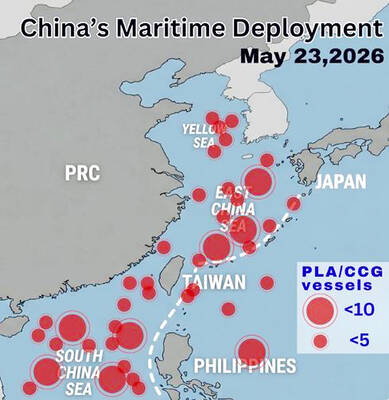
WARNING: China should stop engaging in actions that undermine regional peace and stability, as it would only build resentment among people across the Strait, the CGA said China has deployed more than 100 navy, coast guard and other vessels in waters from the Yellow Sea to the South China Sea and the western Pacific since US President Donald Trump and Chinese President Xi Jinping (習近平) met in Beijing, National Security Council Secretary-General Joseph Wu (吳釗燮) said yesterday. “In this part of the world, #China is the one & only PROBLEM wrecking the #StatusQuo & threatening regional peace & stability,” Wu wrote on X. In a separate post, he said Beijing was coercing Taiwan’s maritime domain, calling it illegal and provocative, after the Coast Guard Administration (CGA) expelled a


 RSS
RSS