


The vessel Taima Lun (
The devotees of Matsu, Goddess of the Sea, gathered early yesterday morning in front of the Tienhou Temple (天后宮) on Nankan Island, part of the Matsu archipelago, to greet the statues of the goddess before boarding the vessel.
Dressed in red coats and accompanied by a magistrate from the Lianchiang County Government, Liu Li-chyun (劉立群), local KMT Legislator Tsao Erh-chung (曹爾忠) and county council speaker Chen Chen-ching (陳振清), they waved to crowds before steaming away from Fuao port at 7:30am.

PHOTO: LEE HUNG-MING, TAIPEI TIMES
Cabinet Secretary-General Chiou I-jen (邱義仁), Vice Chairman of the Mainland Affairs Council Chen Ming-tung (陳明通) and other central government officials were there to see them off with firecrackers and applause.
"We hope the first voyage will lay a foundation for peaceful cross-strait interaction [in the future]," Chiou said.
"The sea today is so calm it seems to represent our confidence [in cross-strait relations]," Tsao said on the boat.
Upon arrival in China's Mawei port, the Taima Lun was greeted by some 40 Chinese officials, with only a few of them applauding.
The pilgrimage to Putian -- Matsu's supposed birthplace -- and Meizhou -- where the goddess resided before she was deified -- then set off.
Some members of the Taiwanese media, however, were barred from covering the event.
News photographers were asked to leave their cameras on the boat while other reporters were asked to remain with the group and to limit their reports to nothing but the religious side of the journey.
Local Chinese media, nevertheless, all rushed into the port to witness the first-ever pilgrimage made directly from Taiwan to China.
Meanwhile in Taipei, Premier Chang Chun-hsiung (
"I'd like to ask the Chinese authorities to [assist and] take care of those who made these first voyages from Kinmen and Matsu as part of the small three links," Chang said yesterday morning.
Chang said that yesterday's first legal direct voyages (from Kinmen as well as Matsu) were an opportunity for both sides of the Taiwan Strait to ease the political standoff and usher in a new era of peaceful co-existence.
"Leaders of both sides of the Strait should sit down and talk, otherwise, it will be hard to implement the small three links smoothly," Chang said, adding that he hoped he would recall this moment with pride in years to come.
The group said it plans to return to Fuao port on Nankan Island on Friday, concluding a four-day trip.
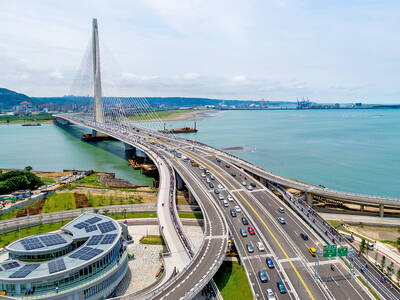
The Ministry of Transportation and Communications yesterday inaugurated the Danjiang Bridge across the Tamsui River in New Taipei City, saying that the structure would be an architectural icon and traffic artery for Taiwan. Feted as a major engineering achievement, the Danjiang Bridge is 920m long, 211m tall at the top of its pylon, and is the longest single-pylon asymmetric cable-stayed bridge in the world, the government’s Web site for the structure said. It was designed by late Iraqi-British architect Zaha Hadid. The structure, with a maximum deck of 70m, accommodates road and light rail traffic, and affords a 200m navigation channel for boats,
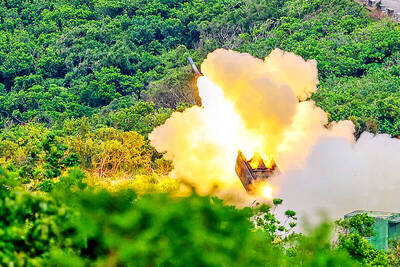
PRECISION STRIKES: The most significant reason to deploy HIMARS to outlying islands is to establish a ‘dead zone’ that the PLA would not dare enter, a source said A High Mobility Artillery Rocket System (HIMARS) would be deployed to Penghu County and Dongyin Island (東引) in Lienchiang County (Matsu) to force the Chinese military to retreat at least 100km from the coastline, a military source said yesterday. Taiwan has been procuring HIMARS and Army Tactical Missile Systems (ATACMS) from the US in batches. Once all batches have been delivered, Taiwan would possess 111 HIMARS units and 504 ATACMS, which have a range of 300km. Considering that “offense is the best defense,” the military plans to forward-deploy the systems to outlying islands such as Penghu and Dongyin so that

Taiwan Semiconductor Manufacturing Co (TSMC, 台積電), the world’s largest foundry service provider, yesterday said that global semiconductor revenue is projected to hit US$1.5 trillion in 2030, after the figure exceeds US$1 trillion this year, as artificial intelligence (AI) demand boosts consumption of token and compute power. “We are still at the beginning of the AI revolution, but we already see a significant impact across the whole semiconductor ecosystem,” TSMC deputy cochief operating officer Kevin Zhang (張曉強) said at the company’s annual technology symposium in Hsinchu City. “It is fair to say that in the past decade, smartphones and other mobile devices were

‘CLEAR MESSAGE’: The bill would set up an interagency ‘tiger team’ to review sanctions tools and other economic options to help deter any Chinese aggression toward Taiwan US Representative Young Kim has introduced a bill to deter Chinese aggression against Taiwan, calling for an interagency “tiger team” to preplan coordinated sanctions and economic measures in response to possible Chinese military or political action against Taiwan. “[Chinese President] Xi Jinping [習近平] has directed the People’s Liberation Army to be ready to invade Taiwan by 2027. China has a plan. America should have one too,” Kim said in a news release on Thursday last week. She introduced the “Deter PRC [People’s Republic of China] aggression against Taiwan act” to “ensure the US has a coordinated sanctions strategy ready should


 RSS
RSS