


Panama's foreign minister Jose Miguel Aleman arrives in Taiwan today for a six-day visit.
His visit comes in the midst of Taiwan's cabinet reshuffle, where foreign minister designate Chen Chien-jen (程建?H) is scheduled to formally take over for Jason Hu (-J志強), the outgoing foreign minister and KMT campaign manager, next Tuesday.
Chen, who is fluent in Spanish, is to meet with Aleman during his stay here.
Aleman's trip follows Hu's visit to Panama last month, where he said high-level Panamanian officials assured him that ties with Taiwan remain firm.
A series of visits by Panamanian officials to China in recent months have fueled speculation that Panama is considering switching diplomatic recognition to Beijing.
China had previously stated that it planned to filch two of Taiwan's diplomatic allies in the Central America region before Oct. 1 this year -- the 50th anniversary of Communist Party rule in China.
With almost half of its 29 formal allies in Central America and the Caribbean, the region is an important diplomatic foothold for Taiwan.
For years, it has been the arena for a continual diplomatic tug-of-war between Taiwan and China.
Panama seems to have tipped the diplomatic balance by inviting Taiwan's ambassador to Panama, Lan Chih-ming (藍智民), to the handover of the Panama Canal next month while leaving China's unofficial trade representative in Panama in the cold.
Leaders from member countries of the Organization of American States, along with delegations from Japan, France, Egypt and Spain, will also attend.
However, Taiwan is concerned that China will gain preponderant influence over Panama through the chairman of Hutchison Whampoa, Li Ka-shing (李1顫?.
Li's Hong Kong-based conglomerate will take control of the waterway, paying the Panamanian government US$22.2 million per year for the next 20 years.
Taiwan and the US have become increasingly concerned that China could gain control of the strategically important canal, as Li is known to maintain close ties with Beijing leaders.
However, Taiwan too has commercial weight in Panama, with Taiwan's Evergreen Group having strong business interests operating warehouses and ports on the canal.
The group recently invested US$100 million in a harbor construction project and, along with a nearly completed housing project, is also planning to venture into the restaurant business there.
Chang Yung-fa (張榮發), the company's founder, has close ties with Panama president Mireya Moscoso and has been invited to attend the canal handover on Dec. 14, reported the Central News Agency yesterday.
Aleman will meet with Chang, along with president Lee Teng-hui (李登輝), economic minister Wang Chih-kang (


RESILIENCE: Taiwan plays a key role in semiconductors, energy, information infrastructure and advanced manufacturing, AIT Director Raymond Greene said Taiwan’s continued investment in deterrence and resilience remains vital, especially in uncrewed systems and other emerging technologies, American Institute in Taiwan (AIT) Director Raymond Greene said yesterday. Greene made the remarks at the annual National Strategic Summit on Supply Chain Resilience held by the Research Institute for Democracy, Society and Emerging Technology (DSET), a government-backed think tank. As Taiwan last year became the US’ fourth-largest trading partner and supply chain security is becoming more important, cooperation in emerging technologies continues to deepen between the two countries, he said. The US is committed to accelerating innovation, building key infrastructure, strengthening cooperation

The National Chungshan Institute of Science and Technology yesterday showcased its locally developed variants of the Vision 60 robotic patrol dog, which it plans to deploy on the nation’s outlying territories in the South China Sea. The variants were produced under the Joint Lab project — created by the institute and domestic companies — and assembled with domestically produced motors, lenses and artificial intelligence (AI) systems alongside licensed tech from the US, Missile and Rocket Systems Research Division deputy director Jen Kuo-kang (任國光) told the media event at a military base in Taipei’s Dazhi (大直) area. Taiwan has built up its strengths

RIGHT DIRECTION: Taiwan’s efforts to prevent forced labor include a proposal to ‘fully prohibit’ employers from withholding workers’ documents, an official said Taiwan is to establish a mechanism to restrict imports of goods linked to forced labor, the Executive Yuan said yesterday, after the US proposed imposing additional tariffs on Taiwanese goods over labor concerns. “The Ministry of Labor and the Ministry of Economic Affairs are to establish an interministerial review procedure,” Executive Yuan spokesperson Michelle Lee (李慧芝) said at a news briefing in Taipei. “The government is to use the Foreign Trade Act [貿易法] as the legal basis to restrict imports of goods produced with forced labor” and bring its supply chain governance more in line with international standards on human rights, resilience
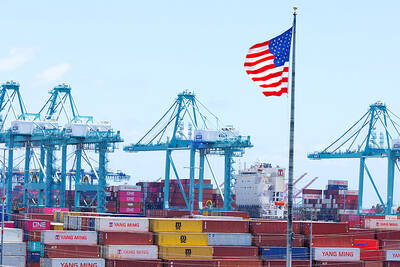
NOT IMMEDIATE: Taiwan has a chance to appeal the proposed 10 percent tariff before it starts, while other countries face a 12.5 percent tariff from the trade office Taiwan is among 60 economies determined by the US to have failed to impose or enforce a ban on the importation of goods produced with forced labor, according to a notice released on Tuesday by the Office of the US Trade Representative (USTR), which proposed imposing an additional 10 percent or more tariff on them. The USTR in a statement said that following an investigation, it had determined under Section 301 of the Trade Act of 1974 that the failure of the 60 economies to impose and effectively enforce a prohibition on the importation of goods produced with forced labor is


 RSS
RSS