


Data gathered by the Formosat-7/COSMIC-2 satellite constellation are to be released for global use today, Taiwanese and US officials announced yesterday.
The six-satellite constellation, which gathers weather data between 50° north and south latitude, was launched into orbit on June 25 last year, another major Taiwan-US collaborative program following the Formosat-3/COSMIC constellation launched in 2006.
After nearly three months of trials, Formosat-7 data are to be released by the Central Weather Bureau (CWB) and the US National Oceanic and Atmospheric Administration (NOAA) simultaneously at 10am, National Applied Research Laboratories (NARL) president Wang Yeong-her (王永和) told a news conference at the Ministry of Science and Technology in Taipei.

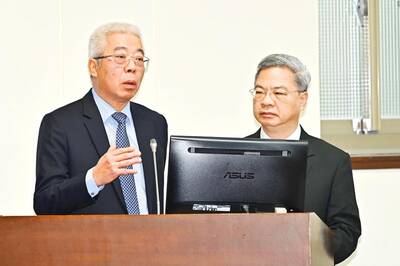
Photo: Chien Hui-ju, Taipei Times
Data would be released from the previous day, the NARL said, adding that hopefully, near-real-time data would be available later.
In addition to improving forecasts, the data would advance projections of space weather events that can affect the precision of information and communication facilities, Wang said.
The satellite program showcases what can be achieved through Taiwan-US science and technology cooperation, proving that the two sides are “real friends” making “real progress,” American Institute in Taiwan Deputy Director Raymond Greene said in Mandarin.
“Wherever I go, I tell people that Taiwan is a leader in many fields and has much to offer the world,” Greene said.
“This satellite mission proves this is true,” he said, adding that he is confident the world would continue to benefit from ongoing Taiwan-US scientific cooperation.
The data would supplement observation data in the tropics, where installing facilities is challenging, given the paucity of land there, CWB Deputy Director-General Mark Cheng (程家平) said.
After using data from the satellites to track 10 typhoons in the Western Pacific last year, the bureau found that 120-hour forecast precision improved 7 percent, Cheng said.
The Formosat-7 program is highly valued worldwide because data can be made available in 30 minutes to one hour, whereas Formosat-3 needed three hours, National Cheng Kung University professor of Earth science Charles Lin (林建宏) said.
Space weather forecasts are receiving mounting attention with the development of autonomous vehicles, which use GPS, Lin said.
The atmospheric data gathered by the Tri-GNSS Radio Occultation System, which was part of each Formosat-7 satellite’s payload, would be available first, said National Space Organization (NSPO) member Chu Chung-hui (朱崇惠), the head of the Formosat-7 project in Taiwan.
Data gathered by the project’s ion velocity meter and radio frequency beacon instruments are being verified and would be made available later, Chu said.
While only two of the six satellites have settled from their injection orbits at an altitude of 720km into their planned orbits of 550km, the project has peaked at 5,802 data packets in a day, surpassing estimates that it would be capable of 4,000 per day, she said.
The four satellites not in the planned orbits are expected to settle in them by February next year, although they can gather data in the meantime, she said.
There are 10 ground stations — in Taiwan; Guam; Hawaii; Darwin, Australia; Mauritius; Kuwait; Ghana; Cuiaba, Brazil; Honduras; and Tahiti — that can receive Formosat-7 data, the NSPO said.
Asked about the next Taiwan-US space program, NSPO Director-General Lin Chun-liang (林俊良) said that the nation plans to develop high-resolution remote-sensing satellites and synthetic aperture radars in its third space program through 2028, while it hopes to learn from the US and other nations about space exploration that requires advanced telecommunications.
Taiwan has arranged for about 8 million barrels of crude oil, or about one-third of its monthly needs, to be shipped from the Red Sea this month to bypass the Strait of Hormuz and ease domestic supply pressures, CPC Corp, Taiwan (CPC, 台灣中油) said yesterday. The state-run oil company has worked with Middle Eastern suppliers to secure routes other than the Strait of Hormuz, through which about 20 percent of the world’s oil and liquefied natural gas typically passes, CPC chairman Fang Jeng-zen (方振仁) said at a meeting of the legislature’s Economics Committee in Taipei. Suppliers in Saudi Arabia have indicated they

South Korea has adjusted its electronic arrival card system to no longer list Taiwan as a part of China, a move that the Ministry of Foreign Affairs said would help facilitate exchanges between the two sides. South Korea previously listed “Taiwan” as “Taiwan (China)” in the drop-down menus of its online arrival card system, where people had to fill out where they came from and their next destination. The ministry had requested South Korea make a revision and said it would change South Korea’s name on Taiwan’s online immigration system from “Republic of Korea” to “Korea (South),” should the issue not be

CCP ‘PAWN’? Beijing could use the KMT chairwoman’s visit to signal to the world that many people in Taiwan support the ‘one China’ principle, an academic said Chinese Nationalist Party (KMT) Chairwoman Cheng Li-wun (鄭麗文) yesterday arrived in China for a “peace” mission and potential meeting with Chinese President Xi Jinping (習近平), while a Taiwanese minister detailed the number of Chinese warships currently deployed around the nation. Cheng is visiting at a time of increased Chinese military pressure on Taiwan, as the opposition-dominated Legislative Yuan stalls a government plan for US$40 billion in extra defense spending. Speaking to reporters before going to the airport, Cheng said she was going on a “historic journey for peace,” but added that some people felt uneasy about her trip. “If you truly love Taiwan,

Tainan, Taipei and New Taipei City recorded the highest fines nationwide for illegal accommodations in the first quarter of this year, with fines issued in the three cities each exceeding NT$7 million (US$220,639), Tourism Administration data showed. Among them, Taipei had the highest number of illegal short-term rental units, with 410. There were 3,280 legally registered hotels nationwide in the first quarter, down by 14 properties, or 0.43 percent, from a year earlier, likely indicating operators exiting the market, the agency said. However, the number of unregistered properties rose to 1,174, including 314 illegal hotels and 860 illegal short-term rental


 RSS
RSS