

The Centers for Disease Control (CDC) yesterday published guidelines for hosting large events amid the rise in COVID-19 cases worldwide, while the number of confirmed cases in Taiwan rose to 44.
The agency said that there have been warning signs of community infections in Taiwan; cluster cases involving families and hospitals; and local infections now outnumber imported cases, with the sources of infection in several cases remaining unknown.
The guidelines define large events as those attended by at least 1,000 people, including graduation ceremonies, festivals, sports events and religious, political, cultural, academic and non-governmental organizations’ events.
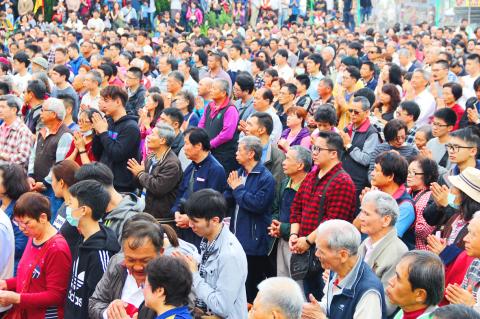
Photo: Hsu Chen-hsun, Taipei Times
The guidelines include six risk indicators for assessment: whether the organizer can secure the travel histories of participants; ventilation at the venue; whether at least 1m of separation can be maintained between participants; whether there are fixed seats; the duration of the event; and if hand disinfection is available and masks should be worn.
Organizers can consult local health bureaus or other authorities for an assessment, the guidelines say.
If an assessment finds an event to be high risk, organizers should postpone or cancel it, or host it in another form, they say.
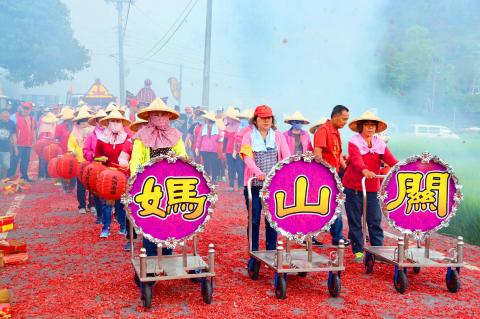
Photo courtesy of Chou Hao-cheng via CNA
However, organizers must follow directives from the Central Epidemic Command Center (CECC) should Taiwan enter the community infection phase, they add.
People with chronic pulmonary diseases, cardiovascular diseases, blood disorders, immunodeficiency diseases, or health issues related to the kidneys, liver and nervous or metabolic system, as well as pregnant women, should avoid large events, the guidelines say.
All events must include disease-prevention measures, including disinfection of the venue and equipment; ensure sufficient hand-washing facilities and ventilation; and avoid grouping too many people in one room, they say.
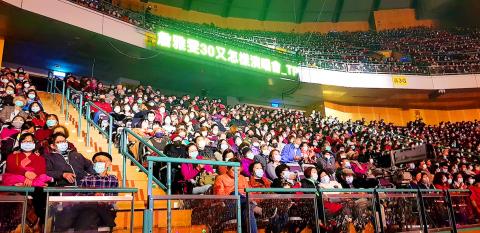
Photo: CNA
The guidelines gave no recommendation that masks be worn for attendees, although staff who frequently come into contact with others or must stay in crowded indoor spaces should wear them at all times, the guidelines say.
If a suspected COVID-19 infection is detected, the organizers must report it to health authorities immediately and cooperate with follow-up investigations and measures, they say.
The CDC also issued a guide for business operations during the virus crisis, which calls for corporations to encourage employees to take leave should they have a fever or shortness of breath.
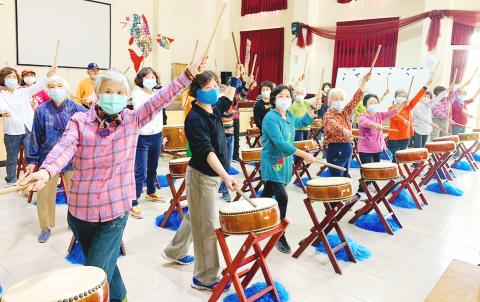
Photo: Lee Jung-ping, Taipei Times
Employees who develop a fever at work should be isolated while transport home is arranged, it says.
Late yesterday, the CECC said that Taiwan had two more confirmed cases of COVID-19.
The 43rd case is a woman in her 50s who lives in northern Taiwan, who had been in contact with the 39th case and has not traveled abroad recently, Minister of Health and Welfare Chen Shih-chung (陳時中) told a news conference in Taipei.
The 44th case is a man in his 30s in northern Taiwan who visited the Philippines from Friday last week to Tuesday and experienced stomach bloating and diarrhea on Monday, said Chen, who heads the center.
Both have been hospitalized in quarantine wards, the center said.
Soap or medical-grade isopropyl alcohol should be provided for employees, while work areas, door handles and elevator buttons should be periodically disinfected, the guide says.
Companies should exhort employees to maintain personal and workplace hygiene, and keep a log of employee health and body temperatures, it says.
Firms should also allow employees to work from home or decrease the number of people working at the same time, the guide says.
Employees should maintain an appropriate distance from each other and all travel plans to other nations, especially China, should be canceled, it says.
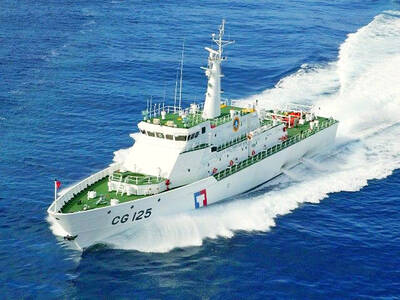
GEOPOLITICAL SIGNIFICANCE: The CGA’s nonmilitary role makes it a tool to avert diplomatic issues, an official said, while confirming the donation of a ship to Manila Coast Guard Administration (CGA) ships are scheduled to sail to the Philippines bearing the words “Taiwan Coast Guard” in a high-profile visit in October next year, the first such visit by a Taiwanese maritime law enforcement vessel to the Southeast Asian nation, the agency said yesterday. The CGA also confirmed that it had donated one of its decommissioned patrol vessels to the Philippines in a rare transfer of a retired ship to a nondiplomatic ally. The Republic of China (ROC) Navy last made such a visit in 1974, shortly before the Philippines switched diplomatic recognition to the People’s Republic of China in

‘GLOBAL WARNING’: The infiltration is not just a local problem, as Beijing has been deploying the same tactics worldwide against Western democracies, a report said Between 50,000 and 100,000 Chinese spies are operating in Taiwan, far more than the National Security Bureau’s previous estimate of 5,000, German journalist and author Jurgen Kremb said on Monday. Kremb presented his research, titled “The War of Spies: How China’s Intelligence Services Are Infiltrating Taiwan — and What Europe Must Learn from It,” at a joint event held by the Taiwan offices of the Friedrich Naumann Foundation and the European Values Center for Security Policy. The report was published in June in the Ministry of Justice Investigation Bureau’s Prospect & Exploration Monthly (展望與探索月刊). By spies, he said he was referring to informants,
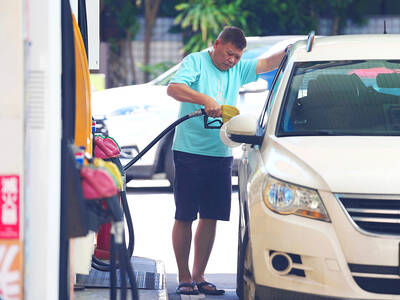
PRICE STABILIZATION: The Ministry of Economic Affairs has urged the legislature to support the Cabinet’s supplementary budget for state-owned energy companies State-owned oil supplier CPC Corp, Taiwan (CPC, 台灣中油) on Saturday announced that it would raise domestic gasoline prices by NT$0.7 (US$0.02) per liter and diesel prices by NT$0.6 per liter this week after international crude oil prices rose above US$100 per barrel last week. Formosa Petrochemical Corp (台塑石化) yesterday said that it matched CPC’s price adjustments for this week. The decisions end a six-week period during which CPC and Formosa kept fuel prices in Taiwan unchanged. Retail gasoline prices this week would rise to NT$31.2, NT$32.7 and NT$34.7 per liter for 92, 95 and 98-octane unleaded gasoline respectively at CPC
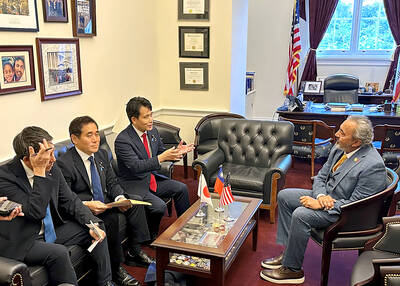
WASHINGTON MEETING: Japan’s Hirofumi Takinami said participants rejected the idea that the US should limit its defensive perimeter to the Second Island Chain US and Japanese lawmakers agree that the US must defend the First Island Chain, including Taiwan, and should not fall back to the Second Island Chain, while “a Taiwan contingency is a Japan contingency and therefore a US-Japan alliance contingency,” media reported after a meeting between officials of the two nations in Washington on Tuesday. A delegation of Japanese lawmakers from the Liberal Democratic Party met with US Senator Thom Tillis, co-chair of the Senate Taiwan Caucus, and US Representative Ami Bera, co-chair of the US Congressional Taiwan caucus, to discuss issues concerning East Asia and the Taiwan Strait. The Japanese and


 RSS
RSS