


President Tsai Ing-wen (蔡英文) yesterday said that the spread of COVID-19 in Taiwan does not qualify as community spread as stated on the US Centers for Disease Control and Prevention (CDC) Web site, given that the nation only has isolated cases, and the Ministry of Foreign Affairs has asked the US to correct Taiwan’s status.
In its latest information, the CDC included Taiwan as a travel destination with apparent community spread of COVID-19, alongside Japan, Singapore, South Korea, Thailand and Vietnam.
While visiting a vaccine center at the National Health Research Institutes in Miaoli County yesterday, Tsai echoed remarks by Minister of Health and Welfare Chen Shih-chung (陳時中), saying that Taiwan’s situation does not constitute community spread and that members of the public should not panic.
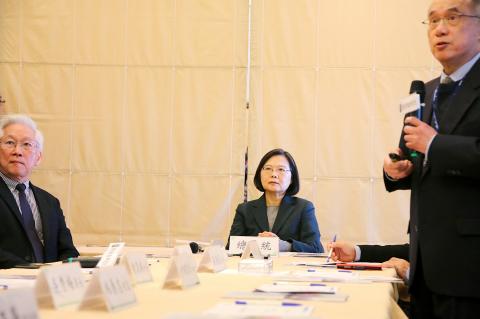
Photo: Cheng Ming-hsiang, Taipei Times
“We will do our best to ensure everyone’s good health,” Tsai said, adding that disease-prevention efforts would always be performed to the highest standard.
Asked about the US move, foreign ministry spokeswoman Joanne Ou (歐江安) said in a statement that the status of COVID-19 in Taiwan does not meet the criteria set by the CDC as necessary for community spread.
For community spread, the CDC states that the infection source of a certain confirmed case cannot be identified, the number of local infection cases far exceeds that of overseas infections, a chain of continuous transmission has been identified and clusters of infection are extensive.
The ministry has asked the US to correct Taiwan’s status to reflect its current situation, Ou added.
In related news, Taiwanese stranded onboard the virus-stricken Diamond Princess cruise ship in Yokohama, Japan, are scheduled to return to Taiwan today on a charter flight operated by China Airlines (中華航空), the ministry said yesterday.
The flight is scheduled to depart from Taiwan Taoyuan International Airport at 1:30pm, land at Tokyo Haneda International Airport and return to Taiwan at 10:30pm.
After being quarantined in their cabins for 14 days, Diamond Princess passengers who tested negative for COVID-19 were allowed to disembark on Wednesday.
Five Taiwanese passengers who disembarked on Wednesday were taken to a hotel after being received by Taiwanese officials, including Representative to Japan Frank Hsieh (謝長廷), at the Port of Yokohama.
Hsieh yesterday received another nine Taiwanese, expressing sympathy to them on behalf of the government.
Five Taiwanese passengers tested positive for COVID-19 and were hospitalized in Japan, but 19 Taiwanese were eligible to take the charter flight, Ou said yesterday.
“The ministry hopes to repatriate all 19, but respects the decision of each person, so the number returning on the charter flight is uncertain,” Ou said, adding that additional tests and a 14-day home quarantine would be required of those who return.
Additional reporting by Lin Chia-nan and Lu Yi-hsuan

‘NO SECURITY RISK’: The Railway Bureau reassured the public that the technicians’ activities were limited to technical guidance and did not involve sensitive systems The Railway Bureau yesterday said it had invited eight Chinese technicians to assist with an airport MRT construction project. The bureau issued the confirmation after an Internet user said Chinese nationals had entered the construction zone of Taiwan Taoyuan International Airport’s Terminal 3 project. They asked why “individuals from an enemy state” were allowed access to such a major national infrastructure project, which raised serious concerns over Taiwan’s industrial safety, sensitive systems and information security. The bureau’s Northern Region Engineering Branch Office said subcontractor Taiwan Handle Industrial Co (台灣手把工業) of the Taoyuan airport MRT’s “Contract No. CU05 Project A14 Station Civil, MEP &
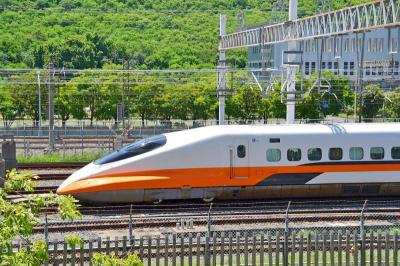
A signaling system malfunction disrupted high-speed rail (HSR) services beginning at 8am today, with trains temporarily reduced to three northbound and three southbound trains per hour as authorities conduct inspections. The malfunction occurred on a section of track in Miaoli County during pre-operation checks early this morning, forcing northbound and southbound trains to use a single track, the HSR operator said. The regular schedule has been replaced with three hourly trains offering only nonreserved seating in each direction, stopping at every station, it said, adding that business class cars would still have reserved seating. Departures from terminal stations are scheduled at the top
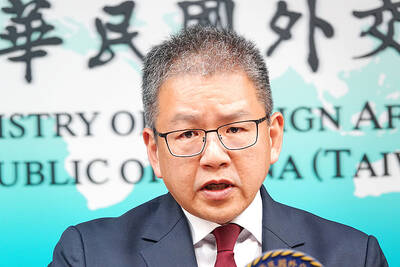
Taiwan is still in the process of assessing the possibility of recruiting workers from Eswatini, the Ministry of Foreign Affairs said yesterday, adding that its goal is to help Eswatini upgrade its vocational training centers. If there are plans to recruit workers from Eswatini, safeguarding national security, protecting public health and ensuring the employment rights of Taiwanese would be prerequisites, Department of West Asian and African Affairs Director-General Yen Chia-liang (顏嘉良) told a news conference. Key considerations would also include filling labor shortages in specific industries, and fostering bilateral professional and technical exchanges, he said. Yen was asked about the progress of labor

A US uncrewed surface vessel (USV) encountered multiple Chinese warships during an autonomous transit of the Taiwan Strait, US defense company Seasats said in a statement on Wednesday. Seasats announced that a Lightfish USV had completed the first autonomous transit of the Taiwan Strait. Over five days, the USV traversed the entire length of the Strait while constantly monitoring surface vessel traffic, the company said. The Lightfish encountered multiple Chinese warships, one of which was a Chinese People’s Liberation Army Navy (PLAN) Type 056 corvette, it said. The Chinese vessels were operating “well within Taiwan’s exclusive economic zone without transmitting their identity via the


 RSS
RSS