


Taiwan yesterday set up an epidemic response command center to contain the spread of a new coronavirus, which was first discovered in Wuhan, China.
With the novel coronavirus 2019 (2019-nCoV) infection spreading to other Asian nations and many people expected to return from China during the Lunar New Year holiday, the Executive Yuan yesterday afternoon approved a Centers for Disease Control (CDC) plan to establish a level 3 National Health Command Center, CDC Director-General Chou Jih-haw (周志浩) said.
The command center, led by Chou, is to be in charge of holding cross-ministerial discussions to improve preventive measures against “severe pneumonia with novel pathogens” in the nation.
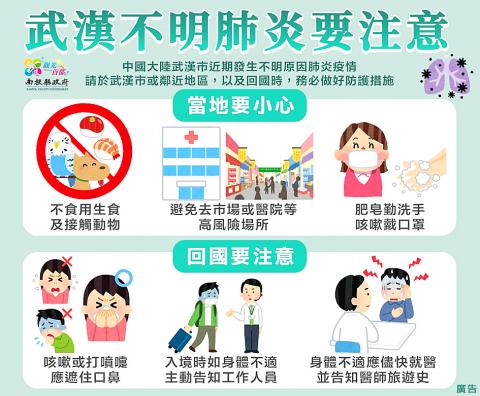
Photo courtesy of the Nantou County Government
Taiwan currently has 44 million surgical masks and 1.9 million N95 masks, more than enough to meet demand, Chou said.
The CDC urged passengers returning from Wuhan or nearby areas who have a fever, cough or other illnesses, to report to the CDC’s airport quarantine stations regardless of whether they have taken medicine to relieve the symptoms.
People who develop a fever or respiratory symptoms within 14 days after returning from Wuhan or nearby areas should also report it to the CDC’s hotline (1922), wear a surgical mask and seek immediate medical attention.
A new confirmed case of a passenger from Wuhan detected with “severe pneumonia with novel pathogens” was reported on Sunday, CDC Deputy Director-General Chuang Jen-hsiang (莊人祥) said yesterday.
The boy had a fever and diarrhea when he arrived from Wuhan, Chuang said.
He was not exposed to livestock and had not visited the Huanan Seafood Wholesale Market in Wuham, but his symptoms met the clinical definition for severe pneumonia with novel pathogens that necessitated a mandatory report to the CDC, Chuang said.
The boy tested negative for influenza viruses and also negative for 2019-nCoV in the first test, and he is to undergo a second test for the 2019-nCoV today, he added.
Another case reported on Saturday showed negative results for 2019-nCoV in two tests and was found to be an influenza type A (H3N2) virus infection, he said.
Separately, the Ministry of Transportation and Communications said that ministry officials overseeing airports, seaports, airlines and tourism have been asked to be on alert and work closely with the CDC on inspection and quarantine efforts at border controls to prevent the spread of the virus from China.
The Civil Aeronautics Administration on Sunday officially notified Taiwanese airlines, as well as those in China, Hong Kong and Macau offering flights to and from Taiwan, that they should broadcast information onboard about the virus before landing in the nation, the ministry said.
All Taiwanese airlines and five Hong Kong and Macau-based airlines have started airing such information on board, it added.
Shandong Airlines (山東航空) said it would start broadcasting such information on Thursday next week, the ministry said, adding that other Chinese airlines are waiting for the instructions from headquarters on when the broadcast would be available.
For flights arriving from Wuhan, both the jet bridges and flight arrival areas would be sterilized after all cabin crew have disembarked from the plane, the ministry said.
The Tourism Bureau has also informed the Travel Agents’ Association, the Association of Tour Managers and other travel associations that it has issued a “yellow” alert for areas surrounding Wuhan per instructions from the Mainland Affairs Council, meaning that the public should beware of their own safety and reconsider whether the trip is necessary, the ministry said.
The associations should ensure that cross-strait travelers and travel agents are aware of the disease and take precautionary actions to avoid contracting it, the ministry said.
Information about the disease would be shown at airports and seaports using multimedia electronic bulletin boards, news tickers and print advertisements, it said.
Airports and seaports should also have cleaning and sterilizing procedures to contain the spread of the disease once the CDC has identified passengers who might have contracted the disease, it added.
Additional reporting by CNA

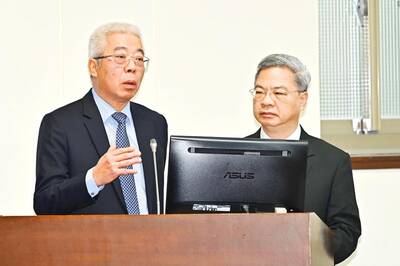
Taiwan has arranged for about 8 million barrels of crude oil, or about one-third of its monthly needs, to be shipped from the Red Sea this month to bypass the Strait of Hormuz and ease domestic supply pressures, CPC Corp, Taiwan (CPC, 台灣中油) said yesterday. The state-run oil company has worked with Middle Eastern suppliers to secure routes other than the Strait of Hormuz, through which about 20 percent of the world’s oil and liquefied natural gas typically passes, CPC chairman Fang Jeng-zen (方振仁) said at a meeting of the legislature’s Economics Committee in Taipei. Suppliers in Saudi Arabia have indicated they
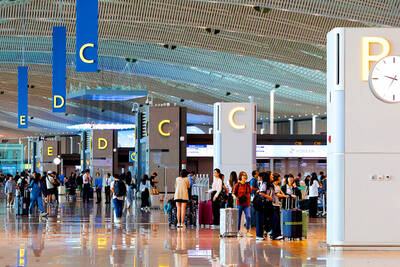
South Korea has adjusted its electronic arrival card system to no longer list Taiwan as a part of China, a move that the Ministry of Foreign Affairs said would help facilitate exchanges between the two sides. South Korea previously listed “Taiwan” as “Taiwan (China)” in the drop-down menus of its online arrival card system, where people had to fill out where they came from and their next destination. The ministry had requested South Korea make a revision and said it would change South Korea’s name on Taiwan’s online immigration system from “Republic of Korea” to “Korea (South),” should the issue not be

Tainan, Taipei and New Taipei City recorded the highest fines nationwide for illegal accommodations in the first quarter of this year, with fines issued in the three cities each exceeding NT$7 million (US$220,639), Tourism Administration data showed. Among them, Taipei had the highest number of illegal short-term rental units, with 410. There were 3,280 legally registered hotels nationwide in the first quarter, down by 14 properties, or 0.43 percent, from a year earlier, likely indicating operators exiting the market, the agency said. However, the number of unregistered properties rose to 1,174, including 314 illegal hotels and 860 illegal short-term rental

AIR ALERT: China’s reservation of airspace over the Yellow Sea and East China Sea could be an attempt to test the US’ response ahead of a Trump-Xi meeting, the NSB head said China’s attempts to infiltrate Taiwan are systematic, planned and targeted, with activity shifting from recruiting mid-level military officers to rank-and-file enlisted personnel, National Security Bureau (NSB) Director-General Tsai Ming-yen (蔡明彥) said yesterday. The Chinese Communist Party’s (CCP) integrates national security, intelligence operations and “united front” efforts into a dense network to conduct intelligence gathering and espionage in Taiwan, Tsai said at a meeting of the legislature’s Foreign Affairs and National Defense Committee. It uses specific networks to screen targets through exchange activities and recruiting local collaborators to establish intelligence-gathering organizations, he said. China is also shifting who it targets to lower-ranking military personnel,


 RSS
RSS